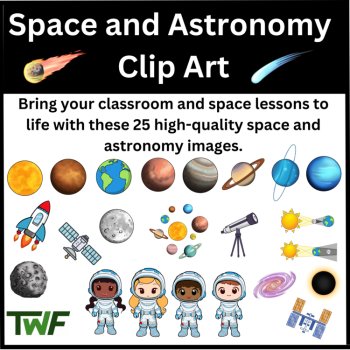
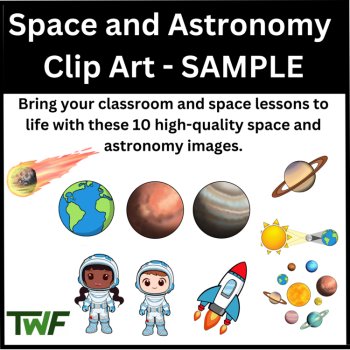
Space and Astronomy Clip Art - Science and Astronomy Clip Art SAMPLE

Free

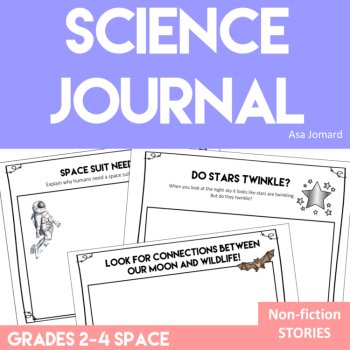
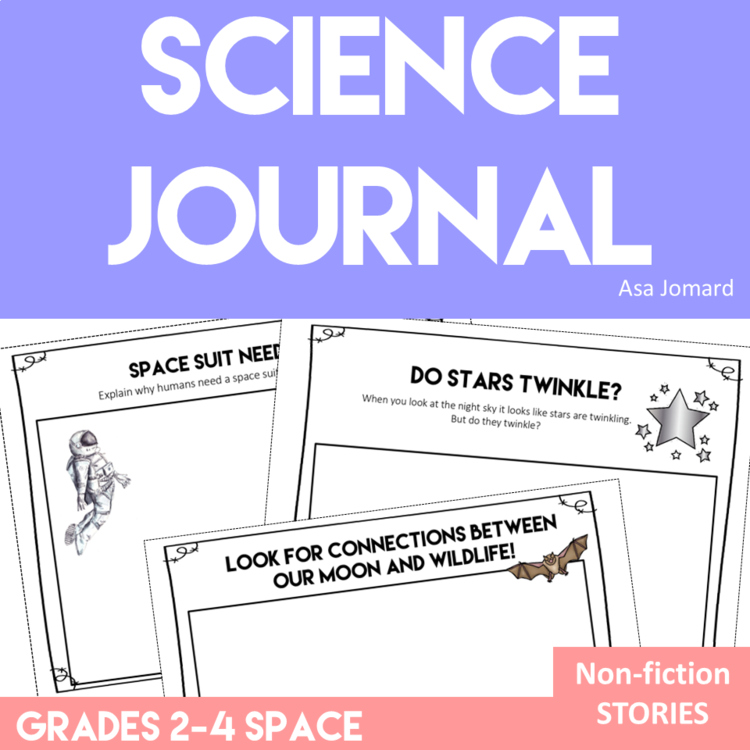
Blast Off into Space Science with Journal Prompts That Spark Wonder & Writing!
What if learning about space could be as boundless as the universe itself? This comprehensive science journal resource transforms space exploration into an adventure of questioning, discovering, and storytelling—where students don't just learn facts about planets, they wonder about them, question them, and imagine themselves among the stars.
Why This Resource Transforms Space Learning:
Beyond Memorization - Students don't just recite that Earth orbits the Sun; they write their cosmic address to aliens, explaining Solar System → Galaxy → Universe and justifying their reasoning
Questions That Ignite Curiosity - "Do stars really twinkle?" "What would happen if our sun disappeared?" "Why is sound a rare thing in space?" These aren't worksheet questions—they're genuine wonderings that lead to authentic scientific inquiry
Science Meets Storytelling - Research shows that narrative thinking helps students retain scientific concepts. By writing science stories, students process abstract ideas through concrete, memorable scenarios
Assessment Through Expression - Watch student understanding unfold on the page! These journals reveal not just what students know, but how they think about scientific concepts
Vocabulary Development in Context - Terms like "exoplanet," "galaxy," "infinite," and "orbit" become part of students' working vocabulary through meaningful use, not rote memorization
Why Science Stories Matter:
Research in science education shows that narrative approaches:
Enhance Engagement - Stories are naturally compelling and memorable
Develop Vocabulary - Scientific terms embedded in context stick better than isolated definitions
Extend Understanding - Students must truly grasp concepts to explain them in story form
Practice Scientific Skills - Asking questions, making observations, and communicating results
Build Confidence - Early exposure to scientific vocabulary prepares students for complex concepts in upper grades
Skills Students Will Develop:
Scientific Thinking:
Observation and description
Questioning and wondering
Cause-and-effect reasoning
Understanding scale (from Earth to universe)
Distinguishing fact from misconception
Connecting concepts (moon phases, planetary systems, light/sound behavior)
Research and information synthesis
Aligned with Standards:
This resource supports:
Next Generation Science Standards (NGSS) - Earth and Space Science standards
Common Core Writing Standards - Informative, narrative, and opinion writing
Scientific Practices - Asking questions, developing explanations, communicating information
Differentiation Strategies:
Emerging Scientists:
Start with concrete prompts (drawing the solar system, describing Earth)
Use sentence starters for writing support
Focus on observation and description before explanation
Grade-Level Learners:
Complete all prompts with drawings and written explanations
Begin incorporating researched information
Connect multiple concepts
Advanced Students:
Add research from multiple sources
Create multi-page responses with detailed scientific reasoning
Design original prompts for peers
Include current space discoveries (James Webb telescope findings, Mars missions)
Assessment Opportunities:
These journals provide insight into:
Conceptual understanding vs. memorization
Ability to explain scientific phenomena
Growth over time (compare early and late entries)
Misconceptions that need addressing
Creative application of knowledge
Communication skills
Perfect for parent conferences—visual evidence of learning journey!
Why Questions Matter More Than Answers:
The best prompts in this resource don't have single "right" answers. Instead, they invite:
Hypothetical thinking ("What if the sun disappeared?")
Personal perspective ("Would you miss Earth?")
Imaginative application ("Write your cosmic address")
Ongoing wonder ("Why is the number of moons changing?")
This approach teaches students that science is about asking good questions, not just memorizing facts.
Connecting Science to Literature:
These prompts work beautifully alongside:
Picture books about space (There's No Place Like Space, The Darkest Dark)
Chapter books (Magic School Bus Lost in the Solar System, George's Secret Key to the Universe)
Poetry collections (Space Songs, Comets, Stars, the Moon, and Mars)
Real-World Relevance:
Students explore concepts that connect to current events:
Light pollution and astronomy
Space exploration and astronauts
Discovery of new exoplanets
Understanding our place in the universe
Environmental awareness (Earth as our only home—so far!)
Questions? Contact me at maliasa@live.com—I love supporting teachers!
Think Dive is built on a simple idea: a handful of curiosity + a bucket of imagination = learning that sticks. Every resource is designed to spark original thinking in young minds.
Format: PDF (US Letter size — A4 available upon request).
#ScienceJournal #SpaceScience #Astronomy #SolarSystem #ScienceWriting #ElementaryScience #PlanetsAndStars #STEMWriting #CreativeScience #SciencePrompts #SpaceExploration #NGSSScience #WritingInScience #Exoplanets #MoonPhases #ScienceLiteracy #InquiryLearning #ScienceStories
Report this resource to Linked Through Learning
Reported resources will be reviewed by our team. Report this resource to let us know if this resource breaks our rules.
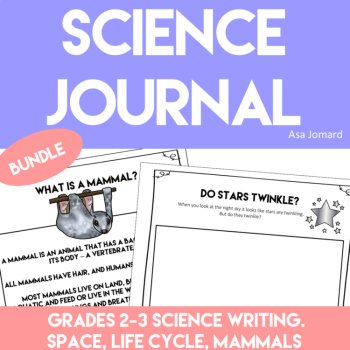 Inspiring Science Journal Prompts Bundle | Engaging Science Writing
$9.50
$13.00
Save 27%
 Engaging Back to School Science and Math Bundle | Grade 2 and Grade 3
$60.00
$88.50
Save 32%
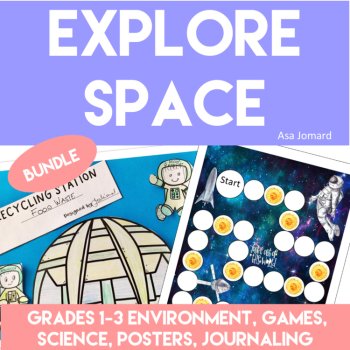 Engaging Space Activities Bundle | Journal Prompts with Game and Posters
$11.50
$16.00
Save 28%
 Unique Back to School Science Bundle - Grade 2 and Grade 3
$60.00
$91.00
Save 34%
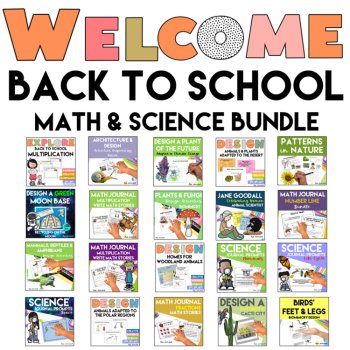 Inspiring Math Science Back to School Bundle | Grade 2 Grade 3
$60.00
$87.50
Save 31%
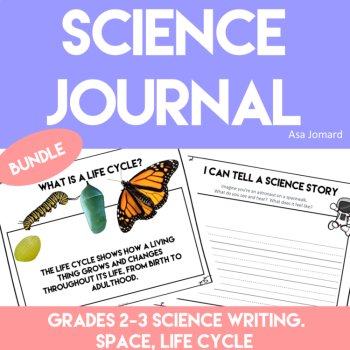 Engaging Science Journal Prompts Bundle | Space & Life Cycle Activities
$7.00
$9.00
Save 22%
No questions yet.
Meet the Seller
Creative resurces for curious students and playful thinkers
Discover exciting & unique science, math and writing activities designed for Kindergarten-Grade 6. My store includes Environmental Activities focusing on Looking for Solutions to Problems, Nature Design Biomimicry Challenges, Math Journal Prompts, Algebra and Creative Writing Activities.
United Kingdom