
Description
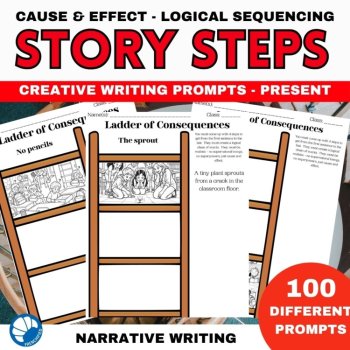
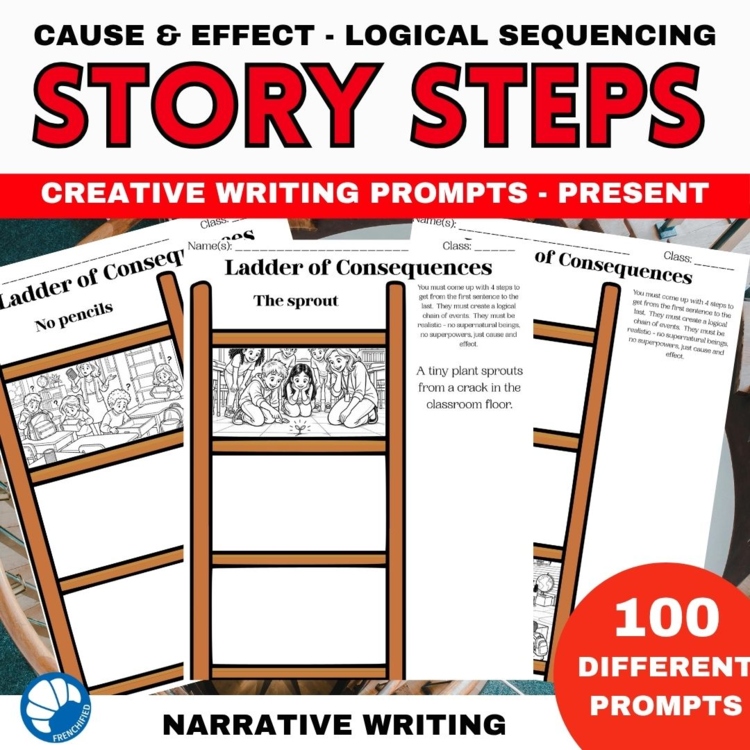
Turn creative writing for your ELA/ESL/English classes into an engaging logic challenge with these Story Steps communication activities!
Each story gives students a starting point and an ending point—but what happens in between is entirely up to them. Students must create four logical events that connect the beginning to the conclusion, building a six-step “ladder of consequences.” Along the way, they practice sequencing, cause and effect, narrative structure, and creative problem-solving.
The two-page story prompts can be used as provided or mixed and matched to create new combinations. Pair any starting point with any ending point for even more writing possibilities!
Students write each part of their story beside a ladder rung and can illustrate the events in the spaces between the rungs. To encourage careful thinking, students should avoid magical shortcuts, superheroes, and unexplained solutions. Every event must follow logically from the one before it.
This flexible activity is ideal for younger writers as well as ESL/ELL students across a range of ages and proficiency levels. This resource includes prompts written in the PRESENT TENSE.
Skills practiced include:
- Creative and narrative writing
- Sequencing events
- Cause-and-effect relationships
- Logical thinking and problem-solving
- Story structure
- Written and oral communication
- Vocabulary and grammar in context
Easily differentiate the activity by giving students additional requirements. For example, ask them to:
- Include two or three assigned vocabulary words
- Use sequencing words and transition phrases
- Add at least one adjective or adverb to each section
- Include a particular grammar structure
- Use at least one negative expression
- Write in a specified verb tense
After students complete their stories, extend the learning by having them share their work orally, develop a story together as a class, add details through questioning, or compare the logic and creativity of different solutions.
Which stories are the most plausible? Which are the most imaginative? Which events are less likely—and why?
With open-ended prompts and mix-and-match possibilities, students can return to this activity again and again while creating a different story every time.
Report this resource to Linked Through Learning
Reported resources will be reviewed by our team. Report this resource to let us know if this resource breaks our rules.
Questions & Answers
Sign in to ask a questionNo questions yet.

Meet the Seller
I have been happily married for 31 years, with three adult children who are currently in college. I'm a language, travel and music person. Languages studied: French, Russian, Spanish, Polish, German, Serbo-Croatian, Italian. Instruments I've dabbled in: Clarinet, cello, flute, oboe, bassoon, saxophone, trumpet, piano, viola da gamba, bagpipes. Countries I've visited: Canada, Mexico, Ireland, England, Poland, Slovakia, Germany, Italy, France, Austria, Netherlands.
Arizona
- 4.86Store rating after 4.9K reviews
- 0Followers
- Nobody ever notices the French teacher to give them awards for anything! My students, my family and my mom like me - is that enough? Oh, and my beer league hockey team won the championship several years ago.