Thanksgiving Gratitude Writing Activities - 'I am thankful for' Coloring Pages

$1.99

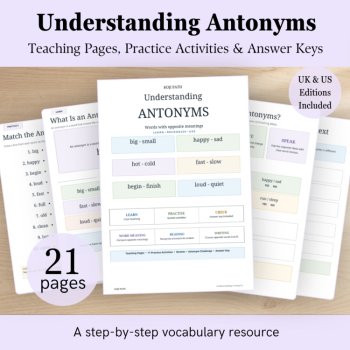
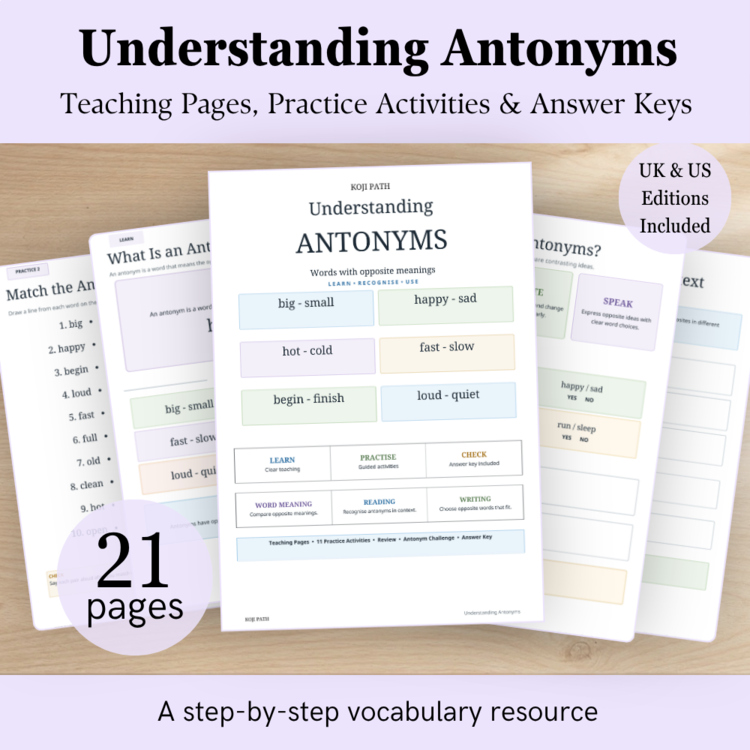
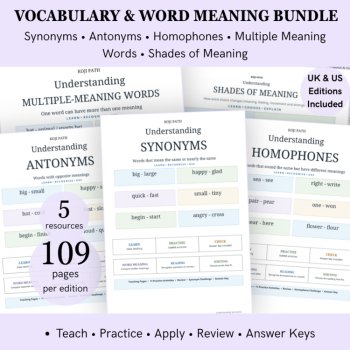
Understanding Antonyms – Opposite Words & Vocabulary Worksheets
Help children understand, recognise and use antonyms with this structured vocabulary resource for Grades 1–3.
Understanding Antonyms introduces children to words with opposite meanings, such as hot and cold, big and small, and happy and sad.
Through clear teaching pages, worked examples and varied activities, children learn how opposites work and how word meaning can change depending on context.
The pack progresses from understanding antonyms to identifying, matching, sorting and applying opposite words in sentences and paragraphs.
This download includes two complete editions:
UK English Edition — 21 pages
US English Edition — 21 pages
Both editions follow the same teaching sequence and activities. Spelling and regional language are localised where appropriate, so teachers and families can choose the version that best suits their learners.
Children first learn what antonyms are and why opposite meanings matter before progressing through guided identification, matching, choosing words in context, sentence work and increasingly independent vocabulary activities.
What children will learn
This resource helps children to:
understand what an antonym is;
identify words with opposite meanings;
understand that the best antonym can depend on context;
match common antonym pairs;
choose an antonym that fits a sentence;
complete sentences using opposite words;
compare contrasting meanings;
build common antonym pairs;
sort words by meaning;
change an important part of a sentence by replacing a word with its antonym;
work with antonyms in sentences and paragraphs;
generate antonyms independently;
apply learning through mixed review and challenge activities.
What’s included
Each 21-page edition includes:
adult guidance;
clear teaching pages;
11 progressive practice activities;
antonym identification activities;
matching activities;
word-bank practice;
sentence-context activities;
antonym pair building;
opposite-word sorting;
sentence and paragraph work;
independent antonym writing;
mixed antonym review;
antonym challenge;
common antonyms quick-reference sheet;
full answer keys with guidance for sensible alternative responses.
A step-by-step approach
Children are not expected to begin with independent worksheets immediately.
The resource progresses through:
LEARN → IDENTIFY → CHOOSE → USE → REVIEW
Teaching pages introduce opposite meanings and explain why context matters. Guided activities then help children identify and select antonyms before moving into sentence work, paragraph work and independent application.
The resource also introduces an important vocabulary idea: one word may have a different antonym depending on the meaning being used.
For example, the opposite of a word in one sentence may not be the best opposite in another. This encourages children to think about meaning and context rather than simply memorising isolated pairs.
Varied practice
Activities include opportunities to:
find antonym pairs;
match opposite words;
choose the best antonym;
complete sentences;
build antonym pairs;
sort opposite meanings;
use sentence clues to choose accurately;
change part of a sentence using an antonym;
work with antonyms in paragraph context;
write antonyms independently;
complete mixed review and challenge tasks.
The varied activity types provide repeated practice without requiring children to complete the same worksheet format again and again.
Print-friendly design
The resource has been designed with home and classroom printing in mind and includes:
clear, readable vocabulary;
generous child working spaces;
mostly white activity areas;
light pastel teaching and support sections;
uncluttered layouts;
printer-friendly colour use;
organised answer keys for straightforward checking.
Suitable for
vocabulary lessons;
English Language Arts / ELA;
word meaning and word relationships;
literacy practice;
independent work;
morning work;
homework;
intervention and additional practice;
homeschool / home education;
tutoring and small-group work;
revision and review.
UK & US English
Both editions teach the same skills and contain the same activities and page sequence.
The language is localised where genuine differences occur, for example:
UK recognise / US recognize
UK practise / US practice
UK Mum / US Mom
Choose the edition that best matches your classroom, home education setting or learner.
Format: ZIP download containing 2 PDF files
UK Edition: 21 pages
US Edition: 21 pages
Page size: A4
Answer key: Included
Editable: No
Printing note: The resource is designed at A4 size. US Letter users can select Fit or Fit to Printable Area in their printer settings.
TERMS OF USE
This resource is for personal, homeschool, classroom and single-educator use only. You may not resell, redistribute, share, upload, copy or claim this resource as your own.
Thank you for supporting KOJI PATH.
© KOJI PATH
Report this resource to Linked Through Learning
Reported resources will be reviewed by our team. Report this resource to let us know if this resource breaks our rules.
No questions yet.

Meet the Seller
Printable Learning Resources for Curious Minds
Welcome to KOJI PATH! We create educational printables designed to help children build knowledge, develop essential skills and grow in confidence as they learn. Our resources cover phonics, reading, spelling, grammar, vocabulary, maths, science and nature studies. You'll also find flashcards, matching and sorting activities, scavenger hunts, puzzles, Bible-based learning resources and more. Each resource is thoughtfully developed with clear explanations, practical examples and activities that encourage children to understand what they are learning, not simply memorise answers. Whether you're teaching in the classroom, supporting learning at home or looking for additional practice, KOJI PATH offers printable resources to make learning clear, purposeful and enjoyable.
United Kingdom