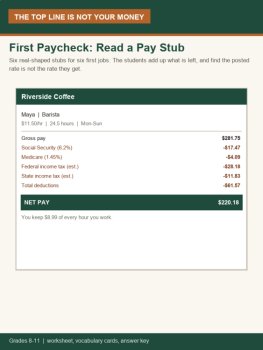
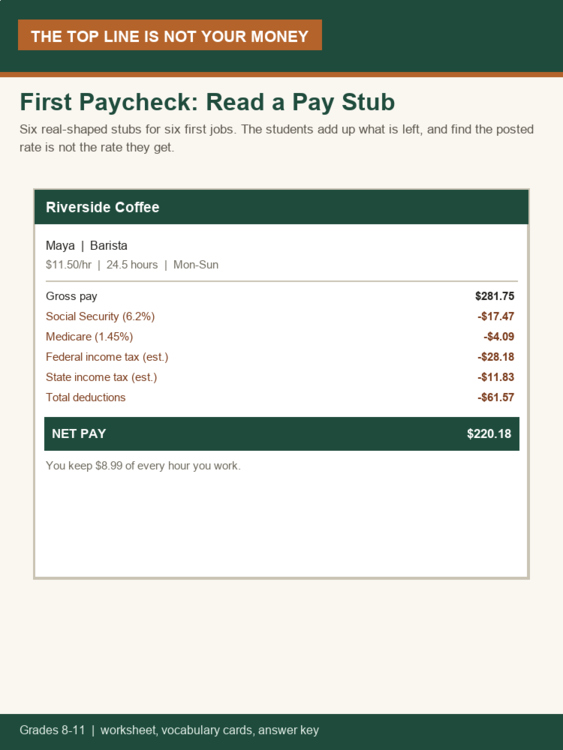
A student takes a Saturday job at sixteen, works 24.5 hours at $11.50, and tells her family she made $281.75. She is not wrong about the multiplication. She is about to find out what the four lines under it do.
This pack puts six real-shaped pay stubs in front of a grade 8-11 room and asks one question per stub: what do you actually keep? The students do the arithmetic themselves, on paper, with a calculator they trust - and the posted rate turns out not to be the rate anybody gets.
What is in the download
Six pay stubs - barista, lifeguard, grocery bagger, camp tutor, dishwasher, retail associate. Two of them carry overtime hours, so gross stops being hours times rate.
One worksheet, six rows: gross, FICA, federal plus state, net, and net per hour. That last column is the one that changes behaviour, because it is the number the student is actually paid for standing there.
Six discussion questions, including the $50 raise that only adds $39.07 and the Marcus-who-says-he-is-exempt question.
14 vocabulary cards - gross, net, withholding, FICA, Social Security, Medicare, pay period, YTD, overtime, exempt, dependent allowance, direct deposit, W-4, I-9. Term on one side, the sentence that defines it on the other. Cut them out last, once the words have numbers attached.
Six things to know before the first shift - the rules an employer assumes a teenager has already read: the three-day I-9, who fills in the W-4, under-18 hour limits, tips, keeping a stub, what a raise does to withholding.
Answer key with every total worked out, plus the teacher note about how the tax lines here were built.
11-slide editable deck (.pptx) - one stub per slide so a number can go on the board while the pair argues about it. Every element is a text box: change the names, the rates and the employers for your own room. Upload it to Drive and open with Google Slides, or run it straight from PowerPoint.
9 print pages in both Letter and A4 and a README with the ten-minute opening that works.
About the numbers, said plainly. Social Security (6.2%) and Medicare (1.45%) are the real rates. The federal and state income lines use a flat classroom rate - 10% and 4.2% - so the arithmetic closes and every total on every stub adds up. A real stub holds back a different amount depending on the W-4, the state and whether the pay period is weekly or twice a month. That is a better lesson than a fake tax table, and the answer-key page spells out how to say it to the room.
Who buys this: life-skills, personal finance and business teachers whose students get their first job in June; math teachers who want percentages attached to something a teenager will actually receive; ELL and transition classes that need the vocabulary in the same hand as the arithmetic; and any counselor who hands out work permits and wants the conversation to continue.
No login, no bank account, no app, no calculator website. Six stubs on the desk, ten minutes, and the room disagrees about one of the answers - which is the whole lesson.
Also from this shop: the Classroom Jobs Kit for middle school, Executive Functioning Task Cards, the Editable Review Game Template, and Phishing Lab, Password Lab and Spooky Inbox - the scam simulations with a free tracker.
License: one classroom, unlimited students and unlimited years. Edit and print it for your own students; please do not resell it or post it on a public site.