Science Posters- The Periodic Table-Brown Corduroy Design
$5.00 (1)

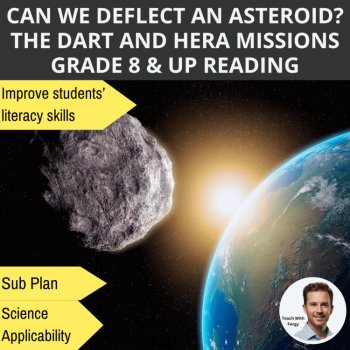
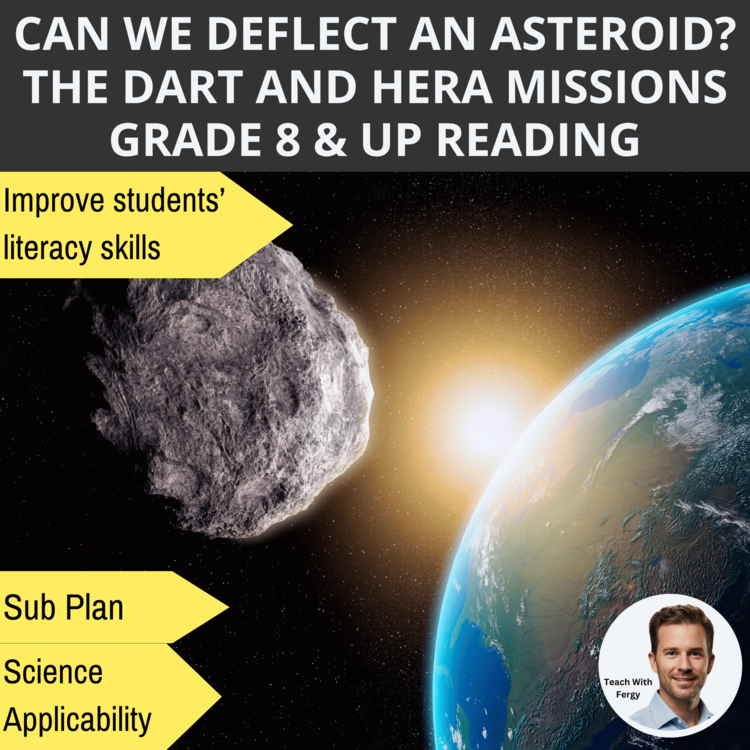
Can We Deflect an Asteroid? The DART and Hera Missions Reading Comprehension Passage and Questions
This reading explores how scientists could prevent a dangerous asteroid from striking Earth. Students learn why early detection is essential, how small changes in an asteroid’s speed can produce large changes over time, and how a kinetic impactor can alter an asteroid’s motion without destroying it.
Students examine NASA’s Double Asteroid Redirection Test (DART), the first mission to deliberately change the motion of an asteroid. They investigate how DART struck Dimorphos, shortened its orbit around Didymos, and transferred additional momentum through escaping rock and dust. The reading also explores the European Space Agency’s Hera mission, which will examine the results of the impact and help scientists improve future asteroid-deflection missions.
This resource covers the following topics:
✅ Grade 8 and Up Reading on Asteroid Deflection: Explains how scientists detect, study, and potentially redirect hazardous asteroids.
✅ No-Prep, Editable Resource: Easy to assign as print or digital scientific literacy practice.
✅ DART and Hera Mission Case Study: Students examine the first successful asteroid-deflection test and the mission investigating its results.
✅ Physics and Space Science Applications: Connects momentum, kinetic energy, velocity, gravity, and orbital motion to planetary defense.
✅ Includes Reading Comprehension and Extension Questions: Comes with 10 comprehension questions, 5 extension questions, and complete answer keys.
This resource covers the following topics:
How this product will help your students:
How this product will help you:
Google Classroom and Distance Learning Ready
No prep, no formatting, no issues. Simply download, print, or upload it to your class site, and you are all set.
The Problem You Face – Not having enough time to teach scientific literacy or improve your students’ reading comprehension and analysis skills while also connecting physics and space science to current real-world missions.
The Solution
This fully editable, NO-PREP reading comprehension article contains relevant, applicable, and engaging activities that can be used to:
This resource will take your students between 60–90 minutes to complete and includes calculation, research, comparison, and evidence-based questions. Complete answer keys are included for your reference.
-----------------------------------------------
You might also be interested in my other individual reading comprehension articles. Each one can be found inside my Grade 8 and Up Reading Mega Bundle.
I have over 200 readings that cover a variety of topics found in:
Report this resource to Linked Through Learning
Reported resources will be reviewed by our team. Report this resource to let us know if this resource breaks our rules.
No questions yet.

Meet the Seller
Middle and High School Science Engaging Resources
I have been selling resources to middle and high school teachers for the last 15 years. During that time I've also been in the classroom so I know what works and what will help your students the most.
Canada