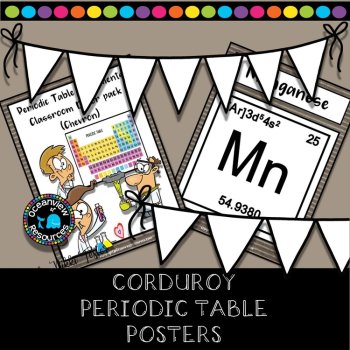
Science Posters- The Periodic Table-Brown Corduroy Design
$5.00 (1)

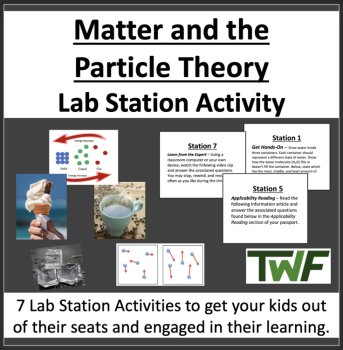
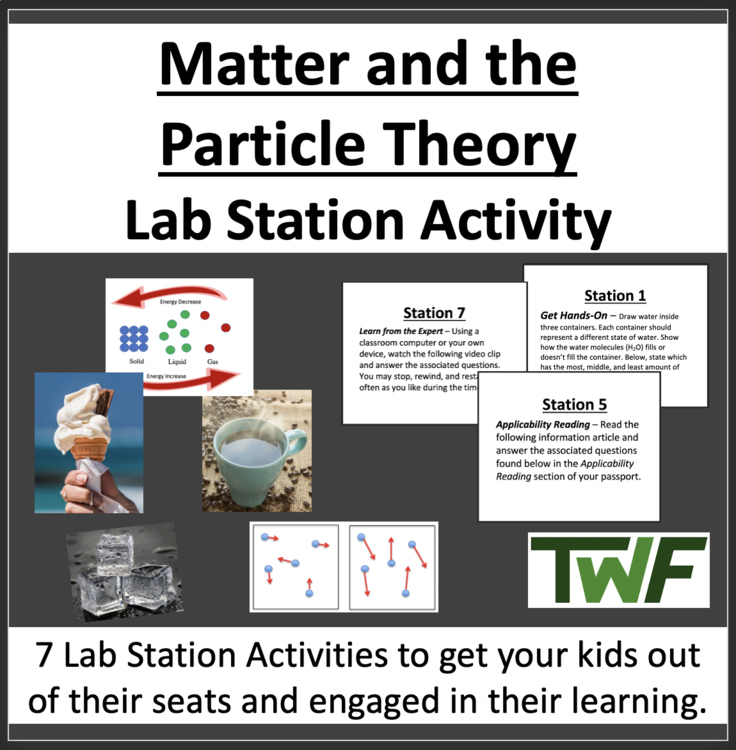
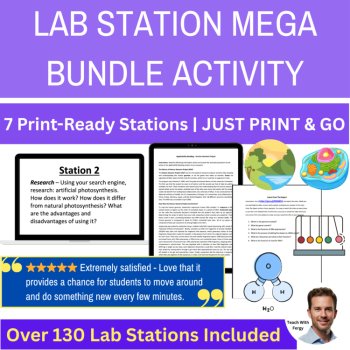
This fully editable Lab Station Activity on Matter and the Particle Theory is meant to get your students out of their seats and engaged in the content.
Each station not only offers a unique opportunity to test your students' knowledge (offer an opinion, answer questions based on a video or reading, draw, etc.) but also provides a fantastic learning opportunity where your kids are learning through assessment. Each station comes with a description card while some also contain more detailed instructions, a reading, questions to answer, etc.
Students are equipped with a recording sheet (passport) to write their answers. There is almost no prep for you. Simply print the cards, lay them out around the room and you're all set. An answer key is also provided where applicable.
No prep, no formatting, no issues. Simply download, print (or upload to your class site) and you're all set.
**This resource is fully editable for your convenience**
This resource covers the following topics:
Bonus Activities: To ensure your students don't have any downtime between stations, your lab also includes a word scramble and word search, both with an answer key. You can use them as part of their mark, as a bonus so it's not mandatory, etc. However you choose to use it, it will ensure that your students are always busy and never idle. Note: For stronger classes, I give the word scramble and for weaker ones, the word search.
How do the Lab Stations work? Each station is specially designed to be a unique complement to the material while at the same time, providing a valuable learning experience. Below is an overview of how each station works. In your activity, each will be tailored to the specific content.
Station 1: Get Hands-On – using their creative skills, students are required to draw or build.
Station 2: Research – using a classroom computer or their own device, students must research a specific question/issue surrounding the topic.
Station 3: Explain yourself – students write down an opinion to a question in paragraph form.
Station 4: Station Complete - students can use this time to catch up on work they didn't have time to complete at a previous station or prepare themselves for an upcoming one.
Station 5 - Applicability reading – students read a short passage from an article, website, etc. which directly connects the classroom content to a real-life application.
Station 6: Test your knowledge – students answer 5 multiple choice questions than provide a written explanation for how/why they came to their conclusions.
Station 7: Learn from the expert – using a classroom computer or their own device, students must watch a short video clip and answer the associated questions. They may stop, rewind, and restart as often as they like during the time frame.
Station 8 - Station Complete
Station 9: Become the question master – Students must create 2 multiple-choice questions, 2 true/false questions, and 1 short answer question. Students must also supply the answers.
-------------------------------
You might also be interested in my other lab station activities
Physics:
• Newton's Three Laws of Motion
• Kinetic and Gravitational Potential Energy
• Current Electricity and Circuit Diagrams
• Static Electricity
• Light Optics and the Production of Light
• Sound, Sound Energy and Speed
• One and Two-Dimensional Motion
• Uniform Acceleration
• How Planes Fly
• Refraction
• Friction
• Energy and Its Forms
• Density and Buoyancy
• Electricity Production
• Calculating Average Speed, Velocity, and Displacement
• Mass, Volume, Density, & Buoyancy
• Work and Energy
• Renewable Energy
• Plate Tectonics
• The Rock Cycle
• Natural Disasters
• Pressure, Volume, and Temperature
• Forces
• Power
• Liquids and Gases
• Fossils and Geologic Time
• Work and Energy - The Sequel
• Nuclear Energy - Fission and Fusion
• Simple Machines
Coming Soon:
- Nonrenewable energy sources
- Projectile Motion
- Momentum, Conservation of Momentum and Impulse
- The Doppler Effect and Supersonic Travel
General Science:
• The Scientific Method and Science Skills
• The Different Types of Clouds
• Meteorology
• Lab Safety
• Scientific Method
Biology:
• Cell and the Cell Theory
• The Human Digestive System
• The Circulatory System
• The Human Respiratory System
• Mitosis and the Cell Cycle
• Cellular Respiration and Photosynthesis
• Photosynthesis
• Cancer: Cell Division Gone Wrong - Volume I
• Cancer: Cell Division Gone Wrong - Volume II
• Cell Membrane and Transport
• Hearing and the Human Ear
• The Human Eye
• Genetic Material: DNA and RNA
• The Nervous System
• Energy Flow In Ecosystems
• DNA Manipulation and GMOs
• Transcription and Translation
• Cellular Respiration
• Thermoregulation
• Proteins and Nucleic Acids
• Mutations
• Meiosis
• DNA, Genes, Chromosomes, and Alleles
• Genetic Disorders
• Fats
• Reproductive Technologies
• Muscular and Skeletal System
• Integumentary System
• Photosynthesis and Cellular Respiration (Middle School)
• Cellular Organelles
Coming Soon:
- Excretory system
- Endocrine system
- Carbohydrates and Lipids
Chemistry:
• Atomic Model, Notation and Atoms
• Chemical Reactions and Balancing Equations
• Molecular and Ionic Compounds
• Physical and Chemical Properties & Changes
• Acids, Bases, and Neutralization Reactions
• The Periodic Table
• Single and Double Displacement Reactions
• Balancing Chemical Equations
• Synthesis, Decomposition and Combustion Reactions
• Atomic Theory, Atomic Structure and Isotopes
• Types of Bonds and Intermolecular Forces
• The Mole/Avogadro's Number
• Density and Buoyancy
• The Particle Theory and the Classification of Matter
• Pure Substances and Mixtures
• Solutions and Mechanical Mixtures
• Matter and the Particle Theory
Coming Soon:
- Periodic table group properties
Ecology and the Environment:
• Ecosystems
• The Classification of Living Things
• Biodiversity and Invasive Species
• The Carbon and Water Cycle
• Climate Change
• Photosynthesis
• Cellular Respiration and Photosynthesis
• Ecological Succession
• Plant Sexual and Asexual Reproduction
• Earth's Seasons
• Interactions Within Ecosystems
• Physical and Behavioral Adaptations
• Biomes
Space Science:
• The Life and Death of Stars
• The Moon and its Phases
• Life In Space
• Our Solar System
• Solar and Lunar Eclipse
• Earth's Seasons
• Asteroids, Comets and Meteors
These station cards are meant to be used as a lab activity but can also be utilized in a review task before a test or a quiz. Used either way, your students will love it! I know mine do and I'm telling you from first-hand experience as I've used this activity in my own class.
*****************************
If you have any questions please feel free to send me an email - devon@teachwithfergy.com
Report this resource to Linked Through Learning
Reported resources will be reviewed by our team. Report this resource to let us know if this resource breaks our rules.
No questions yet.

Meet the Seller
Middle and High School Science Engaging Resources
I have been selling resources to middle and high school teachers for the last 15 years. During that time I've also been in the classroom so I know what works and what will help your students the most.
Canada
$22.50 $34.75 (318)
$22.50 $33.50 (190)