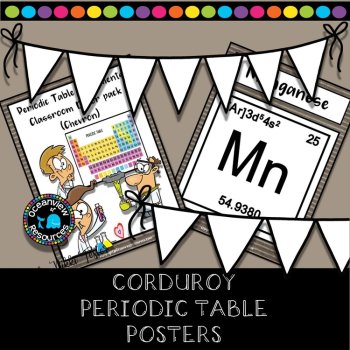
Science Posters- The Periodic Table-Brown Corduroy Design

$5.00 (1)

Each resource inside this bundle was handpicked to cover all aspects of the MS-PS1 NGSS (MS-PS1-1 to MS-PS1-6). The resources found inside will ensure your students fulfill each requirement of the standard and keep them interested and engaged throughout. A description of how each standard is covered is broken down below. This bundle will save you time and money, the two things every teacher needs more of. There are over 75 classroom-tested resources included which individually would cost over $250. You'll save 60% by purchasing them through this bundle not to mention tens or even hundreds of hours of prep time.
What you get
Complete Lessons
• Make sure your students are on track
• Each lesson comes with a teacher and student version to keep them focused
• Lessons come with videos embedded right into your slides
• Includes 5E lessons
Interactive Activities
• Lab Stations
• Digital Scavenger Hunts
• Scientific readings on engaging subjects
Buyer Comments:
- "Great resource!"
- "Great Resource"
- "Thank you. Great resource"
Topics Covered:
• Atoms (1-1)
• Molecules (1-1)
• Solids, Liquids, and Gases (1-1, 1-4)
• Organic Compounds (1-1)
• Elements, Compounds, Mixtures (1-1, 1-3)
• Counting Atoms and Elements (1-1)
• Density of a Regular Shaped Object (1-2)
• Density of an Irregular Shaped Object (1-2)
• Chemical Changes (1-2, 1-3, 1-6)
• Chemical Bonds (1-2, 1-5)
• Conduction, Convection, Radiation (1-4, 1-6)
• Energy Transformations (1-4, 1-5, 1-6)
• Balancing Chemical Equations (1-5, 1-6)
MS PS1: Matter and its Interactions
MS PS1-1: Develop models to describe the atomic composition of simple molecules and extended structures.
Emphasis is on developing models of molecules that vary in complexity. Examples of simple molecules could include ammonia and methanol. Examples of extended structures could include sodium chloride or diamonds. Examples of molecular-level models could include drawings, 3D ball and stick structures, or computer representations showing different molecules with different types of atoms.
Assessment Boundary: Assessment does not include valence electrons and bonding energy, discussing the ionic nature of subunits of complex structures, or a complete description of all individual atoms in a complex molecule or extended structure is not required.
Resources:
MS PS1-2: Analyze and interpret data on the properties of substances before and after the substances interact to determine if a chemical reaction has occurred.
Examples of reactions could include burning sugar or steel wool, fat reacting with sodium hydroxide, and mixing zinc with hydrogen chloride.
Assessment Boundary: Assessment is limited to analysis of the following properties: density, melting point, boiling point, solubility, flammability, and odor.
Resources:
MS PS1-3: Gather and make sense of information to describe that synthetic materials come from natural resources and impact society.
Emphasis is on natural resources that undergo a chemical process to form the synthetic material. Examples of new materials could include new medicine, foods, and alternative fuels.
Assessment Boundary: Assessment is limited to qualitative information.
Resources:
MS PS1-4: Develop a model that predicts and describes changes in particle motion, temperature, and state of a pure substance when thermal energy is added or removed.
Emphasis is on qualitative molecular-level models of solids, liquids, and gases to show that adding or removing thermal energy increases or decreases kinetic energy of the particles until a change of state occurs. Examples of models could include drawing and diagrams. Examples of particles could include molecules or inert atoms. Examples of pure substances could include water, carbon dioxide, and helium.
Resources:
MS PS1-5: Develop and use a model to describe how the total number of atoms does not change in a chemical reaction and thus mass is conserved.
Emphasis is on law of conservation of matter and on physical models or drawings, including digital forms, that represent atoms.
Assessment Boundary: Assessment does not include the use of atomic masses, balancing symbolic equations, or intermolecular forces.
Resources:
MS PS1-6: Undertake a design project to construct, test, and modify a device that either releases or absorbs thermal energy by chemical processes.
Emphasis is on the design, controlling the transfer of energy to the environment, and modification of a device using factors such as type and concentration of a substance. Examples of designs could involve chemical reactions such as dissolving ammonium chloride or calcium chloride.
Assessment Boundary: Assessment is limited to the criteria of amount, time, and temperature of substance in testing the device.
Resources:
Here are additional NGSS bundles I have prepared:
Life Sciences:
• MS LS1 From Molecules to Organisms
• MS LS2 Ecosystems
• MS LS3 Heredity
• MS LS4 Biological Evolution
Physical Science:
• MS PS1 - Matter and its Interactions
••• MS PS1-1 Unit
••• MS PS1-2 Unit
• MS PS2 Motion and Stability
• MS PS3 Energy
• MS PS4 Waves
• HS PS1 - Matter and its Interactions
• HS PS2 - Motion and Stability
• HS PS3 - Energy
• HS PS4 - Waves and their Applications in Technologies for Information Transfer
Earth Science:
• MS ESS1 - Earth's Place in the Universe
• MS ESS2 - Earth's Systems
• MS ESS3 - Earth and Human Activity
---------------------------------------------------
No prep, no formatting, no issues. Simply download, print (or upload to your class site) and you're all set. Each resource is fully editable and classroom tested.
Report this resource to Linked Through Learning
Reported resources will be reviewed by our team. Report this resource to let us know if this resource breaks our rules.
No questions yet.

Meet the Seller
Middle and High School Science Engaging Resources
I have been selling resources to middle and high school teachers for the last 15 years. During that time I've also been in the classroom so I know what works and what will help your students the most.
Canada
$22.50 $34.75 (318)
$22.50 $33.50 (190)