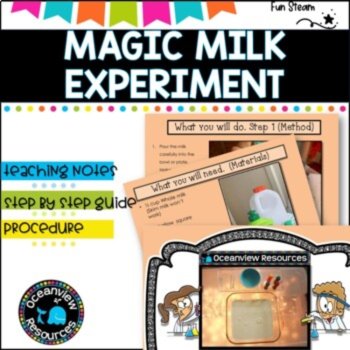
Kitchen Science- Magic Milk Experiment. Simple and great fun

$4.00 (12)

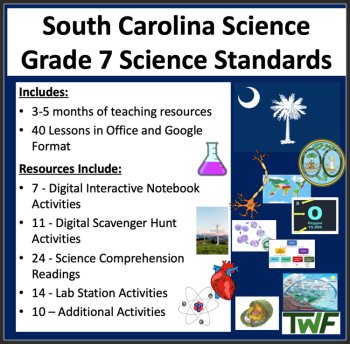
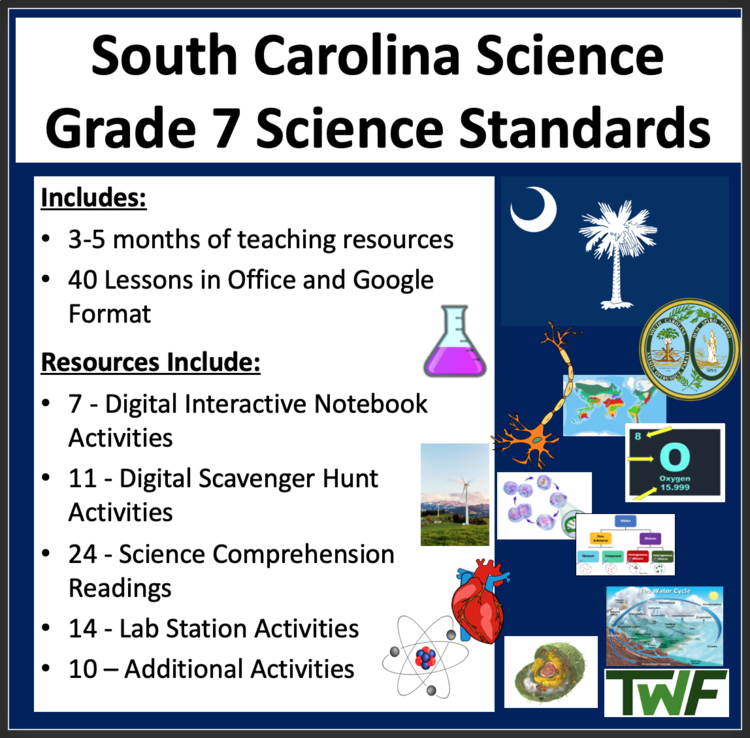
This science package includes ALL of the South Carolina Grade 7 Science Standards and represents a savings of over 40% vs. purchasing the standards individually.
Within the units, you'll find the lessons and activities I use in my own classroom.
SC.7-1. Scientific Inquiry: The student will demonstrate an understanding of technological design and scientific inquiry, including process skills, mathematical thinking, controlled investigative design and analysis, and problem-solving.
This unit includes the following resources:
7-1.1. Use appropriate tools and instruments (including a microscope) safely and accurately when conducting a controlled scientific investigation.
7-1.2. Generate questions that can be answered through scientific investigation.
7-1.3. Explain the reasons for testing one independent variable at a time in a controlled scientific investigation.
7-1.4. Explain the importance that repeated trials and a well-chosen sample size have with regard to the validity of a controlled scientific investigation.
7-1.5. Explain the relationships between independent and dependent variables in a controlled scientific investigation through the use of appropriate graphs, tables, and charts.
7-1.6. Critique a conclusion drawn from a scientific investigation.
7-1.7. Use appropriate safety procedures when conducting investigations.
Included in the package:
SC.7-2. Cells and Heredity: The student will demonstrate an understanding of the structure and function of cells, cellular reproduction, and heredity. (Life Science)
This unit includes the following resources:
7-2.1. Summarize the structures and functions of the major components of plant and animal cells (including the cell wall, the cell membrane, the nucleus, chloroplasts, mitochondria, and vacuoles).
7-2.2. Compare the major components of plant and animal cells.
7-2.3. Compare the body shapes of bacteria (spiral, coccus, and bacillus) and the body structures that protists (euglena, paramecium, amoeba) use for food gathering and locomotion.
7-2.4. Explain how cellular processes (including respiration, photosynthesis in plants, mitosis, and waste elimination) are essential to the survival of the organism.
7-2.5. Summarize how genetic information is passed from parent to offspring by using the terms genes, chromosomes, inherited traits, genotype, phenotype, dominant traits, and recessive traits.
7-2.6. Use Punnett squares to predict inherited monohybrid traits.
7-2.7. Distinguish between inherited traits and those acquired from environmental factors.
Included in the package:
SC.7-3. Human Body Systems and Disease: The student will demonstrate an understanding of the functions and interconnections of the major human body systems, including the breakdown in structure or function that disease causes.
This unit includes the following resources:
7-3.1. Summarize the levels of structural organization within the human body (including cells, tissues, organs, and systems).
7-3.2. Recall the major organs of the human body and their function within their particular body system.
7-3.3. Summarize the relationships of the major body systems (including the circulatory, respiratory, digestive, excretory, nervous, muscular, and skeletal systems).
7-3.4. Explain the effects of disease on the major organs and body systems (including infectious diseases such as colds and flu, AIDS, and athlete's foot and noninfectious diseases such as diabetes, Parkinson's, and skin cancer).
o The Common Cold
o Allergies
o Cancer
o Viruses
o Vaccines T
o he Measles
o Asthma and Asthma Attacks
o The Flu
o Smallpox
o HIV and AIDS
o Cystic Fibrosis
o Diabetes
Included in the package:
SC.7-4. Ecology: The Biotic and Abiotic Environment: The student will demonstrate an understanding of how organisms interact with and respond to the biotic and abiotic components of their environment.
This unit includes the following resources:
7-4.1. Summarize the characteristics of the levels of organization within ecosystems (including populations, communities, habitats, niches, and biomes).
7-4.2. Illustrate energy flow in food chains, food webs, and energy pyramids.
7-4.3. Explain the interaction among changes in the environment due to natural hazards (including landslides, wildfires, and floods), changes in populations, and limiting factors (including climate and the availability of food and water, space, and shelter).
7-4.4. Explain the effects of soil quality on the characteristics of an ecosystem.
7-4.5. Summarize how the location and movement of water on Earth's surface through groundwater zones and surface-water drainage basins, called watersheds, are important to ecosystems and to human activities.
7-4.6. Classify resources as renewable or nonrenewable and explain the implications of their depletion and the importance of conservation.
Included in the package:
SC.7-5. The Chemical Nature of Matter: The student will demonstrate an understanding of the classifications and properties of matter and the changes that matter undergoes.
This unit includes the following resources:
7-5.1. Recognize that matter is composed of extremely small particles called atoms.
7-5.2. Classify matter as an element, compound, or mixture on the basis of its composition.
7-5.3. Compare the physical properties of metals and nonmetals. AND
7-5.9. Compare physical properties of matter (including melting or boiling point, density, and color) to the chemical property of reactivity with a certain substance (including the ability to burn or to rust). AND
7-5.10. Compare physical changes (including changes in size, shape, and state) to chemical changes that are the result of chemical reactions (including changes in color or temperature and formation of a precipitate or gas).
7-5.4. Use the periodic table to identify the basic organization of elements and groups of elements (including metals, nonmetals, and families).
7-5.5. Translate chemical symbols and the chemical formulas of common substances to show the component parts of the substances (including NaCl [table salt], H2O [water], C6H12O6 [simple sugar], O2 [oxygen gas], CO2 [carbon dioxide], and N2 [nitrogen gas]).
7-5.6. Distinguish between acids and bases and use indicators (including litmus paper, pH paper, and phenolphthalein) to determine their relative pH.
7-5.7. Identify the reactants and products in chemical equations.
7-5.8. Explain how a balanced chemical equation supports the law of conservation of matter.
Included in the package:
Each lesson contains:
*****************************
The individual South Carolina Grade 7 Science Standards can be found below:
*****************************
Google, Office, and Distance Learning Ready
What are the student versions and how do they encourage student understanding?
The student versions of the presentations contain multiple blanks that need to be filled in throughout the lesson. These blanks are conveniently underlined and bolded on the teacher copy. I have found this to be the most effective means of keeping my students engaged and active without having them write everything out. This also leaves more time for discussion and activities.
***************************
I also have a range of assignments and lessons/units from other grade levels at my store. Please CLICK HERE to have a look around and don’t forget to follow if you like what you see.
Also, please visit my blog Teach With Fergy for my thoughts on teaching, learning, and everything in between.
Report this resource to Linked Through Learning
Reported resources will be reviewed by our team. Report this resource to let us know if this resource breaks our rules.
No questions yet.

Meet the Seller
Middle and High School Science Engaging Resources
I have been selling resources to middle and high school teachers for the last 15 years. During that time I've also been in the classroom so I know what works and what will help your students the most.
Canada