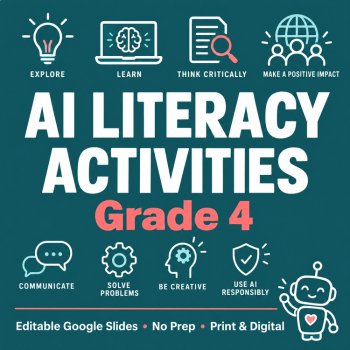
AI Literacy Activities Grade 4 Editable Google Slides No Prep

$2.50

AI Smart Prompting Skills: Turn Students Into AI Power Users With This Complete Workbook!
Give your students the one skill they need for future success: knowing how to ask AI the RIGHT questions. This comprehensive workbook transforms students from getting frustrated, useless AI responses to crafting precise prompts that unlock AI's full learning potential.
The Problem Teacher Faces:
Students are already using ChatGPT and other AI tools—but they're doing it WRONG:
Asking "help with math" and getting overwhelmed responses
Typing "tell me about space" and getting generic info they don't need
Getting frustrated when AI "doesn't understand" them
Tempted to copy-paste instead of actually learning
The Solution: Teach Them to Be Prompt Pros!
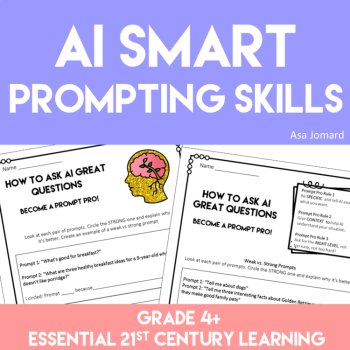
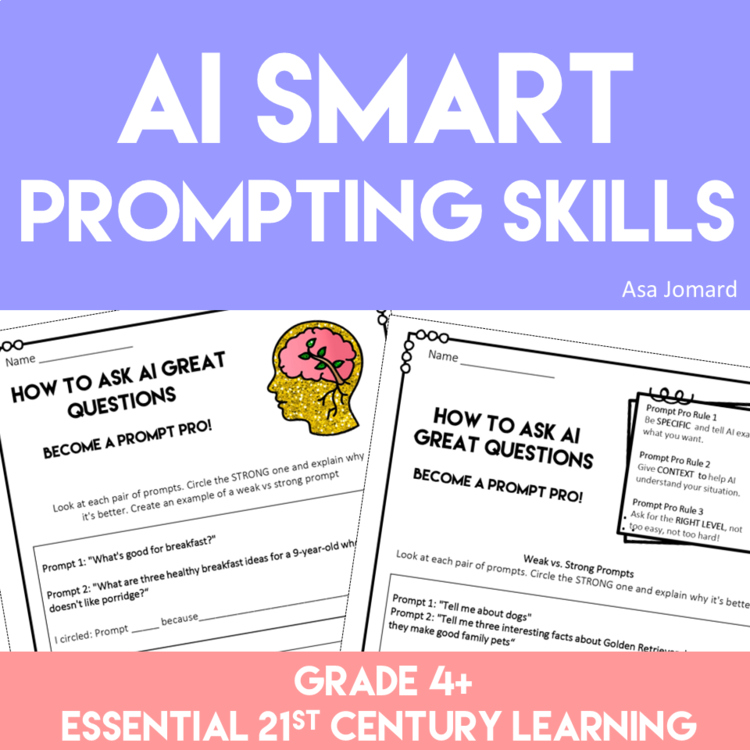
This workbook teaches the Three Prompt Pro Rules:
Be SPECIFIC - Tell AI exactly what you want
Give CONTEXT - Help AI understand your situation
Ask for the RIGHT LEVEL - Not too easy, not too hard!
Students practice transforming weak prompts like "tell me about dogs" into power prompts like "tell me three interesting facts about Golden Retriever dogs and why they make good family pets."
Complete Contents: 15 Practice Worksheets + Teacher Guide
Teacher Resources (5 pages):
Comprehensive Teacher Guide - Complete implementation strategies, learning objectives, and teaching tips
Differentiation Strategies - Support for advanced and struggling learners Extension Activities - Prompt peer review, AI response comparison, real-world applications
Addressing Common Challenges - Solutions for overly complex prompts, context confusion, and frustration
Metacognition Framework - Help students reflect on their learning process
Student Worksheets (15 Hands-On Activities):
Foundation Skills (Worksheets 1-3):
Weak vs. Strong Prompts - Compare prompt pairs and identify what makes prompts effective (includes Golden Retriever facts, breakfast ideas, math homework examples)
Create Your Own Examples - Students design their own weak vs. strong prompt comparisons
The WHO-WHAT-WHY-HOW Framework - Transform weak prompts using guided questions (space and story writing examples)
Adding Context (Worksheets 4-5):
Context for Different Situations - Practice adding context for the same prompt in different scenarios (photosynthesis for tests, projects, and curiosity) Problem-Solving Contexts - Apply context to math problems, friendship issues, and broken toys
The Goldilocks Principle (Worksheet 6):
Finding "Just Right" Prompts - Practice avoiding too-easy and too-hard prompts (water cycle, story writing examples with humor!)
Prompt Transformation Practice (Worksheets 7-8):
Transformation Checklist #1 - Convert "what about animals?" and "help" into strong prompts with guided checklists
Transformation Checklist #2 - Transform "tell me something cool" plus create original weak-to-strong examples
Real-World Application (Worksheet 9):
Scenario-Based Prompting - Write prompts for science fair projects (volcanoes), math homework (long division frustration), and creative writing (friendship stories)
Personal Prompt Toolkit (Worksheets 10-11):
Create Your Prompting Checklist - Students build their own pre-prompt quality check system
Personal Prompt Starters Library - Collect go-to sentence starters and successful prompts ("Explain ___ for a 4th grader who ___")
Advanced Techniques (Worksheet 12): Chain Prompting - Learn to ask follow-up questions that build on previous responses (plant parts → survival → cactus adaptations example)
Show, Don't Tell Technique - Request examples alongside explanations (metaphor practice included)
Reflection & Improvement (Worksheets 13-14):
AI Conversation Reflection - Analyze what worked and what didn't in recent AI interactions
Prompt Revision Strategies - Identify specific improvements with guided checklist (specificity, format, context, step-by-step reasoning, etc.)
Resource Specifications:
Format: Ready-to-print PDF workbook
Total Pages: 30 pages (5 teacher pages + 15 student worksheets + duplicates for practice)
Grade Range: Designed for 4th grade+, works through high school
Time Required:
Quick version: 4-5 class periods (core worksheets only)
Complete unit: 8-10 class periods (all worksheets + discussion)
Ongoing skill-building: One worksheet per week across semester
Digital-Friendly: Print OR use digitally with PDF annotation
No AI Access Required: Works even if your district blocks AI tools!
Skills Students Master Through This Workbook:
1. Specificity & Precision
Transform vague questions into targeted requests
Use precise vocabulary instead of general terms
Specify desired format (list, steps, examples, explanation)
Define scope and boundaries of their question
2. Context Building
Identify their role (grade level, prior knowledge)
Explain purpose (test prep, project, curiosity)
Describe their situation and constraints
Provide relevant background information
3. Appropriate Complexity
Recognize when prompts are too simple (boring)
Identify when prompts are too complex (confusing)
Find the "Goldilocks zone" for their level
Adjust difficulty based on learning goals
4. Metacognitive Awareness
Reflect on what worked and what didn't
Analyze AI responses critically
Identify patterns in successful prompts
Develop personal prompting strategies
5. Iterative Refinement
Practice chain prompting (follow-up questions)
Revise unsuccessful prompts systematically
Use checklists to self-assess before asking
Build a personal library of effective prompts
Cross-Curricular Applications Built Into Worksheets:
Language Arts:
Story writing prompts (friendship stories)
Metaphor explanations with examples
Creative writing idea generation
Math:
Homework help (fractions, long division)
Step-by-step problem solving
Concept explanations at appropriate level
Science:
Science fair research (volcanoes)
Photosynthesis explanations (test prep, projects, curiosity)
Plant biology (parts, survival, adaptations)
Real-Life Problem Solving:
Friendship issues
Broken toy troubleshooting
Healthy breakfast planning
Teacher Implementation Guide Included:
Week 1: Foundations
Introduce Prompt Pro Rules with Worksheet 1-2
Practice weak vs. strong comparisons
Begin WHO-WHAT-WHY-HOW framework (Worksheet 3)
Week 2: Adding Context
Context for different situations (Worksheet 4)
Problem-solving contexts (Worksheet 5)
Goldilocks principle practice (Worksheet 6)
Week 3: Transformation Skills
Guided prompt transformation (Worksheets 7-8)
Real-world scenario practice (Worksheet 9)
Create personal toolkit (Worksheets 10-11)
Week 4: Advanced & Reflection
Chain prompting techniques (Worksheet 12)
Reflection on real AI use (Worksheets 13-14)
Apply to actual assignments
Differentiation Strategies Included:
For Advanced Learners:
Chain prompting challenges
Peer prompt review activities
Help classmates improve their prompts
Create prompt comparison analyses
For Struggling Learners:
Sentence starters provided throughout
Partner work encouraged
Focus on one element at a time
Visual frameworks (WHO-WHAT-WHY-HOW)
Checklists for self-scaffolding
For All Learners:
Progressive complexity across worksheets
Multiple practice opportunities
Reflection journals for metacognition
Personal toolkit customization
Standards Alignment:
ISTE Standards for Students:
1.6.c Knowledge Constructor - Curate information from digital resources using effective strategies
1.3.d Knowledge Constructor - Build knowledge through active exploration
1.5.b Digital Citizen - Manage digital identity and privacy
21st Century Skills:
Critical Thinking & Problem Solving
Communication & Collaboration
Information Literacy
Metacognition & Self-Directed Learning
Why This Workbook Works:
Progressive Structure: Starts with simple comparisons, builds to complex chain prompting
Immediate Application: Every concept has multiple practice opportunities Student Agency: Creates personal toolkit with their own prompt starters Reflection Focus: Students think about their thinking throughout
Relatable Examples: Golden Retrievers, breakfast, friendship, volcanoes—things kids care about!
Perfect For:
Technology/Computer Lab classes
ELA (research and writing skills)
Study Skills/Advisory periods
Library/Media literacy instruction
Gifted and Talented enrichment
Any subject integrating AI tools
Homework/study strategy instruction
Beginning-of-year skill building
Flexible Implementation Options:
Option 1: Intensive Workshop (1 Week)
5 class periods, 3 worksheets per day
Quick skill immersion before AI use
Works great for special workshop weeks
Option 2: Complete Unit (2-3 Weeks)
8-10 class periods with discussion time
Deeper exploration of each concept
Include peer review and revision
Option 3: Semester Skill-Building
One worksheet per week
Apply immediately to coursework
Build expertise gradually
Option 4: Independent Study
Self-paced workbook for advanced students
Perfect for homework or extension work
Reflection journals built in
Materials Needed:
Minimal supplies:
Optional: AI access for live practice (NOT required—all scenarios work hypothetically)
Works perfectly even if your district blocks AI! Students learn the skills for future application.
Frequently Asked Questions:
Q: Do students need AI accounts to complete this? A: No! All 15 worksheets work with hypothetical examples. Students practice the SKILL of prompt-writing without needing actual AI access.
Q: What grades is this appropriate for? A: Designed for 4th grade and up. Works through high school with different applications. The examples are kid-friendly, but the skills are sophisticated.
Q: How is this different from just "teaching students to ask good questions"? A: It's specifically designed for AI interaction, teaching context-building, appropriate complexity levels, and chain prompting—skills unique to AI tools.
Q: Will this teach students to cheat? A: Absolutely not. The workbook emphasizes AI as a learning helper, not an answer provider. Examples focus on understanding concepts, not completing assignments.
Q: Can I use this if I don't know much about AI? A: Yes! The teacher's guide explains everything. You don't need to be an AI expert—the workbook teaches YOU while you teach students.
Q: Do I need to teach all 15 worksheets? A: No—mix and match based on your needs! Core worksheets (1-6) cover fundamentals. Others are reinforcement and advanced skills.
Click the PREVIEW button to see actual worksheet samples!
Bonus: Skills That Transfer Beyond AI
These aren't just "AI skills"—they improve ALL learning:
Better Research: Formulating precise questions for any search.
Clearer Writing: Specifying audience, purpose, and format.
Stronger Critical Thinking: Evaluating response quality.
Enhanced Metacognition: Reflecting on learning processes.
More Effective Communication: Providing context and specificity.
Improved Problem-Solving: Breaking complex tasks into steps
Students apply these skills to:
Google searches (more effective keywords)
Asking teachers for help (clearer questions)
Library research (focused inquiry)
Peer collaboration (better explanations)
Study strategies (targeted practice)
Think Dive is built on a simple idea: a handful of curiosity + a bucket of imagination = learning that sticks. Every resource is designed to spark original thinking in young minds.
Format: PDF (US Letter size — A4 available upon request).
Questions or requests? Contact: maliasa@live.com
#AIPrompting #AILiteracy #DigitalLiteracy #SmartPrompting #ChatGPTEducation #PromptEngineering #CriticalThinking #21stCenturySkills #InformationLiteracy #ResearchSkills #StudySkills #Metacognition #STEMEducation #MiddleSchoolTech #UpperElementary #AcademicSkills #ThinkingSkills #AIForEducation #FutureReadyLearning
Report this resource to Linked Through Learning
Reported resources will be reviewed by our team. Report this resource to let us know if this resource breaks our rules.
No questions yet.
Meet the Seller
Creative resurces for curious students and playful thinkers
Discover exciting & unique science, math and writing activities designed for Kindergarten-Grade 6. My store includes Environmental Activities focusing on Looking for Solutions to Problems, Nature Design Biomimicry Challenges, Math Journal Prompts, Algebra and Creative Writing Activities.
United Kingdom