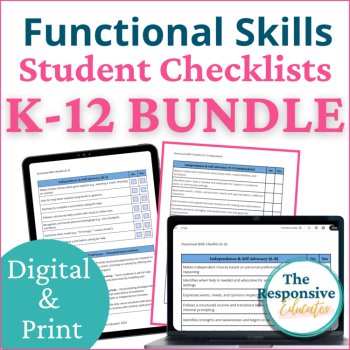
Functional Life Skills Checklist, IEP Goals & Interventions K–12th Grade Bundle
$30.51 $33.90

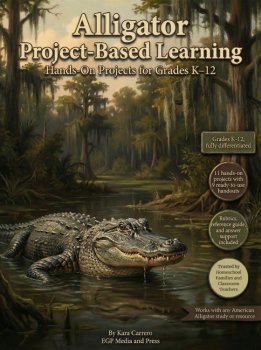
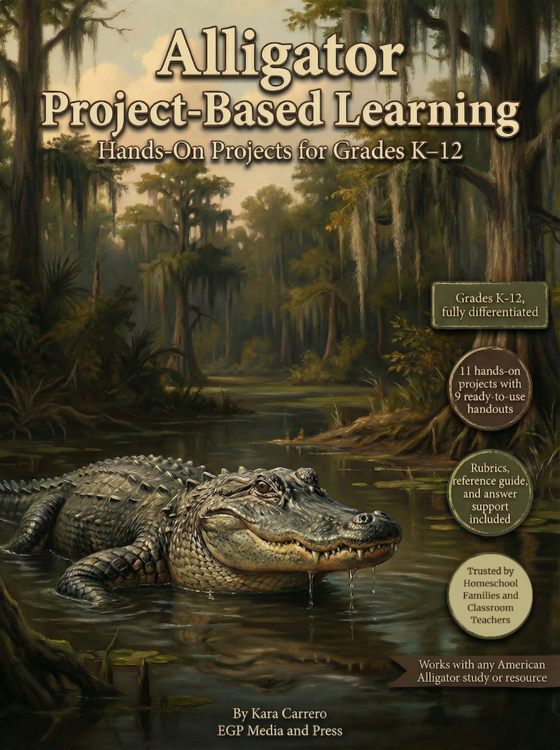
Does your student know that a baby alligator faces more danger from a largemouth bass than from almost anything else in the swamp? That only 1 in 10 hatchlings survives its first year? That an alligator cycles through up to 3,000 teeth in a lifetime?
This project-based learning resource turns those facts into real thinking. Across eleven hands-on projects spanning Kindergarten through 12th grade, students build, illustrate, design, and analyze rather than fill in blanks. Every project produces a tangible artifact, something a student made and can defend, where writing supports the work rather than being the work.
They can read books, watch documentaries, and more to do the research and apply their knowledge.
Projects are fully differentiated across four grade bands: K–2, 3–5, 6–8, and 9–12. A kindergartner and a fifth grader can work from the same resource at the same time, each producing something appropriate to their level without needing a separate version. Differentiation happens inside the project, not by assigning a different one.
This resource works with any American Alligator study, across the full range from Florida and Louisiana to the Gulf Coast and the Carolinas.
What's included:
Projects include:
Assessment is built into the artifact itself. A student who can defend an unconventional choice with real biological reasoning is demonstrating exactly the kind of thinking these projects are designed to develop.
This resource is also a great fit for: alligator unit study, alligator activities, alligator science unit, reptile unit study, wetland unit study, wetland ecosystem activity, food web activity, food web project, animal adaptations project, keystone species activity, invasive species project, conservation science activity, ecology project, biomimicry lesson, project based learning science, PBL science unit, hands-on science activities, nature study activities, living science curriculum, Charlotte Mason science, homeschool science unit, homeschool nature study, homeschool PBL, multi-level homeschool, all ages homeschool curriculum, unit study homeschool, differentiated science activities, science activities for kindergarten, science projects grades 3-5, middle school science projects, high school biology project, K-12 science unit, animal science project.
Report this resource to Linked Through Learning
Reported resources will be reviewed by our team. Report this resource to let us know if this resource breaks our rules.
No questions yet.

Meet the Seller
Where learning takes root through project-based learning
Differentiated project based curriculum for a K through 12 learners. Perfect for classroom or homeschool use as every unit is flexible, rigorous, and fun!
New Hampshire