OCEAN WEB DETECTIVES
Crack the CORAL CODE to Save the Reef!
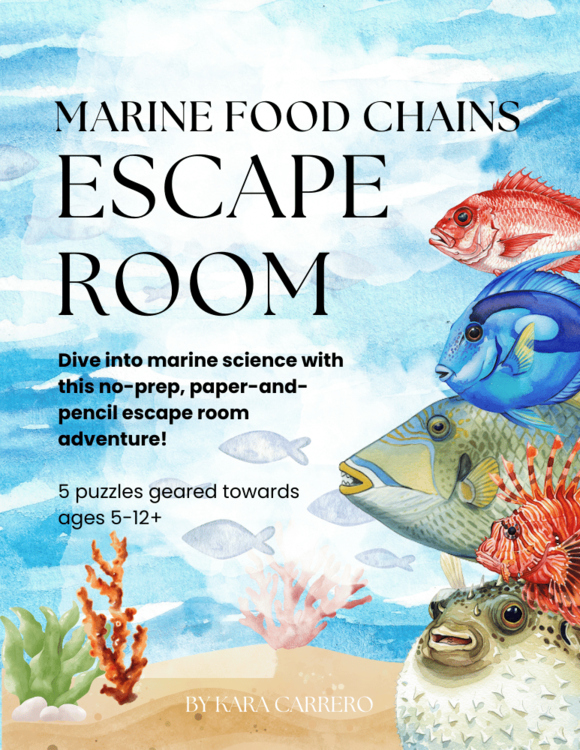
Dive into marine science with this no-prep, paper-and-pencil escape room adventure!
Transform your classroom or homeschool into an underwater laboratory where young marine biologists ages 5-12 must solve the mystery of Coral Cove Reef's ecosystem imbalance. Students will decode food webs, identify fascinating marine creatures, and discover ecological connections to reveal the secret 5-digit CORAL CODE that can restore harmony to the reef!
This printable escape room includes:
- Engaging puzzles that teach real marine science concepts
- Focus on colorful reef fish with unique adaptations and ecological roles
- Progressive challenge system perfect for individual or group learning
- Complete educator guide with differentiation options for ages 5-12
- Zero prep required beyond printing - no physical props or locks needed!
Whether you're teaching an ocean unit, looking for STEM enrichment, or need an engaging rainy-day activity, Ocean Web Detectives delivers deep learning through play. Watch as students transform into ecological problem-solvers while mastering food chains, trophic levels, and conservation concepts!
"The perfect blend of critical thinking and marine biology education. It brought to life what my kids have been playing in a video game, but with actual understanding to synthesize their understanding! They were completely engaged and didn't even realize how much they were learning." - homeschooler of 4
Download includes: Complete educator guide, all printable materials, answer keys, differentiation suggestions, and certificate templates + student satisfaction survey.
Dive into learning today!
Next Generation Science Standards (NGSS)Elementary School (K-5)
- LS1.C: Organization for Matter and Energy Flow in Organisms
- Students explore how animals obtain food from plants or other animals to live and grow
- LS2.A: Interdependent Relationships in Ecosystems
- Students understand that the food of almost any animal can be traced back to plants
- Students identify that organisms are related in food webs
- LS2.B: Cycles of Matter and Energy Transfer in Ecosystems
- Students explore matter cycles between air, soil, plants, animals, and microbes
- LS2.C: Ecosystem Dynamics, Functioning, and Resilience
- Students analyze how ecosystems can change when disruptive events (like introduction of invasive species) occur
- LS4.D: Biodiversity and Humans
- Students recognize that changes in environments can impact the organisms living there
Middle School (6-8)
- MS-LS2-1: Analyze and interpret data to provide evidence for the effects of resource availability on populations of organisms in an ecosystem
- MS-LS2-2: Construct an explanation that predicts patterns of interactions among organisms across multiple ecosystems
- MS-LS2-3: Develop a model to describe the cycling of matter and flow of energy among living and nonliving parts of an ecosystem
- MS-LS2-4: Construct an argument supported by empirical evidence that changes to physical or biological components of an ecosystem affect populations
Common Core State StandardsEnglish Language Arts
- CCSS.ELA-LITERACY.RI.4.7: Interpret information presented visually, orally, or quantitatively and explain how the information contributes to an understanding of the text
- CCSS.ELA-LITERACY.W.5.2: Write informative/explanatory texts to examine a topic and convey ideas and information clearly (through the ecosystem rescue plan)
Mathematics
- CCSS.MATH.PRACTICE.MP1: Make sense of problems and persevere in solving them
- CCSS.MATH.PRACTICE.MP2: Reason abstractly and quantitatively (through food web relationships and population dynamics)
International Baccalaureate (IB) Primary Years Programme
- Living Things: Understanding the interconnectedness of living systems
- Sharing the Planet: Understanding how humans interact with and impact ecosystems
Australian Curriculum
- ACSSU112: Interactions between organisms, including the effects of human activities, can be represented by food chains and food webs
- ACSSU176: Ecosystems consist of communities of interdependent organisms and abiotic components of the environment
UK National Curriculum (Key Stage 2)
- Year 4 Science: Recognize that environments can change and that this can sometimes pose dangers to living things
- Year 6 Science: Identify how animals and plants are adapted to suit their environment and that adaptation may lead to evolution
21st Century Skills
- Critical Thinking: Analyzing ecosystem relationships
- Problem Solving: Developing solutions to environmental challenges
- Collaboration: Working in teams to solve the escape room puzzles
- Communication: Discussing ecological concepts and solutions
Environmental Education Standards
- Environmental Literacy: Understanding ecological principles
- Systems Thinking: Recognizing interconnections in ecosystems
- Decision Making: Evaluating options for ecosystem management
- Personal Responsibility: Understanding human impacts on marine ecosystems
The Ocean Web Detectives escape room particularly excels at addressing the interdependent relationships within ecosystems, food webs, and human impacts on marine environments—all while engaging students in an interactive format that promotes active learning and critical thinking.