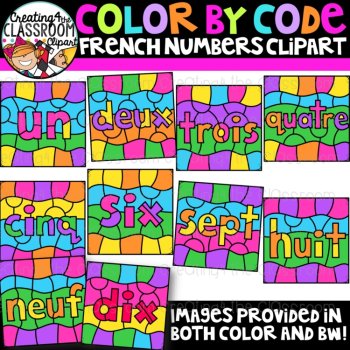
French Number Words Color by Code Clipart | French Numbers 1–10
$4.50 (1)

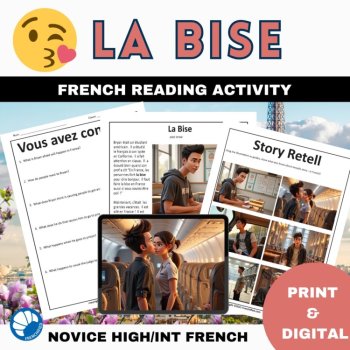
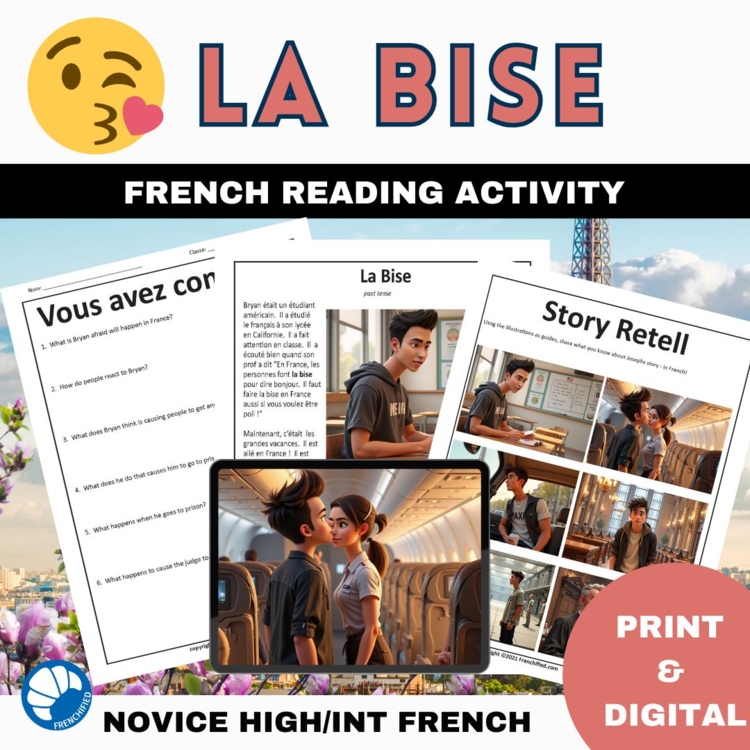
French reading Compréhension de Lecture and French culture short story La Bise
(20 ratings)$5.00
Add to cartThis Intermediate French short story is a reading comprehension activity that will allow your students to read a fun short story, entirely in French.
The story can be used early in second year (present tense) or later (past tense). It tells the story of a man who doesn't understand the importance of knowing when to use la bise.
Bryan is an American who is visiting France. He doesn't want to be rude, so he's prepared himself for the French custom of La Bise. But unfortunately, he didn't listen to the entire explanation in French class! Bryan's trip starts out fine, but his cultural misunderstandings get him into more and more trouble.
This activity packet includes two versions of the 4 page story - both versions include comprehension questions and other activities. One version is in the present tense and the other is in the past tense (passé composé and imparfait). Also includes a map about La Bise with questions and an infographic about French prisons (a topic that comes up in the reading) with comprehension questions. This activity can be read as a class, independently, or as a sub activity.
The print version includes:
The Google™ drive item includes:
Click HERE to join my mailing list and get a free article about adapting a textbook to CI!
Report this resource to Linked Through Learning
Reported resources will be reviewed by our team. Report this resource to let us know if this resource breaks our rules.
“La bise is a great review of la bise and other social norms in France. Students had thoughtful conversations after reading.”
“A little bit challenging for the students, but overall it went well and the students found it informative. Merci!”
4.8
20
ratings
I found it odd the text was in French and the questions in English.
Reply from Frenchified
Thank you for your feedback. The questions are in English so that you can be sure that students understood the story rather than just copying what is written in the story as their answer. It's also done to isolate the data - if they can't answer a question, you don't know for sure if it's because they didn't understand the story, or if they didn't understand the question, or they don't know how to write the answer in French. By asking and answering in English, you know that they understood the question and they know how to write a response - so they must not understand the French text in the story if they can't answer.
Trisha P.
Grades taught: 9th, 6th, Higher
No questions yet.

Meet the Seller
I have been happily married for 31 years, with three adult children who are currently in college. I'm a language, travel and music person. Languages studied: French, Russian, Spanish, Polish, German, Serbo-Croatian, Italian. Instruments I've dabbled in: Clarinet, cello, flute, oboe, bassoon, saxophone, trumpet, piano, viola da gamba, bagpipes. Countries I've visited: Canada, Mexico, Ireland, England, Poland, Slovakia, Germany, Italy, France, Austria, Netherlands.
Arizona
AI Assisted
I develop the ideas, plan the activities, and guide the creation of all resources. AI tools assist with writing, illustrations, and design. Every resource is reviewed, edited, and refined using my teaching experience to ensure quality, accuracy, and meaningful real-world learning.
$6.38 $7.98

AI Assisted
I develop the ideas, plan the activities, and guide the creation of all resources. AI tools assist with writing, illustrations, and design. Every resource is reviewed, edited, and refined using my teaching experience to ensure quality, accuracy, and meaningful real-world learning.
$7.60 $9.50

AI Assisted
I develop the ideas, plan the activities, and guide the creation of all resources. AI tools assist with writing, illustrations, and design. Every resource is reviewed, edited, and refined using my teaching experience to ensure quality, accuracy, and meaningful real-world learning.
$5.60 $7.00

AI Assisted
I develop the ideas, plan the activities, and guide the creation of all resources. AI tools assist with writing, illustrations, and design. Every resource is reviewed, edited, and refined using my teaching experience to ensure quality, accuracy, and meaningful real-world learning.
$5.60 $7.00

AI Assisted
I develop the ideas, plan the activities, and guide the creation of all resources. AI tools assist with writing, illustrations, and design. Every resource is reviewed, edited, and refined using my teaching experience to ensure quality, accuracy, and meaningful real-world learning.
$6.56 $8.20
AI Assisted
I develop the ideas, plan the activities, and guide the creation of all resources. AI tools assist with writing, illustrations, and design. Every resource is reviewed, edited, and refined using my teaching experience to ensure quality, accuracy, and meaningful real-world learning.
$7.60 $9.50