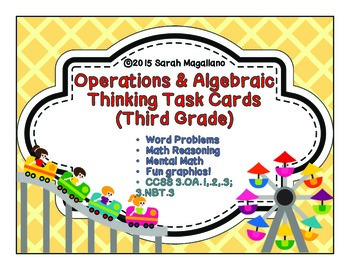
Third Grade Operations & Algebraic Thinking Math Task Cards

$3.75 (2)

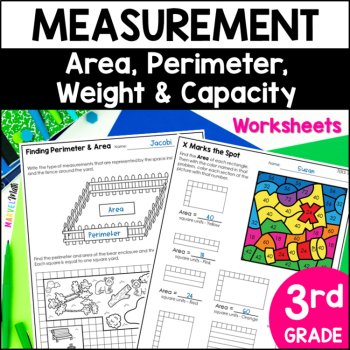
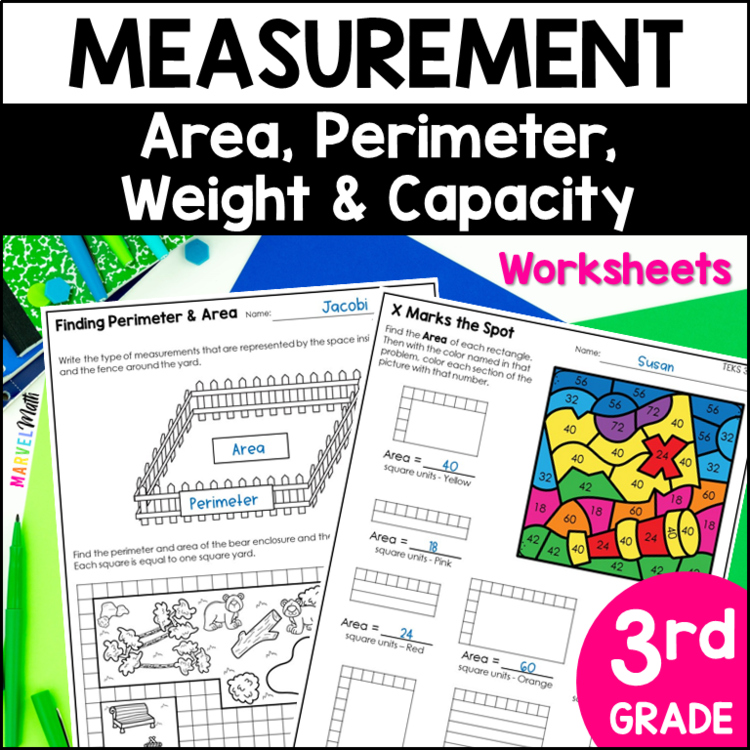
3rd Grade Area and Perimeter Worksheets, Capacity and Weight Worksheets
(5 ratings)$4.00
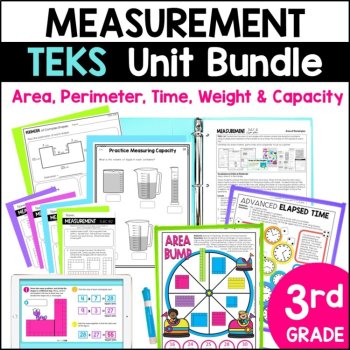
Add to cartNo Prep Area and Perimeter Worksheets plus Capacity and Weight worksheets? Yes, please! Give your students the fun and engaging measurement practice they need with fun worksheets and a hands-on Area Project. The worksheets give your students a huge variety of area and perimeter practice, including area of combined rectangles and find the missing side perimeter problems. Students will also practice measuring and selecting between units for capacity and weight.
What's Included:
Great ways to use these 3rd Grade Measurement Worksheets:
3rd Grade Measurement Topics include:
Standards Alignment:
TEKS
3.6C: Determine the area of rectangles with whole number side lengths in problems using multiplication related to the number of rows times the number of unit squares in each row.
3.6D: Decompose composite figures formed by rectangles into non‐overlapping rectangles to determine the area of the original figure using the additive property of area.
3.7B: Determine the perimeter of a polygon or a missing length when given perimeter and remaining side lengths in problems.
3.7D: Determine when it is appropriate to use measurements of liquid volume (capacity) or weight.
3.7E: Determine liquid volume (capacity) or weight using appropriate units and tools.
Common Core
3.MD.A.2: Measure and estimate liquid volumes and masses of objects using standard units of grams (g), kilograms (kg), and liters (l). Add, subtract, multiply, or divide to solve one-step word problems involving masses or volumes that are given in the same units, e.g., by using drawings (such as a beaker with a measurement scale) to represent the problem.
3.MD.C.5: Recognize area as an attribute of plane figures and understand concepts of area measurement.
a. A square with side length 1 unit, called “a unit square,” is said to have “one square unit” of area, and can be used to measure area.
b. A plane figure which can be covered without gaps or overlaps by n unit squares is said to have an area of n square units.
3.MD.C.6: Measure areas by counting unit squares (square cm, square m, square in, square ft, and improvised units).
3.MD.C.7: Relate area to the operations of multiplication and addition.
a. Find the area of a rectangle with whole-number side lengths by tiling it, and show that the area is the same as would be found by multiplying the side lengths.
b. Multiply side lengths to find areas of rectangles with whole-number side lengths in the context of solving real world and mathematical problems, and represent whole-number
products as rectangular areas in mathematical reasoning.
d. Recognize area as additive. Find areas of rectilinear figures by decomposing them into non-overlapping rectangles and adding the areas of the non-overlapping parts, applying
this technique to solve real world problems.
3.MD.D.8: Solve real-world and mathematical problems involving perimeters of polygons, including finding the perimeter given the side lengths, finding an unknown side length, and exhibiting rectangles with the same perimeter and different area or with the same area and different perimeter.
___________________________________
Copyright © Marvel Math
Permission to copy for single classroom use only.
Please purchase additional licenses if you intend to share this product.
Report this resource to Linked Through Learning
Reported resources will be reviewed by our team. Report this resource to let us know if this resource breaks our rules.
“My students enjoyed learning while practicing math skills with this resource. Thanks!”
“I love Marvel Math resources. The activities provided are very engaging, and there are several to choose from.”
No reviews match. Try other filters.
No questions yet.
Meet the Seller
In addition to my work in education, I also run a STEM-based Christmas Light Show business. When I'm not creating new math resources or working with teachers, I'm designing and fabricating light shows sequenced to music with my husband and our team. That business came about after our family was featured on ABC's The Great Christmas Light Fight. My son attends the University of Texas, Austin and I'm currently soaking up every last minute with my daughter, a high school senior.
San Antonio, Texas
 Unlocking Potential Educational Services,LLC
$3.95
AI Assisted
The seller says AI was used in making this resource, but didn't add details.
Unlocking Potential Educational Services,LLC
$3.00