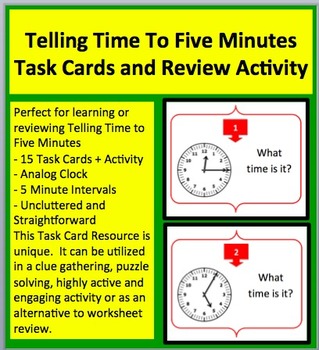
Telling Time to Five Mintues - Task Cards and Engaging Review Activity

$5.97

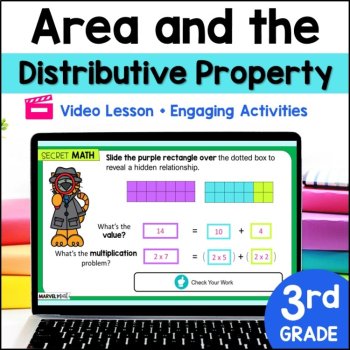
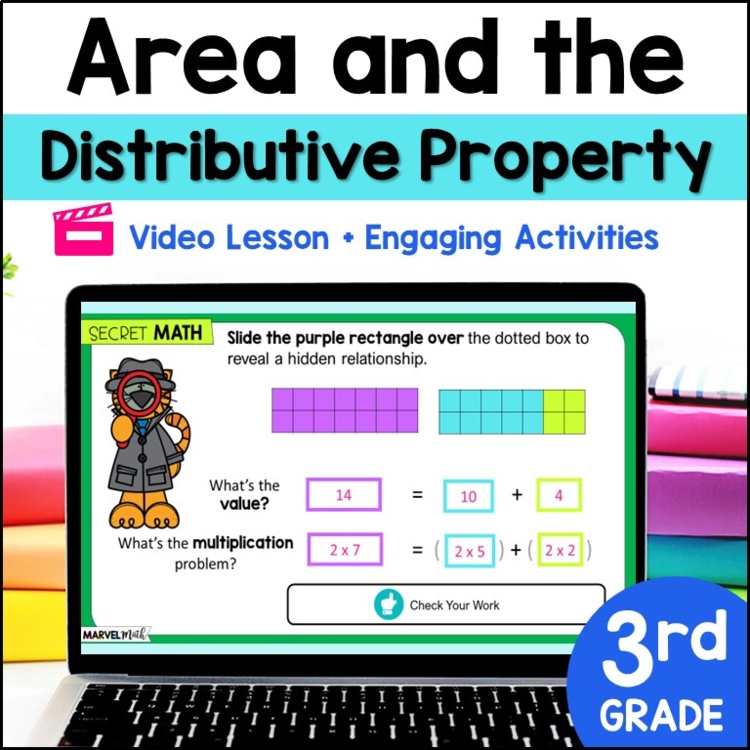
Area and Distributive Property Interactive Google Slides and Video Lesson
(108 ratings)$4.00
Add to cartYour students will love learning to use Area Models to represent the Distributive Property using the hands-on activities in these Google Slides. You will love the ready-made Video Lesson! This Area and Distributive Property resource is perfect to guide a whole class lesson or to use for math stations, review or tutoring. This Simple and Easy-to-Use lesson is designed for 3rd grade students and aligns to CCSS 3.MD.C.7c.
What Teachers are saying:
⭐⭐⭐⭐⭐ This product is fantastic for visualizing the distributive property. The instruction video was also wonderful and I love that it's self check. -Katrina M.
⭐⭐⭐⭐⭐ This resource is engaging and meaningful. It is well organized and prepared and easy for students to use!. -Amanda W.
The Video Lesson:
⭐Many of the slides are self-checking, so students can work through the activity with confidence.
Activities Include:
What's Included?
Standards Alignment
CCSS.3.MD.C.7c Use tiling to show in a concrete case that the area of a rectangle with whole-number side lengths a and b + c is the sum of a × b and a × c. Use area models to represent the distributive property in mathematical reasoning.
This is Lesson 6 in a comprehensive bundle that covers all the area topics your students need to learn.
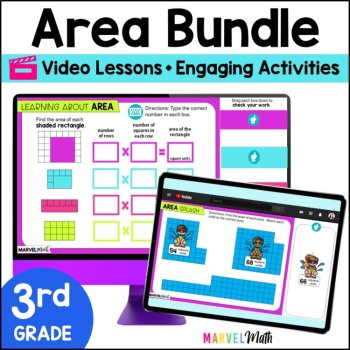
Save 30% on this resource by purchasing the Digital Area Bundle!
Lessons in the Digital Area Bundle Include:
Area Lesson 1: Understand the Concept of Area by filling Rectangles with Square Units
Area Lesson 2: Find Area by Multiplying the Number of Rows by the number of Unit Squares in Each Row
Area Lesson 3: Multiplying Whole Number Side Lengths to find Area
Area Lesson 4: Area of Composite Figures using Unit Squares
Area Lesson 5: Area of Composite Figures using Side Lengths
Area Lesson 6 *This Resource*: Use Area Models to Prove the Distributive Property
You may also be interested in this coordinating Perimeter Bundle.
Report this resource to Linked Through Learning
Reported resources will be reviewed by our team. Report this resource to let us know if this resource breaks our rules.
“This resource is very helpful but I was disappointment that there were no slides about distributive property process only.”
“This was a great independent practice to assign to my students.”
4.9
108
ratings
This TPT product is a great addition to my classroom! The activities are engaging, easy to follow, and align with grade-level standards. The clear layout and detailed instructions make it simple to use, and my students enjoy the interactive worksheets. It’s a fun and effective way to reinforce key concepts. Highly recommend!
Reading C.
Grades taught: 3rd
No questions yet.

Meet the Seller
In addition to my work in education, I also run a STEM-based Christmas Light Show business. When I'm not creating new math resources or working with teachers, I'm designing and fabricating light shows sequenced to music with my husband and our team. That business came about after our family was featured on ABC's The Great Christmas Light Fight. My son attends the University of Texas, Austin and I'm currently soaking up every last minute with my daughter, a high school senior.
San Antonio, Texas