
Description
Turn abstract counting into dynamic, full-body musical architecture! Extension 4: Kinesthetic Body Percussion Lab, Ensemble Scores & Rubrics bridges cognitive rhythm reading with gross-motor muscle memory, small-group collaboration, and objective standards-aligned assessment.
Whether you guide an authentic Montessori 6–9, 9–12, or 6–12 environment, direct an elementary general music classroom, or lead an ensemble in a homeschool cooperative, this turnkey movement lab provides structured, tiered performance activities that get students out of their seats while maintaining absolute rhythmic focus and acoustic control.
---
WHAT’S INCLUDED IN EXTENSION 4:
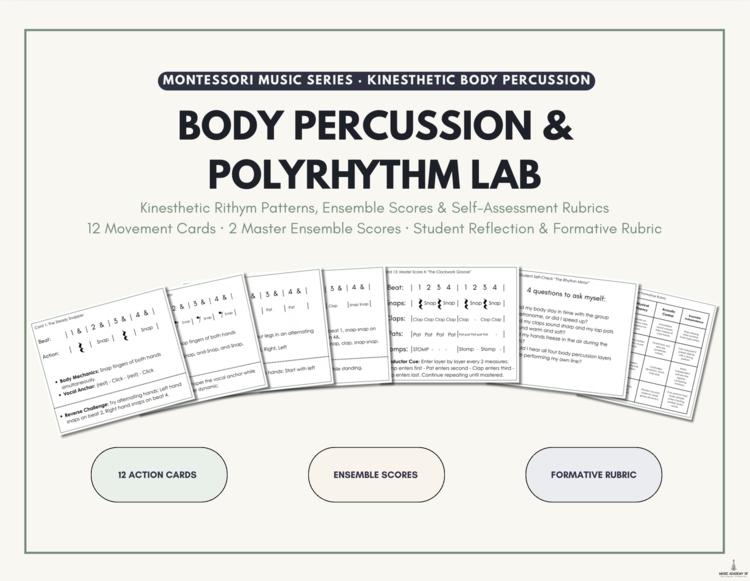
12 Step-by-Step Movement Action Cards: Physical execution cards systematically categorized across four somatic frequency registers:
- Level 1 (High Register): Finger Snaps & Hand Rubs
- Level 2 (Mid-High Register): Claps (Open Hand, Cup Claps, Finger Taps)
- Level 3 (Mid-Low Register): Pats / Patschen (Alternating and Simultaneous Thigh Taps)
- Level 4 (Low Register): Stomps, Floor Taps, and Heel Drops
• Built-In Vocal Anchors & Movement Challenges: Mnemonic vocal rhythm chants, contralateral crossover patterns, and dynamic swell indicators embedded on every action card.
• 2 Multi-Part Master Ensemble Scores: - Score A: "The Clockwork Groove" (4/4 Meter) — A 3-part interlocking polyrhythmic score layering whole, half, quarter, and beamed eighth durations across separate body tiers.
- Score B: "The Rainstorm Waltz" (3/4 Meter) — A delicate, dynamic ensemble piece contrasting silent rests with cascading body percussion timbres.
• "The Rhythm Mirror" Student Self-Assessment Sheet: A guided self-check reflection mat empowering students to critique their own somatic precision, ensemble listening, and metric accuracy independently.
• 4-Point Formative Teacher Observation Rubric: Comprehensive, standards-aligned scoring table with explicit criteria evaluating Physical Fluency, Acoustic Control, Ensemble Independence, and Metric Steadiness.
• Teacher Quick-Start & Group Facilitation Guide: Rehearsal workflows, spatial floor layouts, and sub-ready lesson plans.
---
WHY EDUCATORS LOVE THIS RESOURCE:
✔ Deep Kinesthetic Retention: By mapping higher rhythmic frequencies (eighth notes) to lighter sounds (snaps/claps) and baseline pulses (whole/half notes) to grounded movements (patschen/stomps), students physically internalize duration hierarchy.
✔ Autonomous Ensemble Work: Clear visual scores and independent action cards make this ideal for student-led small group rehearsals, Montessori peer lessons, and co-op performances.
✔ Zero Equipment Required: 100% acoustic body percussion—no instruments, mallets, tech setups, or complex cleanup needed.
✔ Sub-Ready & Classroom-Tested: Explicit vocal anchors and clean score layouts allow non-specialist substitutes to lead engaging, structured music lessons without hesitation.
✔ Objective Performance Evidence: The dual combination of student self-checks and 4-point teacher rubrics makes generating standards-based report card data effortless.
---
STANDARDS & CURRICULUM ALIGNMENT:
National Core Arts Standards (NCAS - Music):
- MU:Pr4.2 (Demonstrate understanding of the structure and elements of music including rhythm and meter in performance)
- MU:Pr6.1 (Perform music with appropriate technique, expression, and ensemble awareness)
- MU:Cr1.1 (Generate musical movement ideas within specified metric and temporal boundaries)
Common Core State Standards (CCSS Alignment):
- CCSS.ELA-LITERACY.SL.1.1, SL.2.1, SL.3.1, SL.4.1 (Collaborative ensemble discussions, following multi-step performance rules, and group execution)
- CCSS.MATH.CONTENT.3.NF.A.1 & 4.NF.B.3.A (Kinesthetic subdivision and proportional temporal fractions)
Texas Essential Knowledge and Skills (TEKS - Music):
- Creative Expression & Performance: 117.109(b)(2)(A), 117.115(b)(2)(A), 117.118(b)(2)(A) (Perform rhythmic patterns using body percussion in diverse meters)
- Critical Evaluation & Response: 117.109(b)(4)(A), 117.115(b)(4)(A) (Evaluate personal and ensemble musical performance)
Montessori Cosmic Education:
Kinesthetic Harmony, Ensemble Community (Grace & Courtesy in Collaboration), and Somatic-Temporal Integration.
---
EXPAND YOUR RHYTHM STUDIO:
This standalone resource is Extension 4 of the comprehensive Rhythm Values & Proportional Note Duration Curriculum. For tactile fraction duration strips, audio QR listening stations, musical math worksheets, and self-checking task cards, check out the complete Rhythm Values & Proportional Note Duration Bundle to save over 12%!
---
FILE FORMAT:
Delivered as an instant-download print-ready PDF formatted for standard 8.5" x 11" letter paper/cardstock.
© The Music Academy of Northwest Arkansas, LLC. All rights reserved.
Report this resource to Linked Through Learning
Reported resources will be reviewed by our team. Report this resource to let us know if this resource breaks our rules.
Questions & Answers
Sign in to ask a questionNo questions yet.

Meet the Seller
Music and Montessori resources for ALL
With a Bachelor of Music Education, I am a certified Music educator with experience in directing choirs (elementary, middle school, high school, and adult choirs), orchestra, theatre, band, and general music for ages 18 month-12th grade; and I am an AMS credentialed Montessori 6-12 guide with experience in both lower and upper elementary classrooms! With these two passions in mind, I want to make music and Montessori more accessible to all children! With extensive research in the importance of music in a child's cognitive development, and having presented at conferences on the subject, I am deeply passionate about bringing music into a child's everyday life! Welcome to the marriage of music and Montessori!
Bella Vista, Arkansas
- 0Followers
- A proud milestone in my teaching journey was presenting to fellow educators at a Montessori conference in St. Louis on the neurological power of music for neurodivergent learners. I shared research-backed methods to take the fear out of implementing the Montessori bells and demonstrated how any classroom—regardless of budget or access to traditional instruments—can become a thriving, joyful hub of musical exploration.