FREE Indigenous Animal Craft & Writing Activities | Native American Art Project

Free (9)

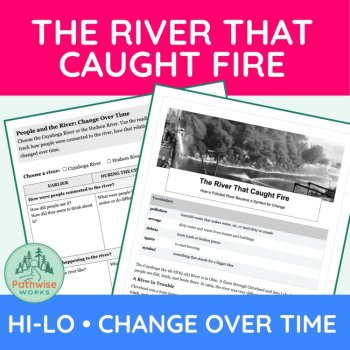
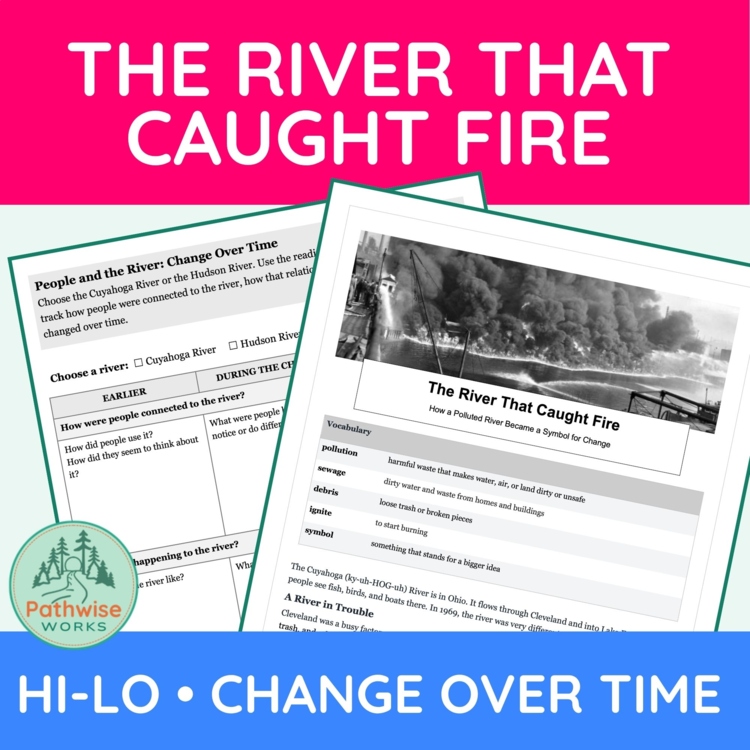
Looking for a hi-lo reading passage for older struggling readers that keeps the text accessible without lowering the level of thinking? The River That Caught Fire tells the true story of the Cuyahoga River, the 1969 fire, and how years of pollution, public attention, laws, and cleanup efforts helped change the river over time. The passage is written at approximately a Flesch-Kincaid 4.0*–4.6 level. If I don't include place names and the Environmental Protection Agency in the calculation, the reading level is 4.0. If those are included, it's 4.6.
This resource goes beyond a passage and comprehension questions. Students work with change-over-time text structure, evidence-based responses, scaffolded writing, word study, and optional video connections. Teachers can use the core reading as a short lesson or extend it into a multi-source study of how people’s relationship with a river changed over time.
What's Included
Hi-lo informational passage with vocabulary support
6 text-dependent reading comprehension questions
Two levels of scaffolded evidence-based writing support
Change Over Time graphic organizer
Two optional Watch & Connect video activities
Word work with morphology, spelling patterns, pronunciation, and vocabulary
Text-structure, signal word, and sentence-combining extensions
Teacher guide with flexible lesson pathways
The extension activities are built directly from the passage, so students can strengthen comprehension while also working with roots and affixes, comparative forms, word families, shades of meaning, signal words, chronological order, and sentence structure.
The optional Watch & Connect activities give students a second source for examining change over time. One video extends the Cuyahoga story and its recovery, while the other introduces Pete Seeger and the Hudson River, adding a broader connection to civic action and environmental change.
Use it for reading intervention, special education reading support, small-group instruction, or independent practice. Students do not need to complete every activity. Choose the pathway and supports that fit your instructional goal and your students’ needs.
Report this resource to Linked Through Learning
Reported resources will be reviewed by our team. Report this resource to let us know if this resource breaks our rules.
No questions yet.
$1.00 (154)
$3.25 (36)