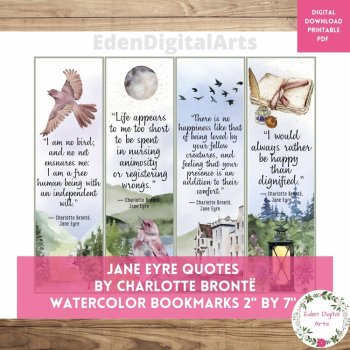
Jane Eyre Quotes Bookmarks, Charlotte Bronte Watercolor Book Club Cards Gift

$2.40

Before students meet Gatsby, Daisy, Tom, East Egg, or West Egg, give them a social system to navigate.
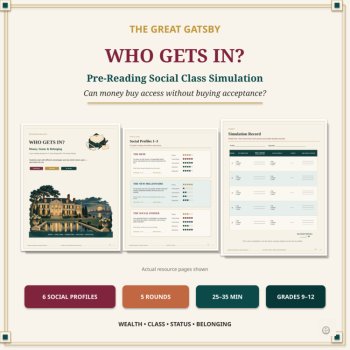
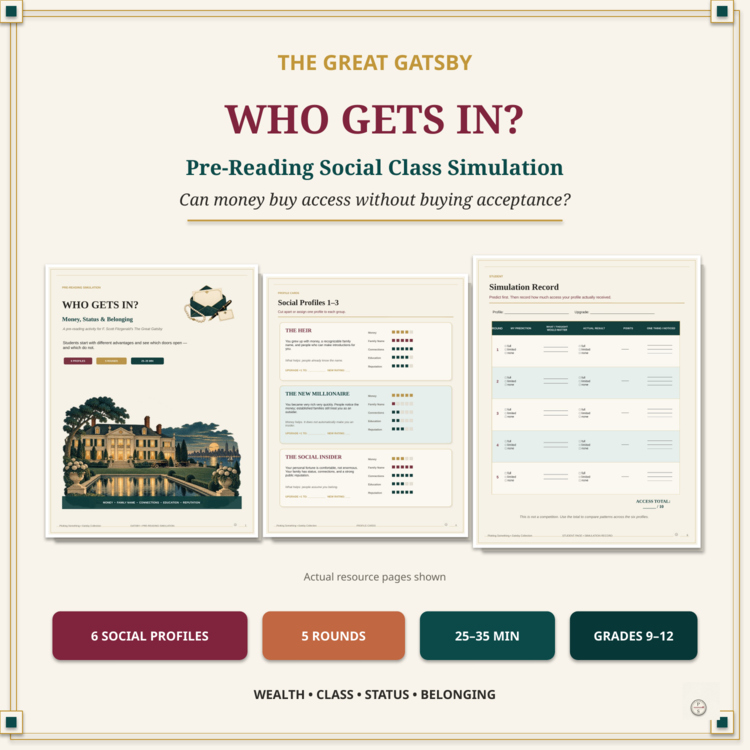
In Who Gets In?, students take on one of six fictional social profiles. Each profile begins with a different mix of money, family name, connections, education, and reputation. Students may improve one rating before the simulation begins, then move through five social situations in which different gatekeepers control access.
Students predict first. Then the rule is revealed.
A profile with plenty of money may still be shut out. A strong family name may matter more in one setting than another. Connections may open a door that education cannot. By the end, students have something concrete to discuss before the novel asks them to think about old money, new money, status, belonging, and the limits of social mobility.
WHAT STUDENTS DO
THE FIVE ROUNDS
Each round introduces a different social barrier. Students discover that wealth, inherited status, connections, education, and reputation do not carry equal weight in every situation.
WHAT'S INCLUDED
TWO PACING OPTIONS
25-minute version: Use three selected rounds with adjusted scoring and guided comparison. Ideal for shorter class periods or a focused introduction.
35-minute version: Complete all five rounds, compare access totals, and debrief the patterns students discovered.
Both versions include preparation and discussion guidance.
A NOTE ABOUT THE PROFILES
The fictional profiles intentionally leave race, gender, and ethnicity unspecified. Students do not need to invent these details or disclose anything about their own backgrounds. After reading the novel, students can consider the additional ways Fitzgerald's social world is shaped by race, gender, and other forms of power.
The simulation is a simplified model designed to generate questions and discussion, not a historical reconstruction of every social barrier of the 1920s.
WHEN TO USE IT
Use this activity immediately before beginning The Great Gatsby, before introducing East Egg and West Egg, or as a bridge into discussion of social class, wealth, reputation, status, and the American Dream.
Students do not need prior knowledge of the novel.
TEACHING THE WHOLE NOVEL?
When students are ready to move from questions of status and belonging into close character analysis, continue with my The Great Gatsby Character Analysis Mini-Unit | Literary Analysis & Writing.
WANT MORE PRE-READING SIMULATIONS?
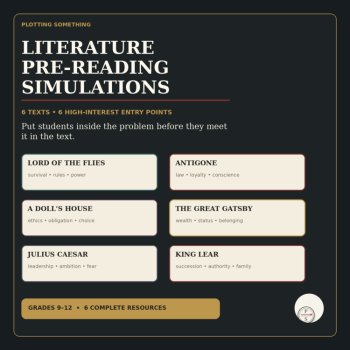
The Great Gatsby: Who Gets In? is also included in the Literature Pre-Reading Simulations Bundle, featuring six decision-based activities for major secondary texts.
These simulations encourage students to make decisions, examine consequences, and explore important themes before beginning their reading.
FILES INCLUDED
PowerPoint + PDF | Grades 9–12 | 22-page complete resource
Plotting Something • Secondary ELA
22-page complete resource
Plotting Something • Secondary ELA
Report this resource to Linked Through Learning
Reported resources will be reviewed by our team. Report this resource to let us know if this resource breaks our rules.
No questions yet.

Meet the Seller
Thoughtful Resources for Secondary ELA
Literature-rich lessons, engaging classroom activities, and thoughtfully designed teaching resources for secondary English teachers.
Pennsylvania