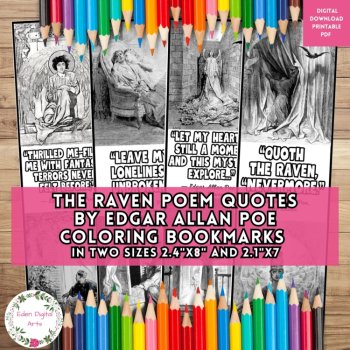
The Raven Quotes by Edgar Allan Poe Bookmarks to Color Book Marker Activity Gift

$2.40

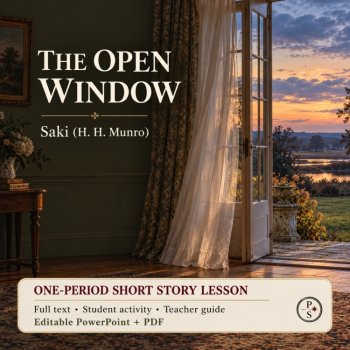
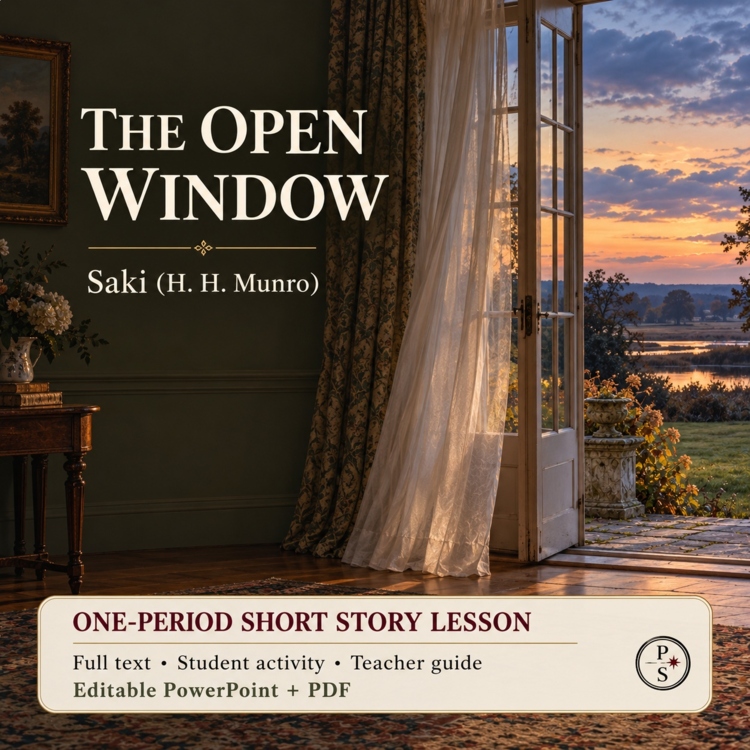
Teach Saki’s “The Open Window” in one class period without stopping the story to death. Students read the complete story straight through, briefly sort out the ending, and then go back to examine how Vera gets Framton to believe her. Includes the full public-domain text in a beautifully illustrated two-page reader, an editable teacher deck, a focused student activity, and a one-page teacher guide.
“The Open Window” is short, funny, a little cruel, and much better when students get to experience the ending before anyone explains the trick.
This one-period lesson is built around that idea.
Students begin with a quick question about what makes someone seem trustworthy, then read the full story straight through. The included two-page reader opens with an atmospheric illustration of an open French window and the countryside beyond. After the final line, students briefly make sure the ending is clear. Only then do they go back into the text to examine how Vera gets Framton to believe her.
The main activity keeps the work focused. Students trace what Vera does, find the evidence, and explain how each choice helps fool Framton. The lesson closes with Saki’s final line, a discussion of irony, and a short written response asking whether Vera is impressive, cruel, or both.
WHAT’S INCLUDED
• 5-slide editable teacher PowerPoint
• 2-page illustrated student reader with the complete public-domain story (editable Word + PDF)
• 1-page editable student activity (PowerPoint + PDF)
• 1-page editable teacher guide with pacing and answer notes (PowerPoint + PDF)
• PDF version of the teacher deck
LESSON FLOW
• Quick launch: What makes someone seem trustworthy?
• Read “The Open Window” straight through
• Brief reset: What actually happened?
• Return to the text and examine how Vera wins Framton’s trust
• Discuss the irony of the final line
• Short written response grounded in evidence
SKILLS & CONCEPTS
• Characterization
• Irony
• Point of view and limited knowledge
• Text evidence
• Author’s craft
• Twist endings
• Making and defending an interpretation
TEACHING TIME
One class period; approximately 35 usable instructional minutes.
BEST FOR
Grades 8–12; short story units; irony and characterization lessons; close reading; author’s craft; secondary ELA.
TEXT NOTE
The complete public-domain story is included in the illustrated student reader. Students do not need a separate anthology or text.
ANSWER SUPPORT
The teacher guide includes pacing, quick-reset answers, chart answer notes, guidance on defensible student interpretations, and directions to keep Slides 3–5 hidden until students finish reading.
FILE TYPES
Microsoft PowerPoint (.pptx)
Microsoft Word (.docx) — illustrated student reader
PDF
TOTAL INSTRUCTIONAL PAGES/SLIDES
Nine: five teacher slides, two illustrated reader pages, one student activity, and one teacher guide.
Teaching another classic suspense story?
The Monkey’s Paw Lesson | Gothic Suspense, Foreshadowing, Irony & Ambiguity
Want another twist-driven reading experience for older students?
For Use with Strawberry Spring by Stephen King | AP Lit Halloween Case File
Report this resource to Linked Through Learning
Reported resources will be reviewed by our team. Report this resource to let us know if this resource breaks our rules.
No questions yet.

Meet the Seller
Thoughtful Resources for Secondary ELA
Literature-rich lessons, engaging classroom activities, and thoughtfully designed teaching resources for secondary English teachers.
Pennsylvania