A post says the school is switching to snack-bar lunches next month. Four hundred students share it before the bell. Nobody signed it, no district is named, and there is no date it takes effect - and that is the whole lesson.
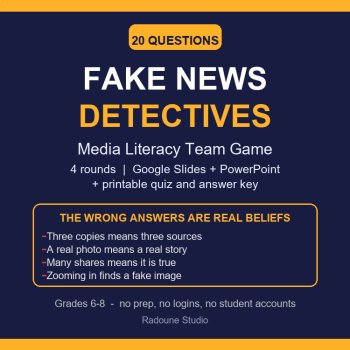
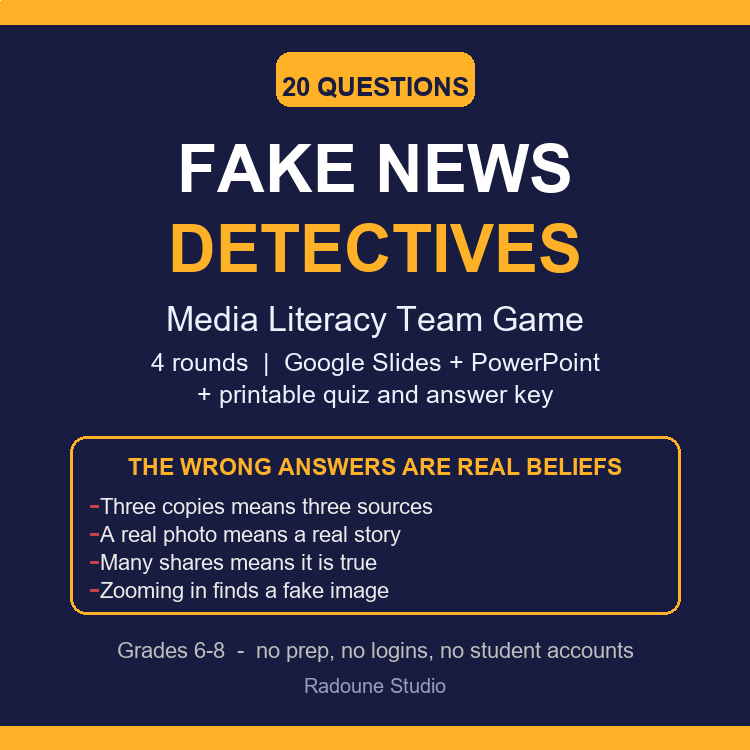
Fake News Detectives is a 20-question media literacy team game for grades 6-8, built the way students actually meet misinformation: a too-neat claim, a real photo under a false caption, a story with no byline, and the sixty seconds before they hit share. Every question offers four options, and three of them are beliefs your class already holds. The wrong answers are not silly - they are the tells that genuinely fool kids, which is why the reveal page, not the score, is where the teaching happens.
The four rounds
Round 1 - Spot the Made-Up Story: claims that are too tidy, too fast, or too nameless to check.
Round 2 - That Photo Is Lying: real pictures carrying false sentences, and what a photograph can actually prove.
Round 3 - Who Says So? following the byline, the funding, and the oldest version of a story instead of the loudest.
Round 4 - Before You Share: the two checks that stop a spread rather than feed it.
What you get
52-slide editable deck in both Google Slides and Microsoft PowerPoint - project it and run the whole game.
The same 20 questions as an 8-page printable quiz in Letter and A4, for a quiet round, a substitute day, or a student who was absent.
A full answer key: the best answer, why it wins, the trap in each distractor, and a one-line teaching note per question.
Team answer sheets, a scoring guide, four wildcard prompts, five tie-breakers and three exit reflections.
A plain-English README with the Google Drive import steps and five ways to run it.
Five ways to run it in a real week
Team huddle - one shared answer per question, teams hold it up; only the best answer scores.
Stand-up vote - four corners are A, B, C, D; students move, then one defends their corner.
Quiet round - hand out the printable, run it like a quiz, then reveal the deck answer by answer.
Speed round - Round 4 against a 45-second timer, no talking inside the team.
Reverse it - give a team a true headline and have them write the believable fake; the tells they invent are the tells they will now spot.
Scoring is short and fair: 2 points for the best answer, 1 bonus point for naming the trap option, each round capped at 10, so the game is out of 40 and a close match stays close to the last slide.
Prep: upload, project, play. No logins, no student accounts, no website to whitelist, no assignment setup. One 45-55 minute class, or one round a week as a bell ringer. It also works as a no-prep sub plan for ELA, media literacy, digital citizenship and advisory.
Edit it to your class: every slide is editable. Swap the example posts for the claims your students actually saw this week and keep the four-option shape - the deck still runs itself. Score bands and team names are editable too.
About the content: the posts, brands, schools and people in the scenarios are fictional; the recycled-photo, no-byline and fake-study patterns are the ones that come back every year. Nothing in the game asks a student to judge a story by how it looks, so no answer depends on unreliable tricks like counting likes or trusting a date stamp. The checks taught here are the ones that still work next year, on platforms that do not exist yet.
License: one classroom, unlimited students and years. The printable quiz and answer key may be photocopied for your students. Not for public website hosting or resale.
More from this shop: Internet Safety Quiz - Digital Footprint Activity - Phishing Lab - AI Bias Detective Task Cards - Review Bingo Kit.