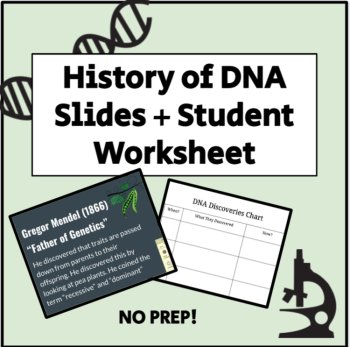
History of DNA Slides + Student Worksheet
 Ms Kiaras Science Teacher Shoppe
$4.00

This 7 Characteristics of Living Things lesson introduces students to the major characteristics shared by living organisms in a clear, student-friendly way This middle school life science lesson builds understanding without overwhelming learners. Students examine familiar examples—including plants responding to light, sweating and panting, dormant seeds, viruses, fire, and peppered moths—to understand how scientists determine whether something is alive.
Students are introduced to cells, cellular organization, energy use, response to stimuli, growth and development, reproduction and heredity, homeostasis, waste removal, adaptation, and evolution at both a basic and application level. Using diagrams, real-world examples, and thought-provoking cases, students learn that no single characteristic defines life. Instead, scientists look for several characteristics working together as part of a living system.
In Order, the Lesson Covers:
Included in the Lesson Package:
✅ Clear Overview: Cells, energy use, stimuli, growth, reproduction, homeostasis, waste removal, heredity, and evolution are explained in accessible language.
✅ Interactive Lesson: Students are encouraged to predict, discuss, and explain examples such as why a plant bends toward light and whether a dormant seed should be considered alive.
✅ Conceptual + Real-World Focus: Students connect characteristics of life to familiar examples including sweating, dogs panting, plant growth, reproduction, waste removal, dormant seeds, and peppered moth evolution.
✅ Critical Thinking: Students examine tricky cases such as viruses and fire and learn why displaying one life-like characteristic is not enough to classify something as living.
✅ Classroom Ready: This presentation works well for introducing the characteristics of living things, whole-class instruction, review, or reinforcing a life science unit.
⭐️⭐️⭐️⭐️⭐️ One of the major goals of this lesson is to move students beyond simply memorizing a list of characteristics. Students see how the characteristics work together and apply what they learn to examples that are not always obvious. A dormant seed may appear inactive, a virus contains genetic material, and fire can grow and use energy—but students must consider the complete evidence before deciding whether something is living.
⭐️⭐️⭐️⭐️⭐️ The lesson also clearly distinguishes between changes that happen to an individual organism and changes that occur in populations across generations. The peppered moth example gives students a visual way to understand how inherited traits can become more common through natural selection.
The student version of the presentation contains multiple blanks that need to be filled in throughout the lesson. These blanks are conveniently underlined and bolded on the teacher copy. I have found this to be the most effective means of keeping my students engaged and active without having them write everything out. This also leaves more time for discussion and activities.
Google and Distance Learning Ready
Having both options allows you to use either without worrying about formatting issues as all the work has already been done for you. It safeguards you in case your department or school decides to go Google 100% and allows you as well as your students to access everything no matter where you are or what kind of equipment is being used.
____________________
I also have a range of assignments and lessons/units from other grade levels at my store. Please CLICK HERE to have a look around and don’t forget to follow if you like what you see.
Report this resource to Linked Through Learning
Reported resources will be reviewed by our team. Report this resource to let us know if this resource breaks our rules.
No questions yet.

Meet the Seller
Middle and High School Science Engaging Resources
I have been selling resources to middle and high school teachers for the last 15 years. During that time I've also been in the classroom so I know what works and what will help your students the most.
Canada