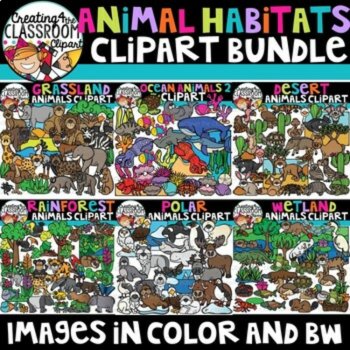
Animal Habitats Clipart MEGA Bundle – 6 Sets

$32.50 $50.00 (398)

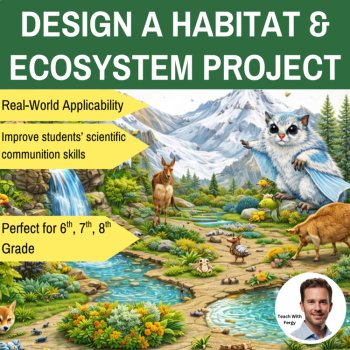
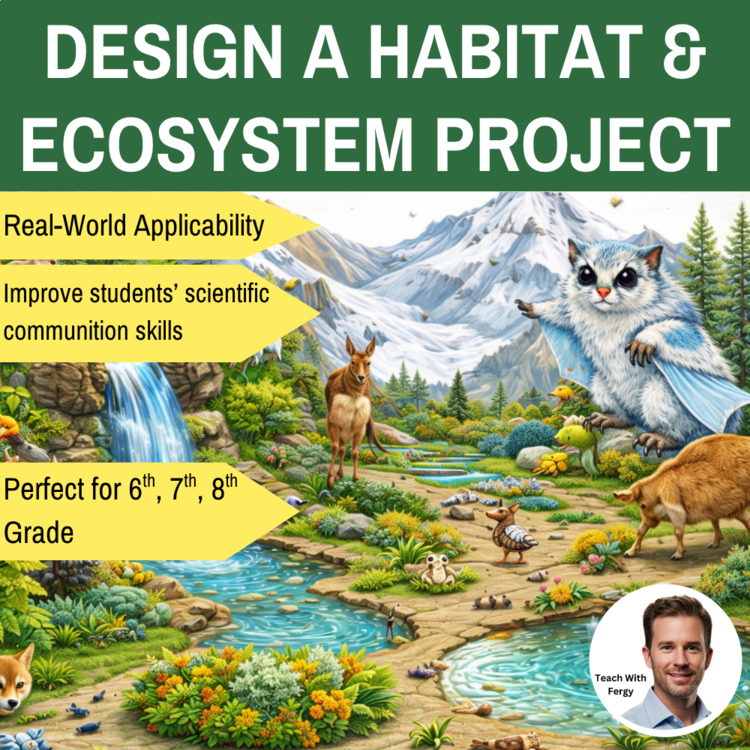
In this project, your students will explore how habitats support life and how organisms are specially adapted to survive in different environments. Students will design their own habitat, create 10 unique organisms with specific adaptations, and investigate how living and non-living factors interact to form a functioning ecosystem. They will also examine how energy flows through ecosystems by building a food web and analyzing relationships between organisms.
Students will demonstrate their understanding by designing a complete ecosystem project that includes a habitat model, adapted organisms, written explanations, and a food web. They apply scientific concepts to explain how organisms survive, interact, and depend on one another. Using evidence from their designs, students communicate how ecosystems function and how changes can impact stability.
Students then extend their learning through a Human Impact & Ecosystem Change Investigation, where they analyze how factors like climate change, pollution, invasive species, or habitat destruction affect their ecosystem. They modify their food web and use CER (Claim, Evidence, Reasoning) to explain ecosystem changes and impacts.
Habitat & Ecosystem Project Highlights
✅ Real-World Science Connection: Students explore how ecosystems function and how organisms survive in different environments.
✅ Creative, Student-Driven Learning: Students design habitats and organisms, promoting engagement and ownership.
✅ Cause-and-Effect Focus: Emphasizes how changes in ecosystems impact populations and stability.
✅ Science Communication: Students explain scientific ideas through writing, visuals, and models.
✅ Standards-Aligned: Supports NGSS ecosystem standards with modeling, explanation, and reasoning.
Key Topics Explored
This project offers an engaging, hands-on way for middle school students to explore ecosystems through creativity, design, and scientific reasoning. It promotes critical thinking and problem-solving while reinforcing core life science concepts through application and modeling.
The project is fully adaptable for different classroom settings and includes structured instructions, clear expectations, student exemplars, and detailed rubrics. Students build both scientific understanding and communication skills while completing a meaningful, standards-based task.
NGSS Ready
MS-LS2-1 – Analyze and interpret data to provide evidence for the effects of resource availability on organisms and populations.
MS-LS2-3 – Develop a model to describe the cycling of matter and flow of energy among living and nonliving parts of an ecosystem.
Report this resource to Linked Through Learning
Reported resources will be reviewed by our team. Report this resource to let us know if this resource breaks our rules.
No questions yet.

Meet the Seller
Middle and High School Science Engaging Resources
I have been selling resources to middle and high school teachers for the last 15 years. During that time I've also been in the classroom so I know what works and what will help your students the most.
Canada
$32.50 $50.00 (398)
$22.50 $34.50 (169)