Midnight approaches in Hallowbrook, and the town’s Lantern of Wards is flickering. To keep prankster spirits from short-circuiting Halloween, we must fuel the lantern with treats that have enough Treat Heat—the real, measurable energy hidden inside candy.
You are the Order of the Calori-mancers. Your mission: test different Halloween candies to discover which one packs the most usable energy per gram. Using a safe cauldron calorimeter, you’ll capture heat from a tiny, controlled burn and track the temperature rise.
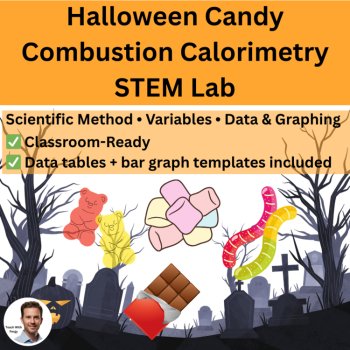
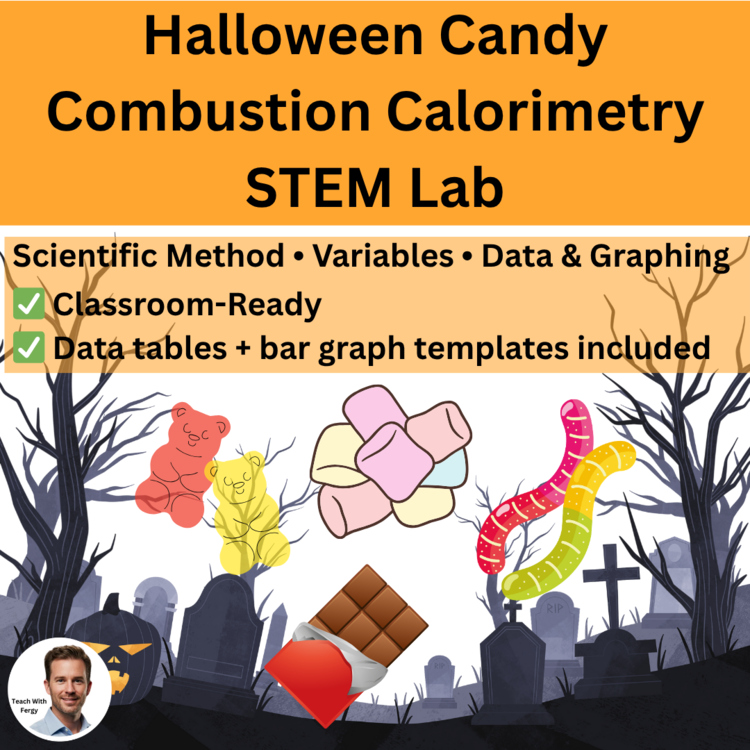
Turn Halloween treats into a rigorous calorimetry and energy conservation investigation. Students burn a small candy sample under a soda-can calorimeter, measure the water’s temperature change, calculate q = m·c·ΔT, and estimate energy per gram (J/g and kcal/g)—then argue from evidence which halloween candy has the most energy.
You can also find this activity at a discount inside my - Halloween Science Activities and Investigations Growing Bundle.
What students do
- Identify IV, DV, and controls and write a testable hypothesis
- Follow a step-by-step procedure to conduct replicated trials
- Measure mass (initial/final), Tᵢ/Tf, ΔT, and compute q and kcal/g
- Create a bar graph (Candy Type vs Energy per gram) with labeled axes/units
- Complete analysis questions on heat loss pathways, method differences, and comparison to ~4 kcal/g for sugar
- Write a CER that uses conservation of energy to explain results
What you get
- Teacher Guide: Setup checklist, materials, safety/ignition protocol, timing/roles; background on combustion, heat transfer (q = m·c·ΔT), and conservation of energy; quick troubleshooting.
- Student Packet: Driving question, hypothesis template, variables table (IV/DV/controls), and a numbered, step-by-step procedure for fair tests and repeats.
- Data Tables: Trial logs for mass (initial/final), water volume, Tᵢ/Tf, ΔT, with spaces for averages and quick notes.
- Calculations & Graph Page: Structured prompts for q = m·c·ΔT, J/g ↔ kcal/g conversions, and a bar-graph template (Candy Type vs Energy per gram).
- Analysis + Model Answers: Focused questions on energy losses, procedural differences, comparison to ~4 kcal/g sugar value, and an exemplar CER; concise answer key.
- Simple Rubric: Single-point rubric with 4 performance levels for Safety/Setup, Design & Procedure, Data Quality, Calculations/Units, Graphing, and Analysis/CER.
Materials needed
- Aluminum soda-can calorimeter + stand (or ring stand)
- 100 mL water (≈100 g), thermometer
- Balance (0.01 g preferred), small candy samples (mini marshmallow, hard candy, sugar cube, chocolate mini), small foil tray
- Wire/paperclip holder, heat-resistant tray or tile, tongs/forceps
- Goggles for all students; lighter/matches (teacher-only), fire blanket/extinguisher
Timing & prep
- Prep: 10–15 minutes (set out cans, water cups, thermometers, balances, trays)
- Class time: 45–70 minutes (intro/safety 5, measurements 25–35, calculations/CER 10–15, debrief 5)
- Cleanup: 5–10 minutes (cool apparatus; discard residue; rinse/dry)
Why teachers love it
- High-engagement seasonal hook (Halloween candy) with real chemistry math
- Clear, copy-ready handouts—minimal prep, low-cost materials
- Strong alignment to data literacy (units, significant figures, graphing) and CER
- Works in one period; easy to scale for honors or general chemistry
I also have the following STEM Labs in My Store:
- Blow Cup Challenge STEM Lab
- Paper Table STEM Lab
- Pendulum STEM Lab
- Parachute STEM Lab
- Catapult STEM Lab
- Paper Airplane - Angle of Attack STEM Lab
- Bottle Flip STEM Lab
- Paper Helicopter STEM Lab
- Yeast Balloon STEM Lab
- Ghost Balloon STEM Lab
- Candy Combustion Calorimetry STEM Lab
NGSS alignment
- HS-PS3-1/4: Energy conservation; energy transfer and temperature change
- Science & Engineering Practices: Planning & Carrying Out Investigations; Analyzing & Interpreting Data; Using Mathematics & Computational Thinking; Engaging in Argument from Evidence (CER)
- Crosscutting Concepts: Energy & Matter; Cause & Effect