Animal Habitats Clipart MEGA Bundle – 6 Sets
$32.50 $50.00 (398)

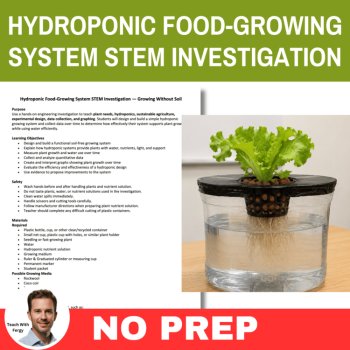
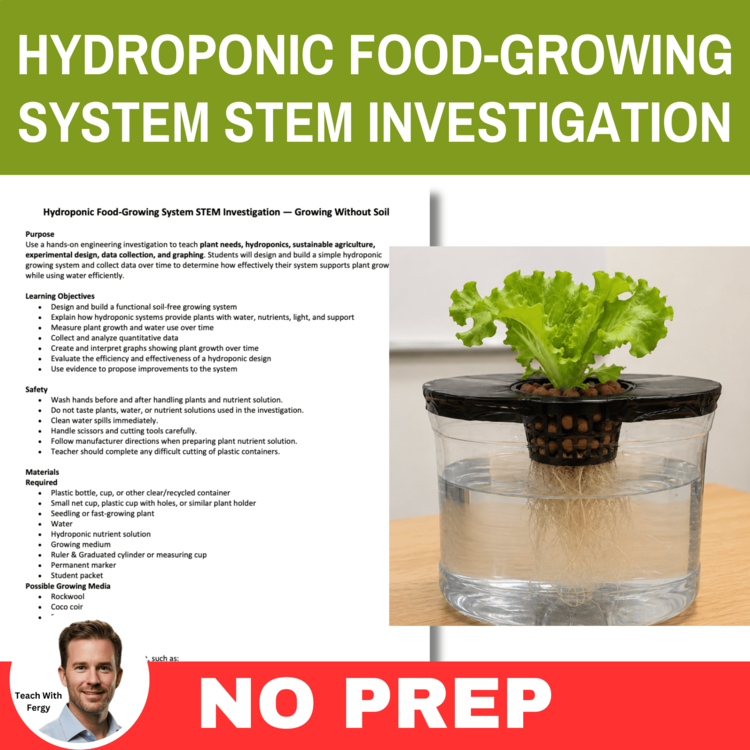
Students will investigate hydroponics, plant growth, and sustainable food production by designing and building their own soil-free food-growing system. Using a simple reservoir, nutrient solution, growing medium, and fast-growing plant, students explore how plants can receive the water and nutrients they need without traditional soil.
Over a 10–14 day investigation, students measure plant height, track water use, observe plant health, and evaluate how effectively their hydroponic system supports growth while conserving water. Through engineering design, quantitative data collection, graphing, analysis questions, and a structured Claim–Evidence–Reasoning (CER) response, students connect plant biology to real-world sustainability and agricultural engineering.
Learning Targets
What’s Included
Teacher Guide
Background explanations of hydroponics, plant needs, water efficiency, and sustainable agriculture. Includes safety notes, suggested plant and growing-medium options, implementation guidance, expected results, and common classroom pitfalls with practical fixes.
Student Packet
Driving question, hypothesis prompt, variables chart, engineering design plan, step-by-step system setup instructions, plant-growth and water-use data tables, plant observation prompts, graphing task, analysis questions, and a guided CER response.
Data Collection & Graphing
Students measure plant height and water use at scheduled intervals throughout the investigation. They create a line graph of Plant Height vs Time and analyze patterns in plant growth and system performance.
Analysis & Answer Key
Sample growth and water-use data, expected patterns, detailed analysis-question responses, scientific explanations, common sources of error, and a complete model CER connecting plant growth, hydroponics, and water efficiency.
Rubric
Assesses engineering design, variables and controls, procedure, data collection, plant observations, graphing, scientific understanding, sustainability, CER writing, design improvements, collaboration, and safety.
What Students Will Learn
Why Teachers Love It:
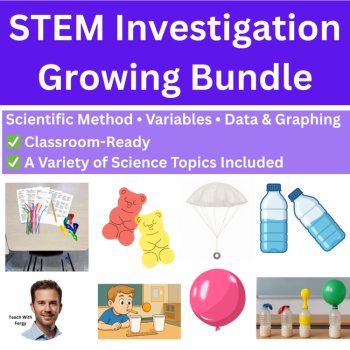
➡️ You can get this STEM as well as all my other ones in this series inside my STEM Investigations Growing Bundle. As more labs are added, the price will increase. CLICK HERE to have a look
Best For
Life Science (plant growth and plant needs), Environmental Science, sustainability, agriculture, engineering design, data collection, graphing, CER writing, STEM challenges, or project-based learning.
Materials Needed
Plastic bottle, cup, or other container; small net cup or plastic cup with holes; fast-growing seedling such as lettuce or basil; water; hydroponic nutrient solution; growing medium such as rockwool, coco coir, perlite, clay pebbles, or sponge; ruler; graduated cylinder or measuring cup; permanent marker; student packet (included).
Estimated Timing
Day 1: Design → build → setup → initial measurements
Days 3, 5, 7, 10 & 14: Plant-growth and water-use measurements
Allow approximately 10–20 minutes on each data-collection day, with additional time at the end for graphing, analysis questions, CER writing, and design evaluation.
➡️ You can get this activity inside my STEM Investigations Growing Bundle.
I also have the following STEM Labs in My Store:
NGSS Alignment
MS-LS1-5 — Construct a scientific explanation based on evidence for how environmental factors influence the growth of organisms.
MS-ETS1-1, MS-ETS1-3 — Define the criteria and constraints of a design problem and analyze data from tests to determine similarities and differences among solutions.
Assessment
Use the included rubric to score engineering design, variables and controls, procedure, data collection, graphing, scientific understanding, sustainability connections, CER strength, design improvements, collaboration, and safety.
Report this resource to Linked Through Learning
Reported resources will be reviewed by our team. Report this resource to let us know if this resource breaks our rules.
No questions yet.

Meet the Seller
Middle and High School Science Engaging Resources
I have been selling resources to middle and high school teachers for the last 15 years. During that time I've also been in the classroom so I know what works and what will help your students the most.
Canada
$32.50 $50.00 (398)
$22.50 $34.50 (169)