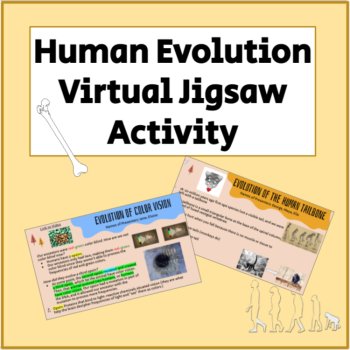
Human Evolution Virtual Jigsaw Activity
 Ms Kiaras Science Teacher Shoppe
$4.00

Light and its Production Complete 5E Lesson Bundle | Electromagnetic Spectrum
$19.48 $14.97
Get BundleLight and its Production - Fully editable and Complete 5E Lesson. By purchasing this bundle you will save 54% vs. purchasing the individual components separately.
**If you'd like to watch a VIDEO PREVIEW of this resource, CLICK HERE.**
Lesson Objectives:
Throughout this 5E lesson, students will
• Investigate the properties of light
• Learn about how light is created
• Be able to identify and define key terms related to light and its production
• Understand the basics behind key phenomena related to light including why the sky is blue, how prisms work, and the reason behind color blindness
• Gain an understanding of the electromagnetic spectrum as well as luminous and nonluminous objects
• Overcome many misconceptions they would otherwise bring with them into adulthood
My Promise to You
I know every classroom is different. If you purchase a resource and feel it is not the right fit for your students, contact me and I’ll provide 2x the amount you paid in store credit toward another resource in my store, so you can find something that better supports your students.
Buyer Comments:
- "Great introduction for my astronomy class as we went into EM spectrum"
- "I found this lesson unit extremely helpful. It was detailed and with enough information to teach the children but also to refresh the teacher's memory who has not covered this information in a while. I would like to make a special note about the student activity involving the refraction of light in a cup with a penny on the bottom filled with water. This activity sparked interest even in the most disengaged of students. I would recommend buying this product."
****************If you'd like to save some money, please consider my 5E Mega Bundle. By purchasing it, you'll save 77% compared with purchasing each 5E lesson individually. CLICK HERE to have a look
****************
How does the 5E model facilitate learning?
• It emphasizes inquiry, critical thinking, and the process of science
• Its success is backed by countless scientific studies that demonstrate its effectiveness
• It’s built around the idea that humans construct knowledge and meaning from their learning experiences. That they build upon their prior knowledge and to be effective, learning needs to be active and allow the participants to construct new knowledge from their experiences
----------------------------------
What's included?
Engagement Phase
- This could involve a short video with probing question or a discussion based around current events, common misconceptions, etc.
- Creates interest and excitement for your students
- Asks questions and probes their initial conceptions
- In this bundle, your students will begin by answering inquiry and comprehension questions to get them engaged in the topic
Exploration Phase
- Students use and develop creative thinking skills, make observations, record results, and make connections
- This bundle comes with a 7-station, Lab Activity where they will gain real experiences with the topic
**Note: The lab station activity requires very little preparation or materials**
- For a complete description of the lab station activity, please see below
Explanation Phase
- This is the instructional phase where concepts are presented to the students in a clear and applicable way
- Students develop understanding of the content
- Observations and experiences are discussed and critiqued
- Students develop vocabulary
- Students are able to connect the content presented to previous experiences
- This bundle includes TWO lessons in PowerPoint and .PDF formats. For a complete description of each, please see below
Elaborate Phase
- This phase involves the students completing an activity or assignment that forces them to expand their thinking and knowledge of the topic. They will propose solutions and extend their learning to new situations
- This bundle includes a reading article titled "Why is the Sky Blue?"
**Note: This activity requires no preparation or materials**
- For a complete description of the activity, please see below
Evaluate Phase
- Your students' will demonstrate their understanding and evaluate their own progress
- This phase involves the students completing an activity or assignment that forces them to expand their thinking and knowledge of the topic. They will propose solutions and extend their learning to new situations
- The evaluation section includes a quiz that will allow you to evaluate your students' understanding
------------------------------------------------------------
The NRC's How People Learn has synthesized decades of research across many different disciplines about how people learn (NRC, 1999 blue right-pointing triangle). Key findings from that synthesis include the following. First, students (people) must be interested and engaged in what they are learning and find it useful and meaningful. Second, students (people) must be actively involved in the process of teaching and learning, comparing new information to previous ideas, constructing new understandings, and quite simply changing their own minds about how the world works. And third, students (people) need opportunities to apply what they have learned to new situations, to check the completeness of their understanding, and to evaluate their own learning for themselves. (https://www.ncbi.nlm.nih.gov/pmc/articles/PMC2931660/)
By incorporating this 5E lesson, you will provide your students with a meaningful and coherent way of learning that best suits their needs. You will also utilize technology in a way that creates order and promotes understanding.
------------------------------------------------------------
The following 5E lessons are currently available in My Store
Physics
• Newton's Three Laws of Motion
• Current Electricity and Circuits
• One and Two-Dimensional Motion
• Static Electricity
• Projectile Motion
• Light and its Production
• Energy, Energy Transfer, and its Forms
• Kinetic and Gravitational Potential Energy
• Electricity Production
• Friction
• Density and Buoyancy
• Sound and Hearing
• Uniform Acceleration
• How Planes Fly
• Refraction
• Work
• Power
• Magnetic Fields
• Momentum, Conservation of Momentum, and Impulse
• Forces
Biology
• Cells and the Cell Theory
• Digestive System
• Photosynthesis and Cellular Respiration
• Mitosis and the Cell Cycle
• Circulatory System
• Cancer
• Photosynthesis
• Respiratory System
• Cell Membrane and Transport
• Energy Flow In Ecosystems
• The Human Eye
• Genetic Material: DNA and RNA
• Nervous System
• Plant and Animal Cells
• Carbohydrates and Lipids
Coming Soon:
• Proteins and Enzymes
• Cellular Respiration (Senior)
• Human Reproductive Systems
Ecology
• The Cycling of Matter: The Water and Carbon Cycles
• Cells and the Cell Theory
• Ecosystems
• Biodiversity
• Invasive Species
• Interactions Within Ecosystems
• Photosynthesis
• Biomes
• The Classification of Living Things
• Photosynthesis
• Ecological Succession
• Energy Flow in Ecosystems
• Plant Sexual and Asexual Reproduction
Chemistry
• Physical and Chemical Properties and Changes
• Atoms and the Atomic Theory
• Chemical Reactions
• Types of Chemical Reactions and Balancing Equations
• Molecular and Ionic Compounds
• Acids, Bases, and pH
• The Periodic Table
• Particle Theory and Matter Classification
• The Mole/Avogadro's Number
• Types of Bonds and Intermolecular Forces
• Solutions and Mechanical Mixtures
Coming Soon:
• Atomic Theory, Atomic Structure, and Isotopes
• Matter
• Trends in the Periodic Table
• Nomenclature
• Intermolecular Forces
• Stoichiometry
• Gases
Earth and Space Science
• Climate Change and Global Warming
• The Moon and its Phases
• Our Solar System
• The Seasons
• Human Space Exploration
• The Life and Death of Stars
• Asteroids, Comets, and Meteors
• Solar and Lunar Eclipse
• Tectonic Plates
• Rock Cycle
Coming Soon:
• Galaxies and our Universe
------------------------------------------------------------
Explore - Light Optics and its Production - 7 Engaging Lab Station Activities
This fully editable Lab Station Activity on Light Optics and its Production is meant to get your students out of their seats and engaged in the content. Each station not only offers a unique opportunity to test your students knowledge (offer an opinion, answer questions based on a video or reading, draw, etc.), but also provides a fantastic learning opportunity where your kids are learning through assessment. Each station comes with a description card while some also contain more detailed instructions, a reading, questions to answer, etc. Students are equipped with a recording sheet (passport) to write their answers. There is almost no prep for you. Simply print the cards, lay them out around the room and you're all set. An answer key is also provided where applicable.
Buyer Comments:
- "This was great in my classroom! Very easy to set up and fun for the students. Thanks so much!"
- "Students enjoyed the various stations!"
- "This was great! Students love it!"
- "Great stations to explore light!"
This lab activity covers:
- Light
- Properties of light
- Luminous and non-luminous objects
- History of light
- The electromagnetic spectrum
- Prisms
- Colour Blindness
- How light is produced
----------------------------------------------
Bonus Activities: To ensure your students don’t have any downtime between stations, your lab also includes a 10-word word scramble and word search, both with an answer key. You can use them as part of their mark, as a bonus so it’s not mandatory, etc. However you choose to use it, it will ensure that your students are always busy and never idle. Note: For stronger classes, I give the word scramble and for weaker ones, the word search.
-----------------------------------------------
These station cards are meant to be used as a lab activity but can also be utilized in a review task before a test or a quiz. Used either way, your students will love it! I know mine do and I'm telling you from first-hand experience as I've used this activity in my own class,
How do the Lab Stations work? Each station is specially designed to be a unique complement to the material while at the same time, provide a valuable learning experience. Below is an overview of how each station works. In your activity, each will be tailored to the specific content.
Station 1: Get Hands-On – using their creative skills, students are required to draw or build.
Station 2: Research – using a classroom computer or their own device, students must research a specific question/issue surrounding the topic.
Station 3: Explain yourself – students write down an opinion to a question in paragraph form.
Station 4: Rest Station - students can use this time to catch up on work they didn't have time to complete at a previous station or prepare themselves for an upcoming one.
Station 5 - Applicability reading – students read a short passage from an article, website, etc. which directly connects the classroom content to a real life application.
Station 6: Test your knowledge – students answer 5 multiple choice questions then provide a written explanation for how/why they came to their conclusions.
Station 7: Learn from the expert – using a classroom computer or their own device, students must watch a short video clip and answer the associated questions. They may stop, rewind and restart as often as they like during the time frame.
Station 8 - Rest Station.
Station 9: Become the question master – Students must create 2 multiple-choice questions, 2 true/false questions and 1 short answer question. Students must also supply the answers
Explanation - This bundle contains two lessons
1) Light (Properties & Characteristics)
Everything you need to introduce or review Light Optics is right here including the lesson (student and teacher versions) and a student lesson handout. The PowerPoint is interactive and engaging with YouTube videos and online simulations hyperlinked directly onto the slides. No more searching, just click on the slide and it will take you directly to them.
Buyer Comments:
- "Great visuals, thank you."
- "Great way to deliver notes to my class - I liked the videos linked in the PowerPoint! Thanks so much!"
Included in the lesson package is:
- The teacher and student version of the PowerPoint
- Hyperlinked videos embedded on the slides
- Interactive simulations embedded on the slides
- Student lesson handout
In order, the lesson covers:
- Overview of light
- Properties of light
- Luminous and non-luminous objects
- History of light
- The electromagnetic spectrum
- Prisms
- Colour & Colour Blindness
2) The Production of Light
Everything you need to introduce or review The Production of Light is right here including the lesson (student and teacher versions) and a student lesson handout. The PowerPoint is interactive and engaging with YouTube videos hyperlinked directly onto the slides. No more searching, just click on the slide and it will take you directly to them.
Included in the lesson package is:
- The teacher version of the power point
- The student version of the power point
- Hyperlinked videos embedded on the slides
- Student lesson handout
In order, the lesson covers:
- Incandescence
- Light-Emitting Diode (LED)
- Fluorescent lights
- Compact Fluorescent lights (CFLs)
- Electric Discharge
- Phosphorescence
- Fluorescence
- Chemiluminescence
- Bioluminescence
The student version of the PowerPoints contains multiple blanks that need to be filled in throughout the lesson. These blanks are conveniently underlined and bolded on the teacher copy. I have found this to be the most effective means of keeping my students engaged and active without having them write everything out. This also leaves more time for discussion and activities.
Elaborate - Why is the Sky Blue? An application of light waves - Science Reading Article
Why is the Sky Blue? An application of light waves. Tackle literacy and science by having your students read and answer questions from a scientific article. Questions include knowledge (direct from the paper), thinking, connecting, application and open-ended varieties.
No Prep, no formatting, no issues. Simply download, print (or upload to your class site) and you're all set.
**This resource is fully editable for your convenience.**
This resource covers the following topics:
- What are electromagnetic waves?
- What is the visible light spectrum?
- Why is the sky blue?
- Why are sunsets red?
The Problem You Face - Not having the time to properly teach scientific literacy (disciplinary literacy) or improve your students reading comprehension and analysis skills.
The Solution
This fully editable, NO PREP reading comprehension article is composed of relevant, applicable and engaging reading activities which can be used to:
• introduce your topic
• improve your students reading comprehension and scientific literacy skills
• improve your students' analysis skills
• provide an extension activity to students who move at a faster pace
• provide extra credit to students in need
• measure your students literacy skills
Furthermore, this resource works very well as an emergency substitute plan as it will keep your students on task and focused while you are away.
This resource will take your students between 50-75 minutes to complete and includes some open-ended questions. An answer key is also included for your reference.
Report this resource to Linked Through Learning
Reported resources will be reviewed by our team. Report this resource to let us know if this resource breaks our rules.
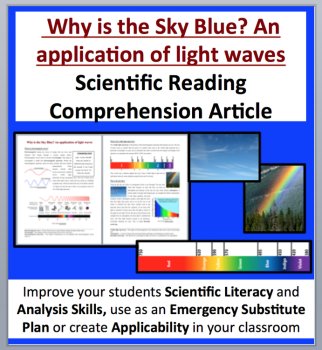
Why is the Sky Blue? An application of light waves - A Grade 8 and Up Reading Comprehension Passage and Questions. This resource is suitable for high school students as well as strong middle-school students. Tackle literacy and science by having your students read and answer questions from a scienti
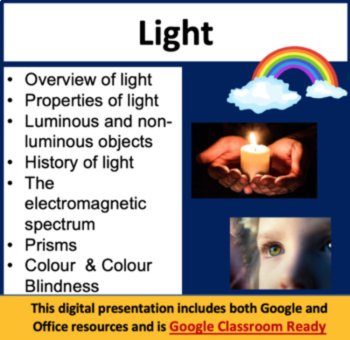
Everything you need to teach Light Optics is right here including the lesson (student and teacher versions), an auto-graded Exit Ticket to check for student understanding, a Bill Nye Video on color (includes answer key), and a student lesson handout. The presentation is interactive and engaging with
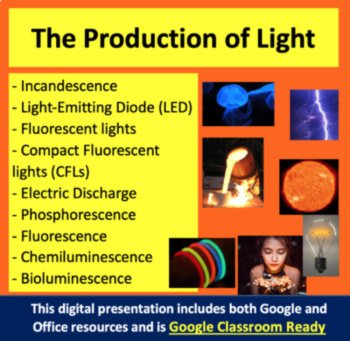
Everything you need to teach The Production of Light is right here including the lesson (student and teacher versions), an auto-graded Exit Ticket to check for student understanding, and a student lesson handout. The presentation is interactive and engaging with YouTube videos hyperlinked directly o
This fully editable Lab Station Activity on Light Optics and its Production is meant to get your students out of their seats and engaged in the content. Each station not only offers a unique opportunity to test your students knowledge (offer an opinion, answer questions based on a video or reading,
No questions yet.

Meet the Seller
Middle and High School Science Engaging Resources
I have been selling resources to middle and high school teachers for the last 15 years. During that time I've also been in the classroom so I know what works and what will help your students the most.
Canada
$22.50 $34.75 (318)
$22.50 $33.50 (190)
$22.50 $33.00 (128)
$21.50 $35.00 (221)
$21.50 $34.00 (218)
$21.50 $31.50 (173)