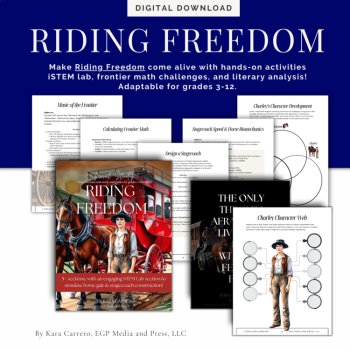
Riding Freedom Novel Study – A Cross-Curricular Journey

$12.00

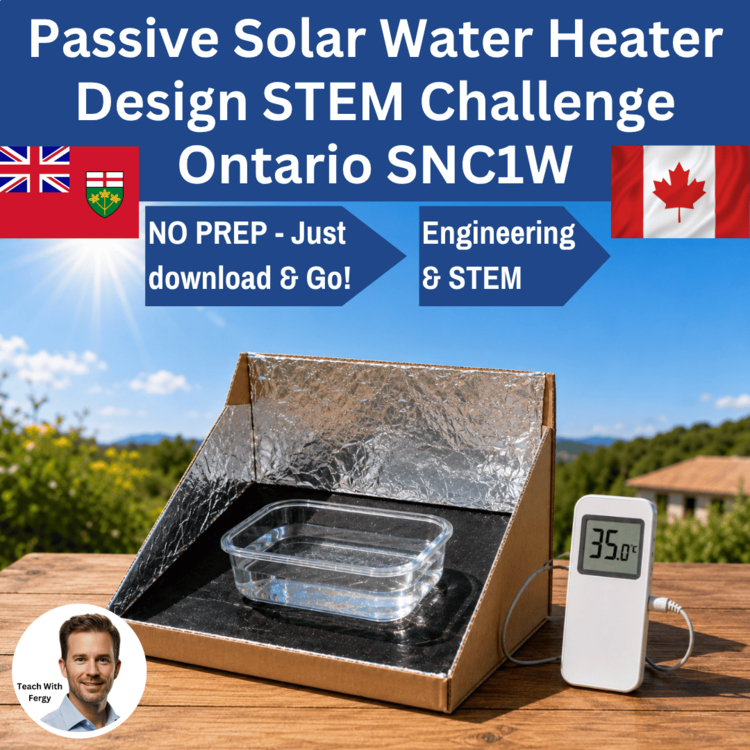
Passive Solar Water Heater Design Challenge | Ontario Grade 9 Science STEM Project and Graphing Lab
In this project, your students will research, design, build, and test a passive solar water heater using simple classroom materials. Students explore how solar energy can be used to warm water and how design choices such as dark surfaces, foil reflectors, insulation, and clear covers can affect heat absorption and heat loss. They compare a baseline model to an improved prototype and use temperature data to determine which design features worked best.
This activity is designed to connect directly to the Ontario Grade 9 Science SNC1W curriculum, especially the focus on scientific investigation, engineering design, real-world applications, sustainability, and the Sun’s role in renewable energy. The activity supports expectations connected to Strand A: STEM Skills and Connections and Strand E: Space Exploration, including research, experimentation, prototype design, safe lab practices, data analysis, communication, and explaining how the Sun’s energy contributes to renewable energy production.
Students will demonstrate their understanding by completing a full engineering design process that includes research, planning, building, testing, data collection, graphing, analysis questions, and a CER-style conclusion. They collect temperature data over time, create a line graph, calculate total temperature increase, compare their prototype to the baseline, and explain their results using evidence from their investigation.
Passive Solar Water Heater Design Challenge Highlights
✅ Ontario Curriculum Connected: Designed for Ontario Grade 9 Science SNC1W, with connections to STEM skills, engineering design, safety, sustainability, graphing, and renewable energy.
✅ Real-World Science Connection: Students explore how solar energy can be used in practical ways connected to home heating, green technology, construction, HVAC, renewable energy, and sustainable design.
✅ Hands-On STEM Learning: Students design and build a working prototype using simple materials such as cardboard, foil, black paper, plastic wrap, water, and a thermometer.
✅ Graphing + Data Analysis Focus: Students record temperature data, create a line graph, compare baseline and prototype results, and use evidence to explain their findings.
✅ Easy to Assess: Analysis questions, a CER-style conclusion, a complete teacher answer key, sample data, example graphs, and a grading rubric are included.
Key Topics Explored
This activity offers an engaging, hands-on way for students to explore solar energy, heat transfer, renewable energy, graphing, and engineering design. Instead of simply reading about renewable energy, students build and test a model that helps them see how design choices can affect performance.
The activity works well over multiple class periods and includes teacher instructions, Ontario curriculum alignment, lesson plan guidance, student directions, design planning, data collection, graphing expectations, analysis questions, reflection prompts, a teacher answer key, example data, example graphs, safety notes, differentiation options, extension ideas, and a grading rubric.
This resource is a strong choice for Ontario science teachers who want a practical Grade 9 STEM activity that combines curriculum expectations, hands-on engineering design, graphing, and evidence-based reasoning. Students are given room to create and improve their own designs while still using structured data collection and analysis to support their conclusions.
Report this resource to Linked Through Learning
Reported resources will be reviewed by our team. Report this resource to let us know if this resource breaks our rules.
No questions yet.

Meet the Seller
Middle and High School Science Engaging Resources
I have been selling resources to middle and high school teachers for the last 15 years. During that time I've also been in the classroom so I know what works and what will help your students the most.
Canada
AI Assisted
I develop the ideas, plan the activities, and guide the creation of all resources. AI tools assist with writing, illustrations, and design. Every resource is reviewed, edited, and refined using my teaching experience to ensure quality, accuracy, and meaningful real-world learning.
$7.60 $9.50
AI Assisted
I develop the ideas, plan the activities, and guide the creation of all resources. AI tools assist with writing, illustrations, and design. Every resource is reviewed, edited, and refined using my teaching experience to ensure quality, accuracy, and meaningful real-world learning.
$6.38 $7.98

AI Assisted
I develop the ideas, plan the activities, and guide the creation of all resources. AI tools assist with writing, illustrations, and design. Every resource is reviewed, edited, and refined using my teaching experience to ensure quality, accuracy, and meaningful real-world learning.
$7.60 $9.50

AI Assisted
I develop the ideas, plan the activities, and guide the creation of all resources. AI tools assist with writing, illustrations, and design. Every resource is reviewed, edited, and refined using my teaching experience to ensure quality, accuracy, and meaningful real-world learning.
$5.60 $7.00
AI Assisted
I develop the ideas, plan the activities, and guide the creation of all resources. AI tools assist with writing, illustrations, and design. Every resource is reviewed, edited, and refined using my teaching experience to ensure quality, accuracy, and meaningful real-world learning.
$5.60 $7.00