
Jane Eyre Quotes Bookmarks, Charlotte Bronte Watercolor Book Club Cards Gift

$2.40

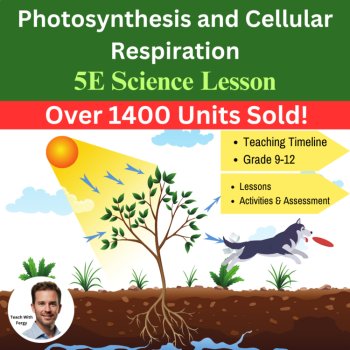
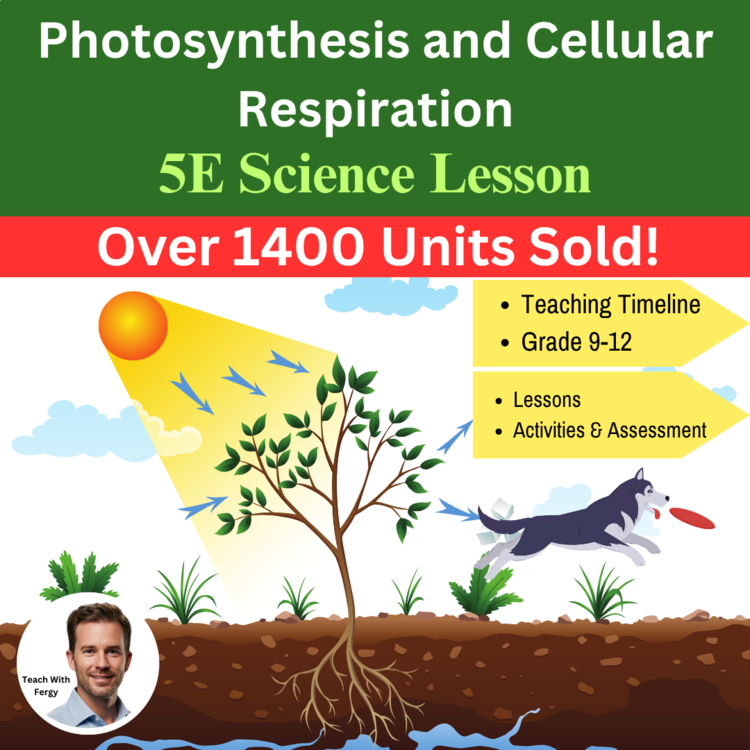
Photosynthesis and Cellular Respiration 5E Lesson Bundle | High School Biology
$26.38 $14.97
Get BundleStudents will be able to describe what occurs during photosynthesis and cellular respiration and gain an understanding of the importance of both to the survival of living things through hands-on exploration and inquiry-based activities, including a 7-station lab, interactive lessons, and real-world applications.
No prep needed: Ready-to-go Daily Teaching Timeline — Open, Print, & Teach
Preview shows exactly how the unit runs, day-to-day.
BEST SELLER - Over 1400 Units Sold!
Specifically, your students will learn:
Fully editable and Complete Photosynthesis and Cellular Respiration 5E Bundle.
Photosynthesis and Cellular Respiration 5E Lesson:
✅ Complete 5E Lesson Bundle – Fully editable and designed for high school, covering Photosynthesis and Cellular Respiration.
✅ Hands-On Learning – Includes a 7-station lab activity, device-based scavenger hunt, and interactive lessons.
✅ No Prep Required – Ready-to-use Google and Office versions with step-by-step teacher instructions.
✅ Built for NGSS & Inquiry-Based Learning – Supports critical thinking, real-world connections, and student-led discovery.
This 5E lesson bundle is meant for high school classrooms. If you're looking for something for middle school, please click here.
What's included?
Engagement Phase
Exploration Phase
Explanation Phase
Elaborate Phase
Evaluate Phase
Buyer Comments:
- "Excellent reinforcement materials that aligned with the "Photosynthesis and Cellular Respiration" Unit."
- "This is one of my favorite resources ever! It fits perfectly into our NGSS transition."
- "These resources follow NGSS protocol. There is nothing else you have to do except copy and use. Fergy is a master and thinking through the planning process and creating units for students that are fabulous!"
- "This resource helps to make my life a little easier. My students love the scavenger hunt."
- "These lessons are perfect! I recommend!"
- "Easy to follow lessons - very student friendly. Thanks!"
Student Expectations:
• Construct a scientific explanation based on evidence for the role of photosynthesis in the cycling of matter and flow of energy into and out of organisms.
• Develop a model to describe how food is rearranged through chemical reactions forming new molecules that support growth and/or release energy as this matter moves through an organism.
• Explain the chemical changes and energy transformations associated with the process of photosynthesis, and compare the reactants (i.e., carbon dioxide, radiant energy, water) to the products (i.e., glucose, oxygen)
How does the 5E model facilitate learning?
• It emphasizes inquiry, critical thinking, and the process of science
• Its success is backed by countless scientific studies that demonstrate its effectiveness
• It is built around the idea that humans construct knowledge and meaning from their
learning experiences. That they build upon their prior knowledge and to be effective, learning needs to be active and allow the participants to construct new knowledge from their experiences
More Buyer Comments:
"Great alignment to the 5E model."
- "Excellent resource. Would definitely recommend."
- "Exactly what I was looking for."
- "Great resource and easy to follow. Thank you!"
- "Perfect "learn by doing" approach"
- "Very visual, which helps the students see the relationship between respiration and photosynthesis."
------------------------------------------------------------
The NRC's How People Learn has synthesized decades of research across many different disciplines about how people learn (NRC, 1999 blue right-pointing triangle). Key findings from that synthesis include the following. First, students (people) must be interested and engaged in what they are learning and find it useful and meaningful. Second, students (people) must be actively involved in the process of teaching and learning, comparing new information to previous ideas, constructing new understandings, and quite simply changing their own minds about how the world works. And third, students (people) need opportunities to apply what they have learned to new situations, to check the completeness of their understanding, and to evaluate their own learning for themselves. (https://www.ncbi.nlm.nih.gov/pmc/articles/PMC2931660/)
By incorporating this 5E lesson, you will provide your students with a meaningful and coherent way of learning that best suits their needs. You will also utilize technology in a way that creates order and promotes understanding.
------------------------------------------------------------
The following 5E lessons are currently available in My Store
Physics
• Newton's Three Laws of Motion
• Current Electricity and Circuits
• One and Two-Dimensional Motion
• Static Electricity
• Projectile Motion
• Light and its Production
• Energy, Energy Transfer, and its Forms
• Kinetic and Gravitational Potential Energy
• Electricity Production
• Friction
• Density and Buoyancy
• Sound and Hearing
• Uniform Acceleration
• How Planes Fly
• Refraction
• Work
• Power
• Magnetic Fields
• Momentum, Conservation of Momentum, and Impulse
• Forces
Biology
• Cells and the Cell Theory
• Digestive System
• Photosynthesis and Cellular Respiration
• Mitosis and the Cell Cycle
• Circulatory System
• Cancer
• Photosynthesis
• Respiratory System
• Cell Membrane and Transport
• Energy Flow In Ecosystems
• The Human Eye
• Genetic Material: DNA and RNA
• Nervous System
• Plant and Animal Cells
• Carbohydrates and Lipids
Coming Soon:
• Proteins and Enzymes
• Cellular Respiration (Senior)
• Human Reproductive Systems
Ecology
• The Cycling of Matter: The Water and Carbon Cycles
• Cells and the Cell Theory
• Ecosystems
• Biodiversity
• Invasive Species
• Interactions Within Ecosystems
• Photosynthesis
• Biomes
• The Classification of Living Things
• Photosynthesis
• Ecological Succession
• Energy Flow in Ecosystems
• Plant Sexual and Asexual Reproduction
Chemistry
• Physical and Chemical Properties and Changes
• Atoms and the Atomic Theory
• Chemical Reactions
• Types of Chemical Reactions and Balancing Equations
• Molecular and Ionic Compounds
• Acids, Bases, and pH
• The Periodic Table
• Particle Theory and Matter Classification
• The Mole/Avogadro's Number
• Types of Bonds and Intermolecular Forces
• Solutions and Mechanical Mixtures
Coming Soon:
• Atomic Theory, Atomic Structure, and Isotopes
• Matter
• Trends in the Periodic Table
• Nomenclature
• Intermolecular Forces
• Stoichiometry
• Gases
Earth and Space Science
• Climate Change and Global Warming
• The Moon and its Phases
• Our Solar System
• The Seasons
• Human Space Exploration
• The Life and Death of Stars
• Asteroids, Comets, and Meteors
• Solar and Lunar Eclipse
• Tectonic Plates
• Rock Cycle
Coming Soon:
• Galaxies and our Universe
------------------------------------------------------------
Buyer Comments:
- "Great resource! Saved me lots of time and the students learned."
- "Excellent. The stations were great."
- "Great resource thank you!!"
- "My students enjoyed this and seemed to grasp the concepts better. They enjoyed the hook and the station rotation."
- "Excellent detail in the planning/teacher instructions. This is a great resource!"
- "Awesome resource!"
Explore - Photosynthesis and Cellular Respiration - 7 Engaging Lab Station Activity
This fully editable Lab Station Activity on Cellular Respiration and Photosynthesis is meant to get your students out of their seats and engaged in the content. Each station not only offers a unique opportunity to test your students' knowledge (offer an opinion, answer questions based on a video or reading, draw, etc.), but also provides a fantastic learning opportunity where your kids are learning through assessment. Each station comes with a description card while some also contain more detailed instructions, a reading, questions to answer, etc. Students are equipped with a recording sheet (passport) to write their answers. There is almost no prep for you. Simply print the cards, lay them out around the room and you're all set. An answer key is also provided where applicable.
This lab activity covers:
- Photosynthesis
- Cellular Respiration
----------------------------------------------
Bonus Activities: To ensure your students don’t have any downtime between stations, your lab also includes a 10-word word scramble and word search, both with an answer key. You can use them as part of their mark, as a bonus so it’s not mandatory, etc. However you choose to use it, it will ensure that your students are always busy and never idle. Note: For stronger classes, I give the word scramble and for weaker ones, the word search.
-----------------------------------------------
How do the Lab Stations work? Each station is specially designed to be a unique complement to the material while at the same time, provide a valuable learning experience. Below is an overview of how each station works. In your activity, each will be tailored to the specific content.
Station 1: Get Hands-On – using their creative skills, students are required to draw or build.
Station 2: Research – using a classroom computer or their own device, students must research a specific question/issue surrounding the topic.
Station 3: Explain yourself – students write down an opinion to a question in paragraph form.
Station 4: Rest Station - students can use this time to catch up on work they didn't have time to complete at a previous station or prepare themselves for an upcoming one.
Station 5 - Applicability reading – students read a short passage from an article, website, etc. which directly connects the classroom content to a real life application.
Station 6: Test your knowledge – students answer 5 multiple choice questions then provide a written explanation for how/why they came to their conclusions.
Station 7: Learn from the expert – using a classroom computer or their own device, students must watch a short video clip and answer the associated questions. They may stop, rewind and restart as often as they like during the time frame.
Station 8 - Rest Station.
Station 9: Become the question master – Students must create 2 multiple-choice questions, 2 true/false questions and 1 short answer question. Students must also supply the answers.
Explanation - Cellular Respiration and Photosynthesis Lesson - Introductory Lesson Package
Cellular Respiration and Photosynthesis Lesson package - This 28 slide Introductory Biology PowerPoint Lesson package discuss both Cellular Respiration and Photosynthesis as well as how they are linked. It is geared towards students who are unfamiliar with both processes.
It outlines the structures of mitochondria and chloroplasts and the variety of pigments found within plants which cause them to change color in the fall. It briefly talks about why energy/ATP is needed inside the cell as well as outlines the importance of photosynthesis for life on Earth and lastly, it compares the processes of photosynthesis and cellular respiration. The processes are laid out in a clear and easy to follow manner with many diagrams, explanations and pictures. It includes the lesson (student and teacher versions of the PowerPoint), 2 embedded videos, a student activity with a marking rubric & answer key and a student lesson handout as a word document which follows the PowerPoint. This lesson is designed for an entry/introductory level biology course.
Included in the lesson package is:
- The teacher version of the PowerPoint
- The student version of the PowerPoint
- 2 videos embedded into the PowerPoint
- Student Activity with rubric and answer key
- Student lesson handout
In order, the lesson covers:
- Earth’s energy budget
- Cellular energy (ATP)
- Mitochondria
- Solar energy
- Chloroplasts
- Chlorophyll
- Photosynthesis vs. Cellular Respiration
- Photosynthesis and life
Elaborate - Photosynthesis and Cellular Respiration – Device-Based Scavenger Hunt Activity
This activity is the coolest thing I've created and your kids are going to love it, mine do. Think of a scavenger hunt, then add devices (Smartphones, Chromebooks, Laptops, or Tablets), engaged students, and learning through assessment and you have this resource.
Quick Disclaimer. In order to use this activity, your classroom must have at least 1 device per 3 students. Smartphones, Chromebooks, Laptops, and Tablets will all work perfectly. The wording and delivery make this resource perfect for a wide range of grade levels. If for some reason you feel this hunt isn't perfect for your classroom, I'm happy to refund your purchase no questions asked.
The Content Includes:
• The importance of photosynthesis and cellular respiration
• An introduction to how each occurs
• The structures involved in each
• Which organisms do each process and why
• What would happen if one or both processes stopped
• Practical applications
Report this resource to Linked Through Learning
Reported resources will be reviewed by our team. Report this resource to let us know if this resource breaks our rules.
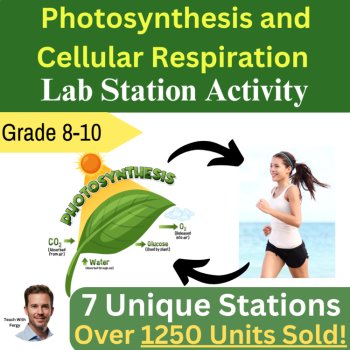
This fully editable Photosynthesis and Cellular Respiration Lab Station Review Activity is meant to get your students out of their seats and engaged in the content. Each station not only offers a unique opportunity to test your students' knowledge (offer an opinion, answer questions based on a video
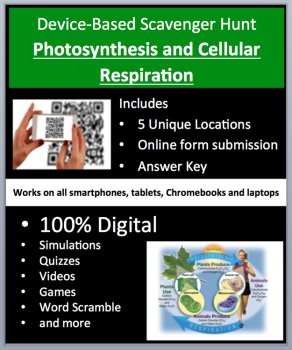
Photosynthesis and Cellular Respiration - Device-Based Scavenger Hunt Activity.Your students are going to love this interactive, digital scavenger hunt activity on cellular respiration and photosynthesis, mine do. Think of a scavenger hunt, then add devices (Smartphones, Chromebooks, Laptops, or Tab
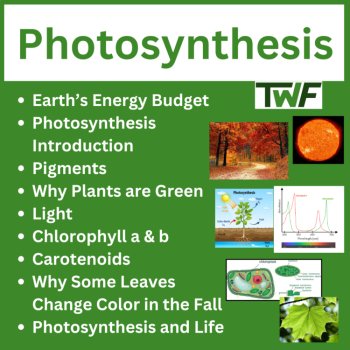
Photosynthesis - Grade 9 and 10 High School Science LessonThis lesson looks at photosynthesis, what it is, why it is important, the pigments and structures involved, as well as the connection between plant pigments, photosynthesis, and leaves changing color. This lesson is intended for students in g
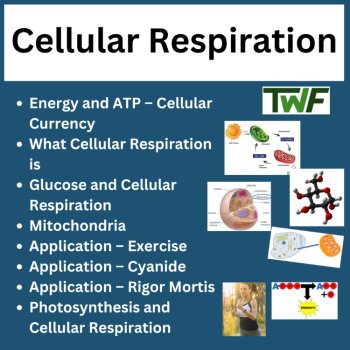
Cellular Respiration - Grade 9 and 10 High School Science LessonThis lesson looks at cellular respiration, what it is, why it is important, ATP, mitochondria, as well as the connection between cellular respiration and photosynthesis. The lesson also includes three real-life applications of cellular
No questions yet.

Meet the Seller
Middle and High School Science Engaging Resources
I have been selling resources to middle and high school teachers for the last 15 years. During that time I've also been in the classroom so I know what works and what will help your students the most.
Canada
$18.50 $31.75 (91)