Social Distancing Learning Infographics
Free

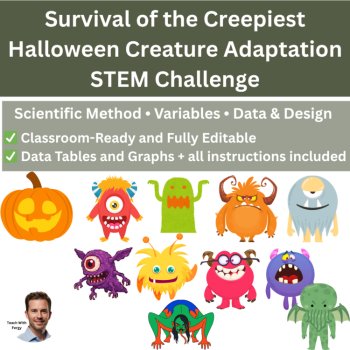
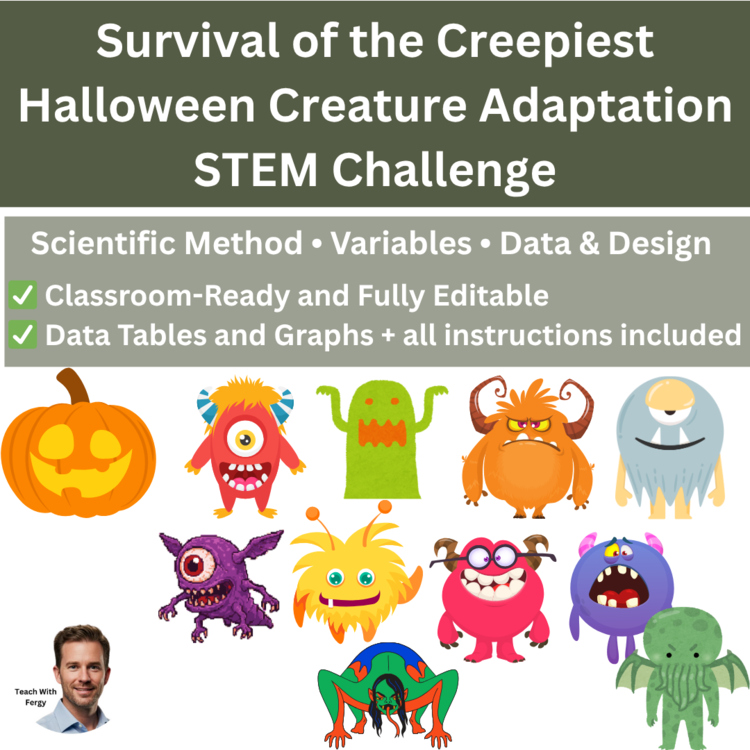
On Halloween night, the Earth's climate fractures into eerie realms warped by monstrous weather. Only creatures born of imagination (and backed by science adaptation) can survive. Your mission: design a horrifying yet biologically believable organism that has adapted to, thrives in, one of these cursed environments. Every adaptation must make scientific sense, or your creature won’t survive the Guardians’ test!
In this activity, your class joins the Order of Monster Makers. They must design a scientifically believable creature for a haunted realm, then prove it can survive. Students justify traits with real biology (CER) and score their designs with a 1–5 Survival Index, pooling class data to graph which realms are truly the toughest.
You can also find this activity at a discount inside my - Halloween Science Activities and Investigations Growing Bundle.
What students do
What You Get
Materials (low prep)
Student pages, paper/colored pencils (or digital tools). No lab chemicals—just imagination grounded in biology.
Timing
Why teachers love it
NGSS & Skills
Tip: Kick off with a “Realm Reveal” slide and spooky soundscape, then crown awards like “Most Biologically Believable,” “Most Terrifyingly Tuned,” and “Best Survival Score.”*
Report this resource to Linked Through Learning
Reported resources will be reviewed by our team. Report this resource to let us know if this resource breaks our rules.
No questions yet.

Meet the Seller
Middle and High School Science Engaging Resources
I have been selling resources to middle and high school teachers for the last 15 years. During that time I've also been in the classroom so I know what works and what will help your students the most.
Canada
AI Assisted
I develop the ideas, plan the activities, and guide the creation of all resources. AI tools assist with writing, illustrations, and design. Every resource is reviewed, edited, and refined using my teaching experience to ensure quality, accuracy, and meaningful real-world learning.
$7.60 $9.50
AI Assisted
I develop the ideas, plan the activities, and guide the creation of all resources. AI tools assist with writing, illustrations, and design. Every resource is reviewed, edited, and refined using my teaching experience to ensure quality, accuracy, and meaningful real-world learning.
$6.38 $7.98
AI Assisted
I develop the ideas, plan the activities, and guide the creation of all resources. AI tools assist with writing, illustrations, and design. Every resource is reviewed, edited, and refined using my teaching experience to ensure quality, accuracy, and meaningful real-world learning.
$7.60 $9.50
AI Assisted
I develop the ideas, plan the activities, and guide the creation of all resources. AI tools assist with writing, illustrations, and design. Every resource is reviewed, edited, and refined using my teaching experience to ensure quality, accuracy, and meaningful real-world learning.
$5.60 $7.00
AI Assisted
I develop the ideas, plan the activities, and guide the creation of all resources. AI tools assist with writing, illustrations, and design. Every resource is reviewed, edited, and refined using my teaching experience to ensure quality, accuracy, and meaningful real-world learning.
$5.60 $7.00