

Jane Eyre Quotes Bookmarks, Charlotte Bronte Watercolor Book Club Cards Gift

$2.40

Teaching “The Fall of the House of Usher” is difficult for one simple reason: students cannot analyze what they cannot follow. Poe’s prose is dense, the plot is strange, and the story’s best ideas only land when students know what is actually happening.
This 8–9 day guided-reading unit gives students more support where they need it without flattening Poe’s story. The reading sequence moves chronologically through the text with concrete plot checks, selective vocabulary, Poe → Plain English moments, and short story-so-far recaps. Once the plot is secure, students move into the real literary work: Gothic atmosphere, Roderick’s fear, “The Haunted Palace,” the sentience theory, premature burial, “The Mad Trist,” rational vs. supernatural explanations, the fissure, and the connection among house, family, and mind.
The materials are designed to work together. The teaching deck tells students when to read, write, discuss, or check their thinking. The student guide follows the story in order. The teacher guide includes exact reading anchors, pacing, likely misunderstandings, suggested answers, and clear directions for when to use each packet page and slide.
WHAT’S INCLUDED
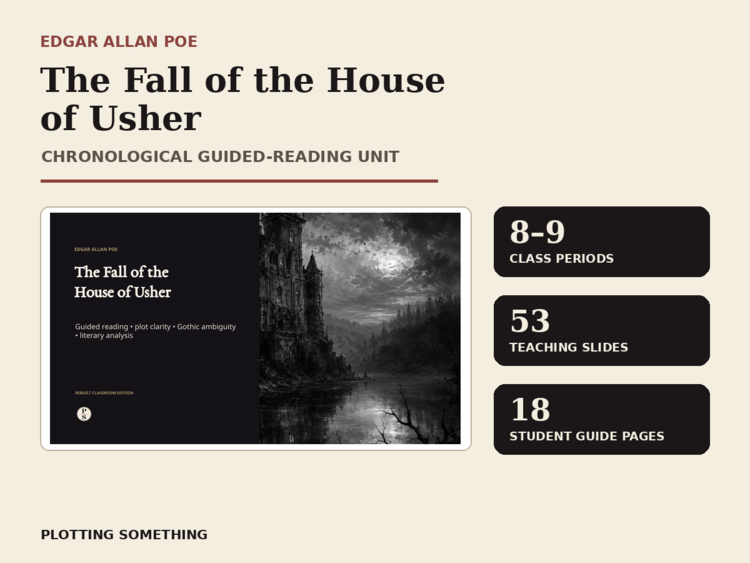
• 53-slide guided teaching presentation — PowerPoint + PDF
• 18-page chronological student reading guide — PowerPoint + PDF
• 7-page “The Haunted Palace” visual close-reading and extended-metaphor activity — PowerPoint + PDF
• 1-page Plot Catch-Up support sheet for absences/intervention — PowerPoint + PDF
• 16-page teacher guide with pacing, exact reading anchors, teaching notes, and a page-by-page answer key — Word + PDF
• Two versions of a reading comprehension quiz + answer key — Word + PDF
• Google Forms-ready quiz question bank — CSV
• Editable files plus print-ready PDFs
TOTAL: 46 printable pages + a 53-slide teaching deck
HOW THE STUDENT READING GUIDE WORKS
The packet follows the story chronologically so students always know where they are. Most reading stops use some version of the same routine:
• What just happened? — secure the literal plot
• Poe → Plain English — untangle a sentence or idea that blocks understanding
• Look Closer — move into interpretation once the event is clear
• Story So Far — record what changed before moving on
The unit slows down for the places students are most likely to lose the story: Roderick’s five senses, his fear of fear itself, Madeline’s illness, Roderick’s belief that the house is sentient, the temporary entombment, the days after the burial, and the sound sequence in “The Mad Trist.”
“THE HAUNTED PALACE”
The separate “Haunted Palace” activity preserves the poem’s discovery. Students first read and draw the palace as a literal place using evidence from Poe’s language. Only after they commit to the literal image do they trace the shift in the poem, notice the human features, and work out the extended metaphor. The final questions connect the poem back to Roderick without turning it into a one-answer symbolism exercise.
SKILLS & ANALYSIS
Students practice:
• separating observation from interpretation
• tracking setting details and foreshadowing
• paraphrasing difficult language without replacing the original text
• analyzing characterization through physical and sensory details
• tracing an extended metaphor in “The Haunted Palace”
• distinguishing a character’s belief from what the story actually proves
• following cause, effect, and chronology in a difficult text
• analyzing the “Mad Trist” sound correspondences
• weighing rational and Gothic/supernatural explanations
• connecting the house, the Usher family, and Roderick’s state of mind
• using evidence from different parts of the story in a short literary analysis
PACING
Designed for approximately 8–9 class periods. The core sequence is built around roughly 35 minutes of usable instructional time per day, which fits a typical 40–45 minute class once routine transitions are included.
Day 1 — Arrival, exterior, interior, and the fissure
Day 2 — Roderick, his five senses, fear, and Madeline
Day 3 — Life inside the house + “The Haunted Palace” literal reading/drawing
Day 4 — Poem reveal + Roderick’s sentience theory + Madeline’s reported death
Day 5 — Temporary entombment and the details that should worry us
Day 6 — Roderick after the burial + the storm
Day 7 — “The Mad Trist,” confession, ending, title, and fissure
Day 8 — Rational vs. Gothic explanations + House/Family/Mind synthesis
Optional Day 9 — Final analysis drafting/revision
ASSESSMENT
Two versions of a straightforward comprehension quiz are included, along with answer keys and a Google Forms-ready question bank. The quiz checks whether students followed the difficult plot. The deeper literary work happens in the reading guide, class discussion, “The Haunted Palace” activity, and final written analysis.
TEACHER-FRIENDLY SUPPORT
The teacher guide is written for someone teaching the story for the first time. Each day includes:
• exact opening and stopping phrases for the reading
• packet pages and slide ranges
• suggested pacing
• what students absolutely need to understand before moving on
• likely student misunderstandings
• suggested answers and discussion moves
• what to cut first if time is short
BEST FOR
Grades 9–12
English Language Arts / Literature / Close Reading
Approximately 8–9 class periods
Whole-class reading, supported independent reading, or small-group instruction
Teachers who want comprehension support without giving students the interpretation
BUILD YOUR POE SEQUENCE
Start with Edgar Allan Poe Biography & Background
Give students the biographical and literary context they need before reading Poe.
Continue with “The Raven”
Extend students’ work with Poe’s mood, symbolism, sound, and unity of effect.
Want the complete sequence? Edgar Allan Poe Unit Bundle
Save with the bundle, which includes the Poe background lesson, “The Fall of the House of Usher,” and “The Raven.”
PLEASE NOTE
The complete text of “The Fall of the House of Usher” is not included. Use your preferred print or digital edition; story page numbers vary by edition. The included CSV is a Google Forms-ready question bank and does not automatically create a Google Form.
Report this resource to Linked Through Learning
Reported resources will be reviewed by our team. Report this resource to let us know if this resource breaks our rules.
No questions yet.

Meet the Seller
Thoughtful Resources for Secondary ELA
Literature-rich lessons, engaging classroom activities, and thoughtfully designed teaching resources for secondary English teachers.
Pennsylvania