
20 Zen Decor Posters Growth Mindset Quotes Relaxing Watercolor Woodland Nature

$5.00 (1)

When a student becomes overwhelmed but cannot clearly ask for help, frustration, avoidance, shutting down, or challenging behavior may follow. These Beach Student Break Cards provide clear classroom visuals that can be used as part of an explicitly taught routine for requesting support, taking an appropriate break, and returning to the activity.
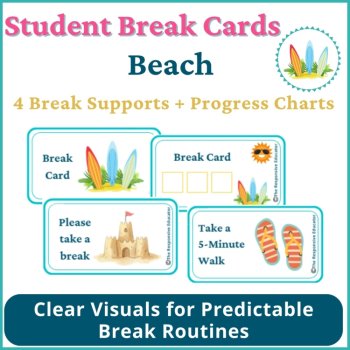
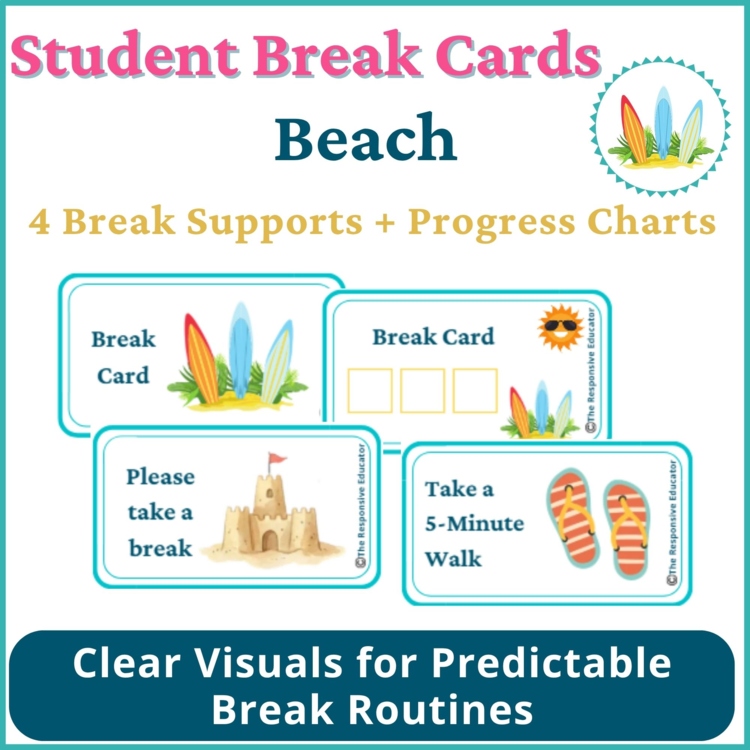
This resource now includes four types of break support: student-requested cards, limited-use cards with three tracking boxes, adult-offered break cards, and five-minute walk cards. Multiple Beach designs allow teachers to choose a visual that is likely to appeal to the individual student.
More Than a Card to Hand Out
Some students recognize that they need a break but have difficulty finding the words to ask for one. Others may leave the area, refuse a task, shut down, or engage in disruptive behavior because they have not yet learned a more effective way to communicate that need.
A break request card gives the student a concrete alternative. The student can hand the card to an adult, place it in a designated location, point to it, or show it when making a verbal request is difficult.
The card does not teach emotional regulation by itself. Students still need to learn how to recognize when they need support, request or accept a break, follow the established routine, and return to the task or activity. The visual helps make that process clearer and more consistent for the student and the adults providing support.
Four Break Card Formats
This resource includes multiple designs across four break card formats:
Student-requested break cards: These cards do not include tracking boxes. They can be used with students who are learning to independently communicate that they need a break or who need access to breaks without a predetermined limit.
Limited-use break cards: These cards include three boxes that can be marked as breaks are used. The boxes provide a visual reminder of how many planned breaks have been used and how many remain.
Adult-offered break cards: The “Please Take a Break” cards allow an adult to offer a visual cue when the adult notices signs of frustration, fatigue, or dysregulation before the student independently recognizes or communicates the need.
Five-minute walk cards: These cards allow an adult to suggest a structured movement break with a clear duration. Teachers should establish the walking route, supervision, and return routine before using this option.
Adult-offered cards should be presented as supportive cues, not as punishment or forced removal from an activity.
Teach Students to Request and Use Breaks Appropriately
Needing a break is not a failure. Adults ask for a moment, step away, or seek support when they need space. Some students need direct instruction and practice to learn those same self-advocacy and emotional-regulation skills.
When a break request is being taught as an alternative to escalation or shutting down, the student first needs to learn that asking works. Initially honoring the agreed break helps build trust in the new communication strategy. Several brief, appropriately requested breaks may result in less lost learning time than a significant behavioral episode followed by a lengthy recovery.
At the same time, teachers can continue building the student’s ability to tolerate frustration and participate in nonpreferred activities. This may include teaching coping strategies, reinforcing time spent with manageable tasks, gradually shortening breaks, or helping the student take a break closer to the activity when appropriate. The purpose is not to provide an unlimited escape from expectations. It is to reduce escalation while teaching communication, regulation, and participation skills together.
When to Consider the Three-Break Card
The limited-use card may be appropriate when the student:
Consistently requests breaks and follows the established routine
Is developing ways to manage frustration and return to tasks
Has a support plan and observation data that support a planned limit
The three boxes do not have to represent three breaks for an entire school day. Depending on the student’s needs and support plan, they may represent three breaks during an hour, class period, half day, or full day. Teach the student when the boxes reset and what support remains available after all three boxes are marked.
If the student is becoming overwhelmed, needed support and breaks should remain available. The adult-offered card can help cue an additional break when the student is not independently recognizing or communicating the need.
How to Introduce the Break Routine
Explain what the break card means and when the student can use it.
Teach the student how to give, show, or point to the card.
Identify where the break will happen and what the student may do.
Establish how the student will know when the break is ending.
Practice requesting and taking a break when the student is calm.
Respond consistently when the student uses the card appropriately.
Teach and support the student in returning to the task or activity.
Monitor requests to identify patterns across tasks, settings, and times of day.
For limited-use cards, print and laminate the card, then mark one box each time a planned break is used. Teach the student when the three boxes reset.
Reinforce Successful Use of the Break Routine
The coordinating progress charts can be used to recognize one individualized skill connected to the student’s break routine, such as:
Asking for a break appropriately
Accepting an adult’s offer of support
Using an agreed coping strategy during the break
Returning to the activity with the planned support
Add a sticker or mark when the student demonstrates the selected skill. The chart should recognize successful use of the routine—not reward the student for going without a needed break.
Why the Beach Theme Can Help
Choosing a theme connected to the student’s interests can make the visual feel more personal and increase the student’s willingness to use it.
The theme does not replace direct instruction, consistent adult responses, or an individualized break routine. It simply provides a familiar and engaging visual for teaching those skills.
What’s Included
Multiple Beach designs for student-requested break cards
Multiple Beach designs for limited-use cards with three tracking boxes
Multiple Beach designs for adult-offered “Please Take a Break” cards
Multiple Beach designs for five-minute walk cards
Coordinating 30-space progress charts
Directions for choosing and using each break card format
Guidance for teaching and reinforcing the break routine
Printable PDF format
Please Note
This resource is a printable PDF and is not editable. The wording, graphics, layout, and number of break-tracking boxes cannot be changed.
Break supports should be selected according to the individual student’s communication, regulation, and instructional needs. Before placing a limit on student-requested breaks, consider why the student is requesting them and whether the breaks are meeting a regulation, communication, sensory, health, or task-related need.
These cards are designed to support an individualized intervention. They do not replace a functional behavior assessment, behavior intervention plan, evaluation, or consultation with qualified members of the student’s educational team.
Save with the Beach Behavior Visual Supports Bundle
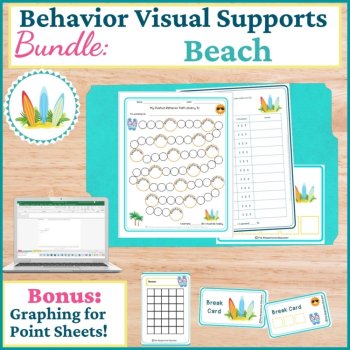
Find additional coordinated behavior supports in the Beach Behavior Visual Supports Bundle. The bundle includes coordinating token boards, behavior point sheets, student behavior reward charts, break cards, and additional classroom visual supports.
Stay Connected
Follow The Responsive Educator on TPT to receive updates when new behavior and SEL resources are added.
After using the resource, you can leave a review to share your experience and earn TPT credits toward future purchases.
Report this resource to Linked Through Learning
Reported resources will be reviewed by our team. Report this resource to let us know if this resource breaks our rules.
No questions yet.
Meet the Seller
Behavior Support and Interventions
I provide resources that help teachers manage classroom behavior and teach social-emotional skills effectively. With over 20 years of experience in special education, I offer practical tools and strategies to support both teachers and students in achieving their best. I have been dedicated to supporting students with special needs since 2005, specializing in both behavioral and academic interventions. My extensive experience spans teaching in self-contained classrooms from grades K-12 and assisting general and special education teachers with managing significant behavioral challenges. As a former lead of an RTI committee and a behavior specialist, I have a deep understanding of effective classroom management strategies.
Florida