Linked Through Learning
Characteristics of Living Things Reading | What is Life? | 6th, 7th, 8th Grade
View Preview

Share

Description

This Grade 6–8 reading comprehension article and questions introduces students to the characteristics shared by living things and how scientists determine whether something is alive. Students explore why showing one life-like feature—such as growing, moving, responding, or releasing energy—is not enough to classify something as living. Instead, scientists examine several connected characteristics that work together as a complete living system.

The article explains concepts such as cells, DNA, metabolism, homeostasis, stimuli, growth, development, reproduction, adaptation, and evolution in clear, student-friendly language. Students apply these characteristics to interesting examples, including bacteria, dormant seeds, viruses, fire, crystals, and robots. A comparison table helps students distinguish between living and life-like systems while developing their scientific literacy and evidence-based reasoning skills.


This resource covers the following topics:

  • How Scientists Determine Whether Something Is Alive
  • Cellular Organization
  • Cells as the Basic Units of Life
  • DNA and Genetic Information
  • Metabolism and Energy Use
  • Photosynthesis and Cellular Respiration
  • Homeostasis and Stable Internal Conditions
  • Responses to Stimuli
  • Growth and Development
  • Reproduction and the Continuation of Species
  • Adaptation and Evolution
  • Why Viruses Are Usually Classified as Nonliving

✅ Grade 6–8 Reading on the Characteristics of Living Things: Students learn how scientists use several connected characteristics to identify living organisms.

✅ No-Prep, Editable Resource: Includes Google Docs, Microsoft Word, and PDF versions for flexible classroom use.

✅ Builds Scientific Literacy: Students read an informational article and answer direct, analytical, application, and extension questions.

✅ Includes Questions and Complete Answer Keys: Features 10 reading comprehension questions, 5 extension questions, and full answer keys.

✅ Includes a Comparison Table: Students compare bacteria, dormant seeds, viruses, fire, and crystals using the characteristics of life.

This resource is perfect for characteristics of life units, biology, life science, scientific classification, scientific literacy instruction, and general science classes. It supports both NGSS science practices and literacy standards for science and technical subjects.


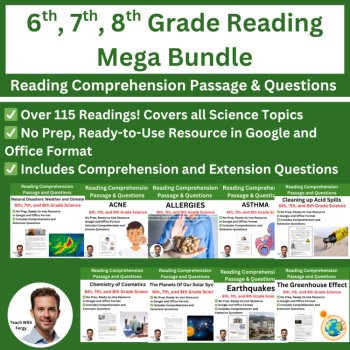
➡️ Save 75% by upgrading to the 6th, 7th, and 8th Grade Mega Bundle!

Includes ALL current and future reading resources for middle school. ⏳ Price increases in September and again in February – grab it now! CLICK HERE ⌛


How this product will help your students:

  • Improve their scientific and disciplinary literacy skills
  • Improve their reading comprehension and scientific knowledge
  • Understand the major characteristics shared by living organisms
  • Apply scientific evidence when classifying living and nonliving systems
  • Recognize why one life-like feature is not enough to prove something is alive
  • Compare difficult examples such as dormant seeds, viruses, fire, and crystals
  • Provide an extension activity for faster-moving or more gifted students

How this product will help you:

  • Help you address NGSS, TEKS, and Common Core literacy standards
  • Provide a concise introduction to the characteristics of living things
  • Give you a ready-to-use activity for independent work, homework, review, or enrichment
  • Provide an engaging and easy-to-leave substitute plan that keeps students on task
  • Give you a meaningful way to measure students’ scientific literacy and comprehension skills
  • Make assessment easier with complete answer keys

This resource will take your students between 50-60 minutes to complete and includes a variety of questions. An answer key is also included for your reference.

The Problems You Face

  • Not having enough time to teach scientific literacy or improve your students’ reading comprehension and analysis skills
  • Needing an accessible introduction to the characteristics of living things
  • Having students who complete their work at different speeds and need meaningful extension activities
  • Creating useful last-minute substitute plans that benefit your students
  • Finding activities that combine science content with literacy and evidence-based reasoning

The Solution

This fully editable, NO-PREP reading comprehension article contains relevant, applicable, and engaging activities that can be used to:

  • introduce the characteristics of living things
  • improve your students’ literacy skills
  • strengthen reading comprehension and scientific literacy
  • improve evidence-based reasoning and analysis skills
  • help students distinguish between living, nonliving, and life-like systems
  • encourage scientific discussion about difficult examples such as viruses and dormant seeds
  • provide an extension activity for students who move at a faster pace
  • provide extra credit to students in need
  • measure your students’ literacy skills and scientific understanding
  • Furthermore, this resource works very well as an emergency substitute plan because it will keep students focused, learning, and on task while you are away.

Google Classroom and Distance Learning Ready

  • This resource is perfect for in-class or distance learning and integrates seamlessly with Google Classroom.
  • Automatically creates a copy of the reading and puts it directly into your Google Drive with a single click.
  • Purchase --> Open --> Click --> Assign to your students
  • The reading also includes a Microsoft Word and PDF version.

Having all three options allow you to assign the reading to your students without worrying about formatting issues as all the work has already been done for you. It also allows you, as well as your students, to access everything no matter where you are or what kind of equipment is being used.


I have over 200 readings that cover a variety of topics found in:

  • Chemistry
  • Energy
  • Biology
  • Health
  • Earth and Space
  • Physics
  • Ecology and the Environment
  • Natural Disasters
  • General Science

Praise For My Other Reading Comprehension Resources:

  • "I teach middle school science and need to include informational text in my classroom. These readings are great for independent reading for my grade-level and upper-level readers. The articles address CCSS.ELA-Literacy.RST.6-8.1 (Citing specific textual evidence to support analysis of science and technical texts.) and CCSS.ELA-Literacy.RST.6-8.10 (By the end of grade 8, read and comprehend science/technical texts in the grades 6-8 text complexity band independently and proficiently.). The leveled questions allow you to subtly assign the questions to different ability students working in a group."
  • Topics are relevant to the students and current. Graphics draw the students into the article. I'm going to have one printed and waiting in for my substitute folder too!"
  • "THANKS!"
  • "Thanks for putting together a wonderful resource."
  • "I teach Special Education high school science in Maryland in a special school for children with learning disabilities/Autism. I liked the readings and I think students could relate to the topics.

We don't spend enough time teaching scientific literacy to our students. This is either because we don't have the resources to do so effectively or we don't have the time. However, teaching our students to become scientifically literate is vital if we want them to succeed in life. We need them to know about the world they live in and about the issues they face.

I also have a range of assignments and lessons/units from other grade levels at my store. Please CLICK HERE to have a look around and don’t forget to follow if you like what you see.

Report this resource to Linked Through Learning

Reported resources will be reviewed by our team. Report this resource to let us know if this resource breaks our rules.

Meet the Seller

Middle and High School Science Engaging Resources

I have been selling resources to middle and high school teachers for the last 15 years. During that time I've also been in the classroom so I know what works and what will help your students the most.

Canada
You May Also Like

More From This Store