Science Posters- The Periodic Table-Brown Corduroy Design

$5.00 (1)

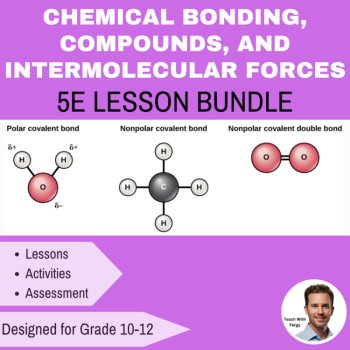
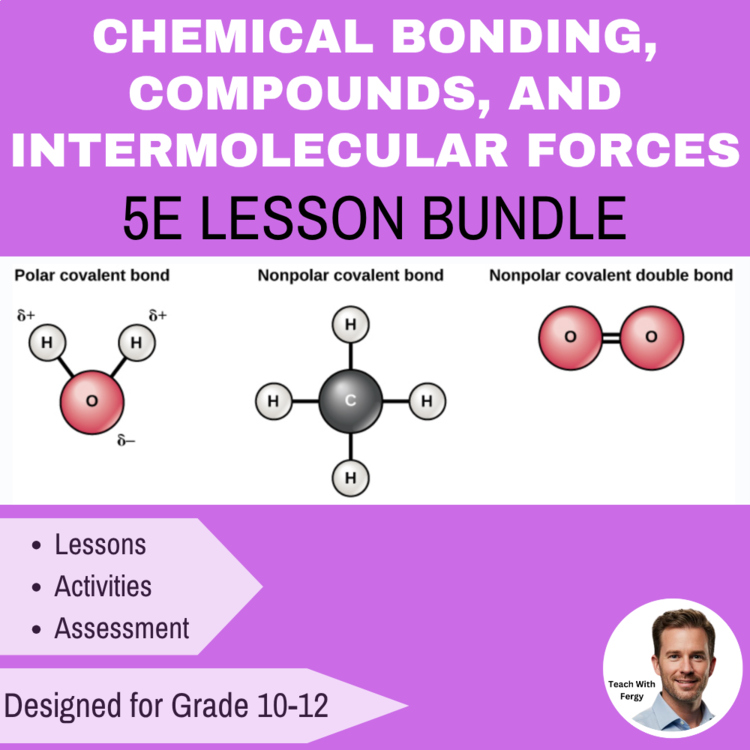
Chemical Bonding, Compounds, and Intermolecular Forces - Fully editable and Complete 5E Lesson. This bundle is designed for chemistry and physical science students studying chemical bonding, compound formation, molecular polarity, and intermolecular forces, and the content can be adapted to fit different learning levels.
Lesson Objectives:
Throughout this 5E lesson, students will learn about:
How does the 5E model facilitate learning?
What's included?
Engagement Phase – Video Worksheet
Exploration Phase – Device-Based Scavenger Hunt Activity
Your students will complete Types of Chemical Bonds Digital Scavenger Hunt Activity. This activity helps students explore bonding vocabulary, compare different types of chemical bonds, and build background knowledge before the main lessons. Students work individually or in small groups and focus on how ionic, covalent, polar covalent, nonpolar covalent, and metallic bonds are different rather than memorizing definitions in isolation.
Explanation Phase – Lessons
Supplemental activities can also be assigned to help students practice and reinforce understanding:
This is the instructional phase where concepts are presented in a clear and applicable way.
Elaborate Phase – Digital Interactive Notebook Pages
Your students will complete one or more of the following digital notebook or compound practice activities:
Teachers can assign one, two, or all of the digital notebook sections depending on time, student level, and how much practice students need with Lewis structures, chemical formulas, compound names, and bonding models. These activities allow students to extend their understanding of chemical bonding by applying bonding patterns to molecular compounds, ionic compounds, Lewis structures, and compound naming.
Evaluate Phase – Lab Station Activity
In groups of 2–3, have your students complete Types of Bonds & Intermolecular Forces Lab Station Activity. Once they are done, they will submit their passport to you. This phase gives students the chance to demonstrate their understanding of chemical bonds, intermolecular forces, and how different types of attractions affect the structure and properties of substances.
You may also use Molecular and Ionic Compounds Lab Station Activity as an additional or alternate evaluation activity if you want students to focus more heavily on compound formation, formulas, and naming.
This phase helps you evaluate whether students can compare different types of chemical bonds, explain the difference between bonds and intermolecular forces, and apply bonding concepts using evidence rather than only naming vocabulary terms.
The following 5E lessons are currently available in My Store
Physics
• Newton's Three Laws of Motion
• Current Electricity and Circuits
• One and Two-Dimensional Motion
• Static Electricity
• Projectile Motion
• Light and its Production
• Energy, Energy Transfer, and its Forms
• Kinetic and Gravitational Potential Energy
• Electricity Production
• Friction
• Density and Buoyancy
• Sound and Hearing
• Uniform Acceleration
• How Planes Fly
• Refraction
• Work
• Power
• Magnetic Fields
• Momentum, Conservation of Momentum, and Impulse
• Forces
• Flight
• Nuclear Energy - Fission and Fusion - Middle School
• Nuclear Energy - Fission and Fusion - High School
• Simple Machines - Middle School
• Simple Machines - High School
Biology
• Cells and the Cell Theory
• Digestive System
• Photosynthesis and Cellular Respiration
• Mitosis and the Cell Cycle
• Circulatory System
• Cancer
• Photosynthesis
• Respiratory System
• Cell Membrane and Transport
• Energy Flow In Ecosystems
• The Human Eye
• Genetic Material: DNA and RNA
• Nervous System
• Plant and Animal Cells
• Carbohydrates and Lipids
• Photosynthesis and Cellular Respiration
• Cellular Organelles - Cell Structure and Function
• Human Body Systems
• Genetics, Heredity, DNA, and Traits
Ecology
• The Cycling of Matter: The Water and Carbon Cycles
• Cells and the Cell Theory
• Ecosystems
• Biodiversity
• Invasive Species
• Interactions Within Ecosystems
• Photosynthesis
• Biomes
• The Classification of Living Things
• Photosynthesis
• Ecological Succession
• Energy Flow in Ecosystems
• Plant Sexual and Asexual Reproduction
Chemistry
• Physical and Chemical Properties and Changes
• Atoms and the Atomic Theory
• Chemical Reactions
• Types of Chemical Reactions and Balancing Equations
• Molecular and Ionic Compounds
• Acids, Bases, and pH
• The Periodic Table
• Particle Theory and Matter Classification
• The Mole/Avogadro's Number
• Types of Bonds and Intermolecular Forces
• Solutions and Mechanical Mixtures
• Matter and the Particle Theory of Matter
• Chemical Bonding, Compounds, and Intermolecular Forces
Coming Soon:
• Nomenclature
• Intermolecular Forces
• Stoichiometry
• Gases
Earth and Space Science
• Climate Change and Global Warming
• The Moon and its Phases
• Our Solar System
• The Seasons
• Human Space Exploration
• The Life and Death of Stars
• Asteroids, Comets, and Meteors
• Solar and Lunar Eclipse
• Tectonic Plates
• Rock Cycle
• Earth, Sun, & Moon Patterns
Coming Soon:
• Galaxies and our Universe
Report this resource to Linked Through Learning
Reported resources will be reviewed by our team. Report this resource to let us know if this resource breaks our rules.
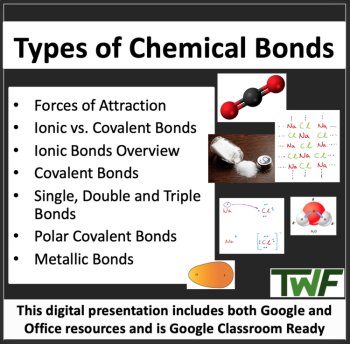
This chemistry lesson package starts by looking at forces of attraction - intramolecular and intermolecular and compares ionic and covalent bonds. It then looks at single, double, and triple bonds, polar covalent bonds, and metallic bonds. It is geared towards students who are in high school chemist
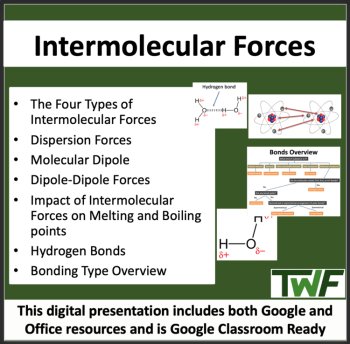
This chemistry lesson package starts by reviewing what intermolecular forces are and the four main kinds. It then goes into detail for each and looks at the impact intermolecular forces have on melting and boiling points. The lesson concludes by comparing inter and intramolecular forces. It is geare
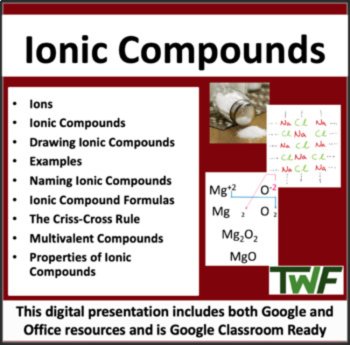
Ionic Compounds. This lesson package includes the lesson (student and teacher versions of the presentation), FOUR worksheets with answers, an auto-graded Exit Ticket to check student understanding, and a student lesson handout as a document. The presentation is fun and engaging with a worksheet buil
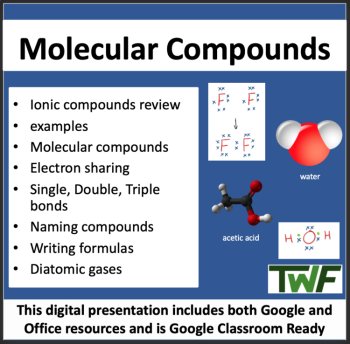
Molecular Compounds. This lesson package includes the lesson (student and teacher versions of the presentation), THREE worksheets with answers, SIX embedded videos, an auto-graded Exit Ticket to check student understanding, and a student lesson handout as a document.➡️ Click here to have a look at t...
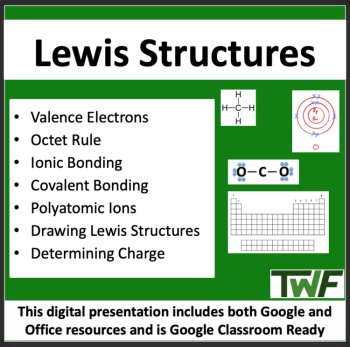
This chemistry lesson package discusses valence electrons, the octet rule, ionic and covalent bonding, polyatomic ions, drawing lewis structures, and determining charge. It is geared towards students who are in high school chemistry, either junior or senior years. In order, the lesson covers:Valence
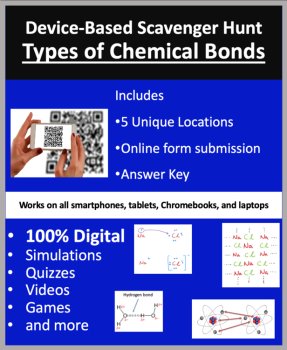
Types of Chemical Bonds - A Digital, Device-Based resource that will get your kids out of their seats, engaged, utilizing technology, and collaborating to solve real problems and test their knowledge. This activity works well across grades as a means of assessment, review, and/or instruction. This h
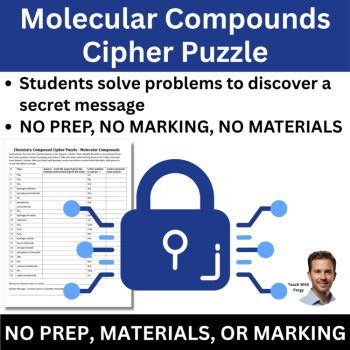
Engage your students with this NO PREP, interactive chemistry cipher activity focused on molecular compounds, chemical formulas, prefixes, and compound naming.In this structured challenge, students solve clues by either naming molecular compounds from formulas or writing formulas from compound names
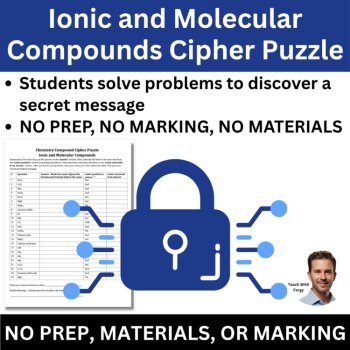
Engage your students with this NO PREP, interactive chemistry cipher activity focused on ionic and molecular compounds, chemical formulas, and compound naming.In this structured challenge, students solve clues by either naming compounds from formulas or writing formulas from compound names. After ea
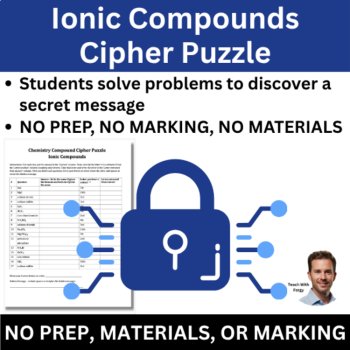
Engage your students with this NO PREP, interactive chemistry cipher activity focused on ionic compounds, chemical formulas, and compound naming.In this structured challenge, students solve clues by either naming ionic compounds from formulas or writing formulas from compound names. After each answe
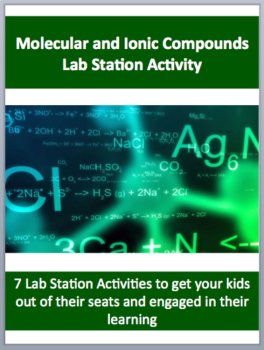
This fully editable Lab Station Activity on Molecular and Ionic Compounds is meant to get your students out of their seats and engaged in the content. Each station not only offers a unique opportunity to test your student's knowledge (offer an opinion, answer questions based on a video or reading, d
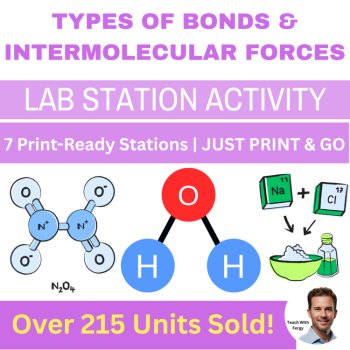
This fully editable Lab Station on Types of Bonds and Intermolecular Forces is meant to get your students out of their seats and engaged in the content. Each station not only offers a unique opportunity to test your students knowledge (offer an opinion, answer questions based on a video or reading,
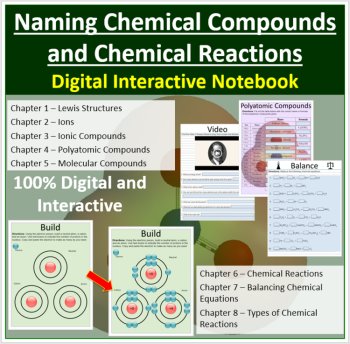
High School Digital Interactive Notebook - Naming Chemical Compounds and Chemical Reactions. Designed specifically for the 1:1 classroom utilizing any kind of digital device such as Chromebooks, Cellphones, or Tablets.This resource comes packed with 26 engaging activities spread over 39 interactive
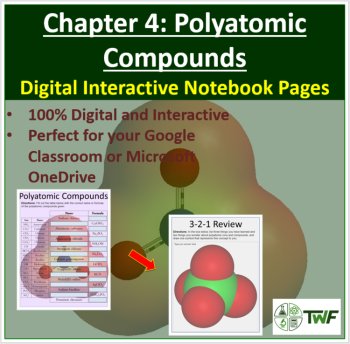
Middle School and High School Digital Interactive Notebook Pages - Polyatomic Compounds. Designed specifically for the 1:1 classroom utilizing any kind of digital device such as Chromebooks, Cellphones, or Tablets.Engage your students and utilize technology to bring science to life for your students
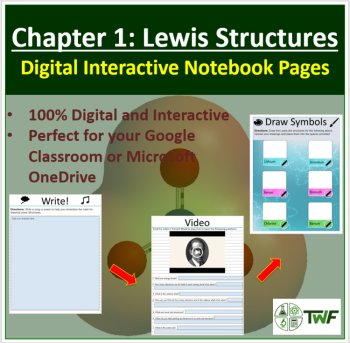
Middle School and High School Digital Interactive Notebook Pages - Lewis Structures. Designed specifically for the 1:1 classroom utilizing any kind of digital device such as Chromebooks, Cellphones, or Tablets.Engage your students and utilize technology to bring science to life for your students. Th
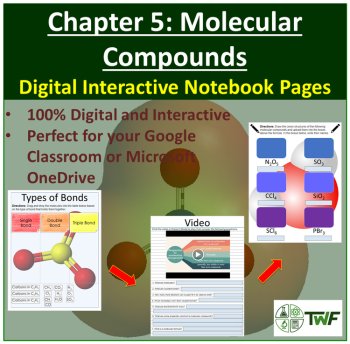
Middle School and High School Digital Interactive Notebook Pages - Molecular Compounds. Designed specifically for the 1:1 classroom utilizing any kind of digital device such as Chromebooks, Cellphones, or Tablets.Engage your students and utilize technology to bring science to life for your students.
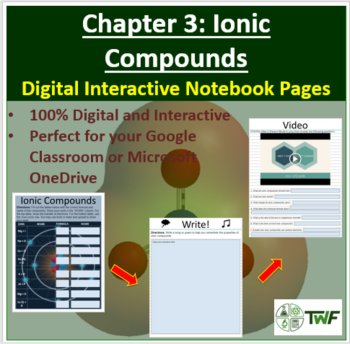
Middle School and High School Digital Interactive Notebook Pages - Ionic Compounds. Designed specifically for the 1:1 classroom utilizing any kind of digital device such as Chromebooks, Cellphones, or Tablets.Engage your students and utilize technology to bring science to life for your students. Thi
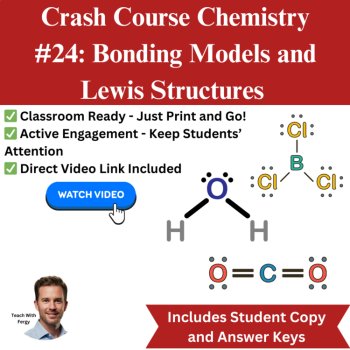
Crash Course Chemistry #24: BONDING MODELS AND LEWIS STRUCTURES Video Worksheet. Whether you are introducing, reviewing, or leaving it as a sub plan, my Crash Course video worksheet is a terrific solution.Your worksheet includes a direct YouTube video link! Just click and go.Key Concepts Covered in
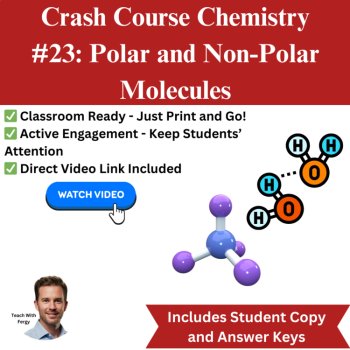
Crash Course Chemistry #23: POLAR AND NON-POLAR MOLECULES Video Worksheet. Whether you are introducing, reviewing, or leaving it as a sub plan, my Crash Course video worksheet is a terrific solution.Your worksheet includes a direct YouTube video link! Just click and go.Key Concepts Covered in the Vi
No questions yet.

Meet the Seller
Middle and High School Science Engaging Resources
I have been selling resources to middle and high school teachers for the last 15 years. During that time I've also been in the classroom so I know what works and what will help your students the most.
Canada
$22.50 $34.75 (318)
$22.50 $33.50 (190)
$22.50 $33.00 (128)