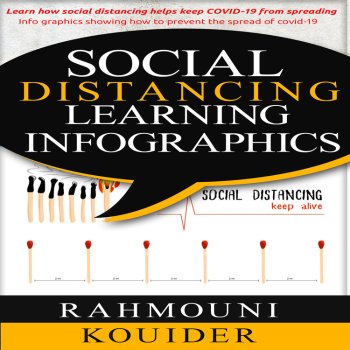
Social Distancing Learning Infographics
Free

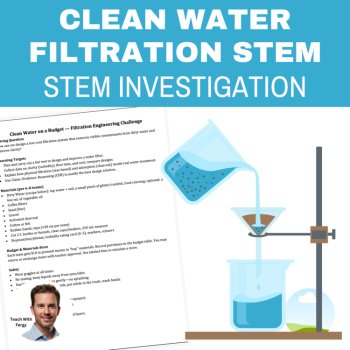
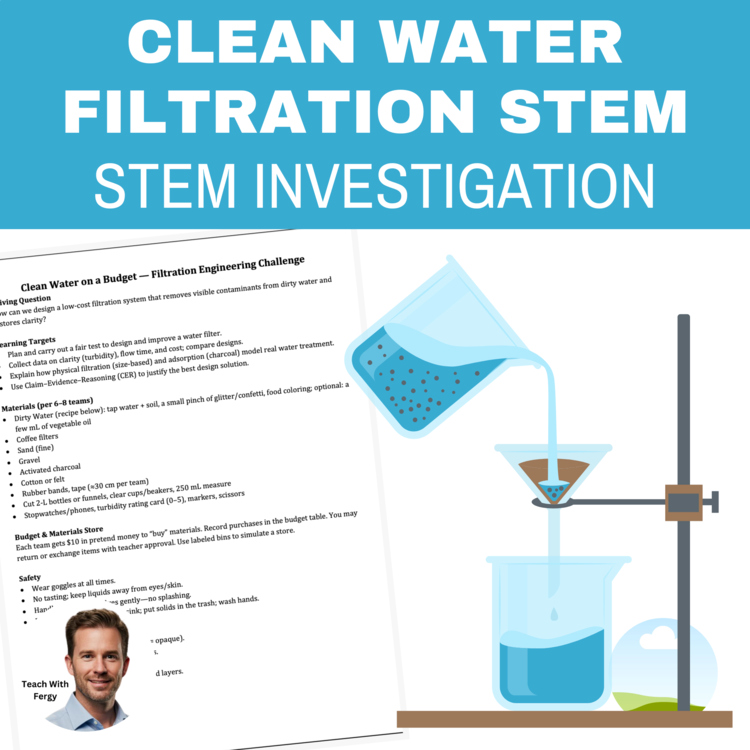
Give students a fast, hands-on engineering investigation: build a low-cost water filter, change only one design choice at a time (layer order, thickness, sealing, or adding charcoal), and measure which design makes the clearest water the fastest—all while staying under a classroom budget cap.
With tight build rules and simple materials, students plan a fair test, collect two trials, average their data, and create a comparison bar graph.
The teacher guide explains the science—physical filtration (size-based particle trapping) and adsorption by activated charcoal—so you can teach why the best design works, not just do the challenge.
What’s Included
Why Teachers Love It
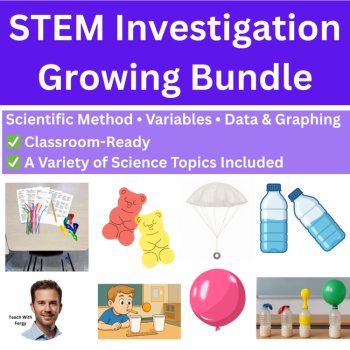
➡️ You can get this STEM as well as all my other ones in this series inside my STEM Investigations Growing Bundle. As more labs are added, the price will increase. CLICK HERE to have a look
Best For
Science or STEM; Earth/Environmental science, engineering design, scientific method, data & graphing, stations, enrichment, or sub plans.
Materials Needed
Estimated Timing
➡️ You can get this activity inside my STEM Investigations Growing Bundle.
I also have the following STEM Labs in My Store:
NGSS alignment
Report this resource to Linked Through Learning
Reported resources will be reviewed by our team. Report this resource to let us know if this resource breaks our rules.
No questions yet.

Meet the Seller
Middle and High School Science Engaging Resources
I have been selling resources to middle and high school teachers for the last 15 years. During that time I've also been in the classroom so I know what works and what will help your students the most.
Canada
AI Assisted
I develop the ideas, plan the activities, and guide the creation of all resources. AI tools assist with writing, illustrations, and design. Every resource is reviewed, edited, and refined using my teaching experience to ensure quality, accuracy, and meaningful real-world learning.
$6.38 $7.98

AI Assisted
I develop the ideas, plan the activities, and guide the creation of all resources. AI tools assist with writing, illustrations, and design. Every resource is reviewed, edited, and refined using my teaching experience to ensure quality, accuracy, and meaningful real-world learning.
$7.60 $9.50

AI Assisted
I develop the ideas, plan the activities, and guide the creation of all resources. AI tools assist with writing, illustrations, and design. Every resource is reviewed, edited, and refined using my teaching experience to ensure quality, accuracy, and meaningful real-world learning.
$5.60 $7.00
AI Assisted
I develop the ideas, plan the activities, and guide the creation of all resources. AI tools assist with writing, illustrations, and design. Every resource is reviewed, edited, and refined using my teaching experience to ensure quality, accuracy, and meaningful real-world learning.
$5.60 $7.00
AI Assisted
I develop the ideas, plan the activities, and guide the creation of all resources. AI tools assist with writing, illustrations, and design. Every resource is reviewed, edited, and refined using my teaching experience to ensure quality, accuracy, and meaningful real-world learning.
$6.56 $8.20