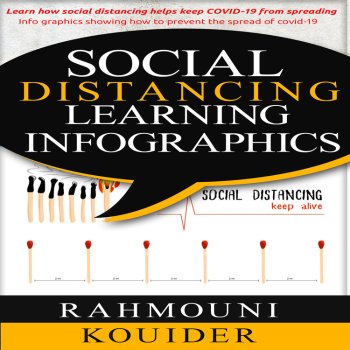
Social Distancing Learning Infographics

Free

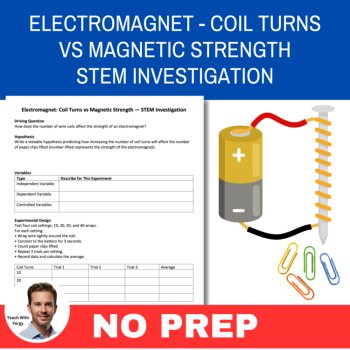
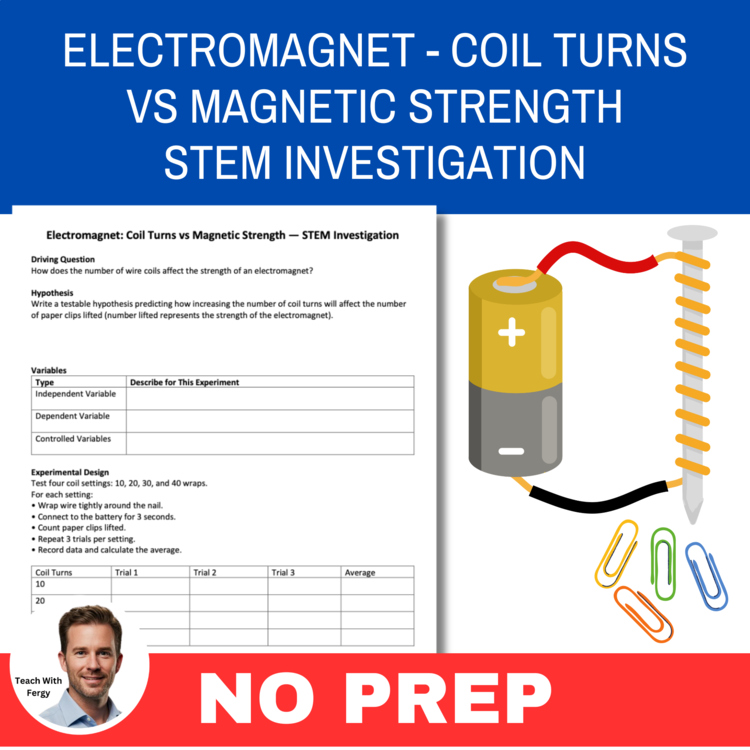
Students will investigate electromagnetism by building their own classroom-made electromagnets and testing how changing the number of wire coils affects magnetic strength. Using an iron nail, insulated wire, a battery, and paper clips, students observe how electric current creates a magnetic field and how increasing coils strengthens that field. Through repeated trials, data collection, averaging, graphing, and a CER, students discover the relationship between coil turns and magnetic force while building core lab and engineering skills.
Learning Targets
What’s Included
Setup diagrams, safety notes, battery-use guidelines, and clear background explanations of electromagnetism. Includes guidance for standardizing coil wrapping, contact time, battery connections, and paper clip testing to ensure fair comparisons.
Hypothesis prompt, variables chart, step-by-step build/setup instructions, 3-trial data table per coil setting, average calculations, comparison table, graphing task, and structured CER response.Class totals chart, bar/line graph template (“Average Paper Clips Lifted vs Coil Turns”), labeled axes, and a caption prompt requiring students to identify which coil setting produced the strongest electromagnet using numerical evidence.
Class totals chart, bar-graph template (“Average Distance vs Nozzle Diameter”), labeled-axes lines, and a caption prompt requiring students to identify which nozzle produced the greatest thrust using numerical evidence.
Expected patterns (more coils → stronger magnet), sample data, reasoning examples, common error sources, and a full model CER paragraph grounded in magnetic field and current concepts.
Assesses experimental design, data accuracy, graph quality, CER strength, and teamwork/safety — fully aligned with middle-school science practices.
Why Teachers Love It:
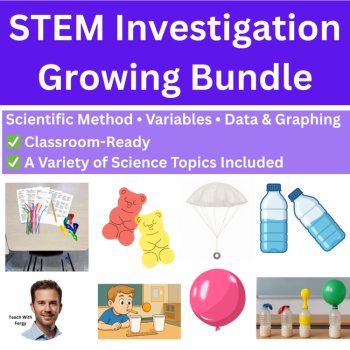
➡️ You can get this STEM as well as all my other ones in this series inside my STEM Investigations Growing Bundle. As more labs are added, the price will increase. CLICK HERE to have a look
Best For
Physical Science (electricity & magnetism), engineering design, lab skills, graphing, CER writing, forces & fields, STEM challenges, or sub-friendly hands-on lessons.
Materials Needed
Iron nail (same size per group), insulated copper wire, D-cell battery or AA battery pack, paper clips (identical size), electrical tape, scissors or wire strippers, student packet (included). Optional: timer, safety goggles.
Estimated Timing
1 class period for build → testing → data collection → class graph
Add 20–30 minutes for CER writing, discussion questions, and improvement proposals
➡️ You can get this activity inside my STEM Investigations Growing Bundle.
I also have the following STEM Labs in My Store:
NGSS alignment
MS-PS2-3, MS-PS2-5 (forces & interactions, electric and magnetic forces)
Practices: Planning & Carrying Out Investigations; Analyzing Data; Using Mathematics & Computation; Constructing Explanations; Argument from Evidence
Assessment
Use the included rubric to score environment understanding, adaptation quality and plausibility, scientific accuracy, CER strength, and class data/graph work.
Report this resource to Linked Through Learning
Reported resources will be reviewed by our team. Report this resource to let us know if this resource breaks our rules.
No questions yet.

Meet the Seller
Middle and High School Science Engaging Resources
I have been selling resources to middle and high school teachers for the last 15 years. During that time I've also been in the classroom so I know what works and what will help your students the most.
Canada
AI Assisted
I develop the ideas, plan the activities, and guide the creation of all resources. AI tools assist with writing, illustrations, and design. Every resource is reviewed, edited, and refined using my teaching experience to ensure quality, accuracy, and meaningful real-world learning.
$6.38 $7.98

AI Assisted
I develop the ideas, plan the activities, and guide the creation of all resources. AI tools assist with writing, illustrations, and design. Every resource is reviewed, edited, and refined using my teaching experience to ensure quality, accuracy, and meaningful real-world learning.
$7.60 $9.50
AI Assisted
I develop the ideas, plan the activities, and guide the creation of all resources. AI tools assist with writing, illustrations, and design. Every resource is reviewed, edited, and refined using my teaching experience to ensure quality, accuracy, and meaningful real-world learning.
$5.60 $7.00
AI Assisted
I develop the ideas, plan the activities, and guide the creation of all resources. AI tools assist with writing, illustrations, and design. Every resource is reviewed, edited, and refined using my teaching experience to ensure quality, accuracy, and meaningful real-world learning.
$5.60 $7.00
AI Assisted
I develop the ideas, plan the activities, and guide the creation of all resources. AI tools assist with writing, illustrations, and design. Every resource is reviewed, edited, and refined using my teaching experience to ensure quality, accuracy, and meaningful real-world learning.
$6.56 $8.20