Science Posters- The Periodic Table-Brown Corduroy Design
$5.00 (1)

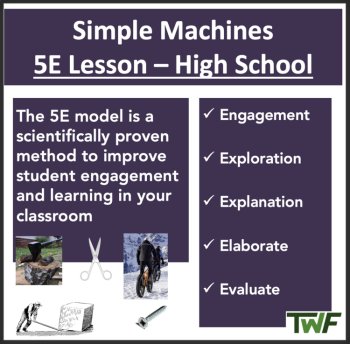
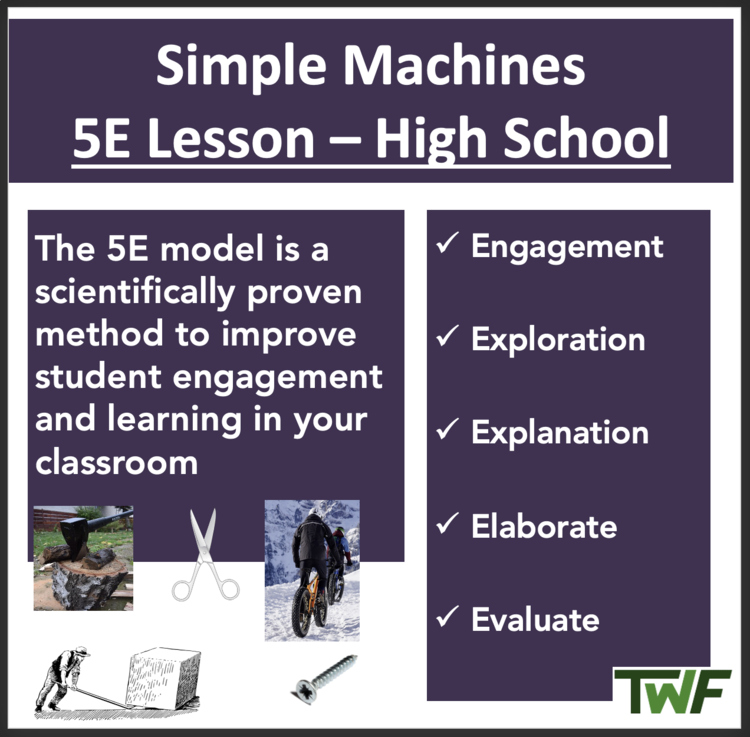
Simple Machines - High School - 5E Lesson Bundle | Lever, Inclined Plane, Pulley
$18.38 $9.97
Get BundleSimple Machines - Fully editable and Complete 5E Lesson. This bundle is designed for a middle school science class - grades 9-11.
Lesson Objectives:
Throughout this 5E lesson, students will learn about:
How does the 5E model facilitate learning?
What's included?
Engagement Phase
- This portion includes a comprehension reading that will introduce your students to nuclear energy and includes discussion and extension questions to test their understanding
- Creates interest and excitement for your students
- Asks questions and probes their initial conceptions
Exploration Phase
- Students use and develop creative thinking skills, make observations, record results, and make connections
- This bundle comes with a 7-station, Lab Activity where they will gain real experiences with the topic
**Note: The lab station activity requires very little preparation or materials**
- For a complete description of the lab station activity, please see below
Explanation Phase
- This is the instructional phase where concepts are presented via a lesson presentation to the students in a clear and applicable way
- Students develop an understanding of the content
- Observations and experiences are discussed and critiqued
- Students develop vocabulary
- Students are able to connect the content presented to previous experiences
- This bundle includes one lesson in PowerPoint and .PDF formats. For a complete description of it, please see below
Elaborate Phase
- This phase involves the students completing an activity or assignment that forces them to expand their thinking and knowledge of the topic. They will propose solutions and extend their learning to new situations
Evaluate Phase
- Your students will demonstrate their understanding and evaluate their own progress
- This phase involves the students completing an activity or assignment that forces them to expand their thinking and knowledge of the topic. They will propose solutions and extend their learning to new situations
- The evaluation section includes a quiz that will allow you to evaluate your students' topic understanding
------------------------------------------------------------
The NRC's How People Learn has synthesized decades of research across many different disciplines about how people learn (NRC, 1999 blue right-pointing triangle). Key findings from that synthesis include the following. First, students (people) must be interested and engaged in what they are learning and find it useful and meaningful. Second, students (people) must be actively involved in the process of teaching and learning, comparing new information to previous ideas, constructing new understandings, and quite simply changing their own minds about how the world works. And third, students (people) need opportunities to apply what they have learned to new situations, to check the completeness of their understanding, and to evaluate their own learning for themselves. (https://www.ncbi.nlm.nih.gov/pmc/articles/PMC2931660/)
By incorporating this 5E lesson, you will provide your students with a meaningful and coherent way of learning that best suits their needs. You will also utilize technology in a way that creates order and promotes understanding.
------------------------------------------------------------
The following 5E lessons are currently available in My Store
Physics
• Newton's Three Laws of Motion
• Current Electricity and Circuits
• One and Two-Dimensional Motion
• Static Electricity
• Projectile Motion
• Light and its Production
• Energy, Energy Transfer, and its Forms
• Kinetic and Gravitational Potential Energy
• Electricity Production
• Friction
• Density and Buoyancy
• Sound and Hearing
• Uniform Acceleration
• How Planes Fly
• Refraction
• Work
• Power
• Magnetic Fields
• Momentum, Conservation of Momentum, and Impulse
• Forces
• Flight
• Nuclear Energy - Fission and Fusion - Middle School
• Nuclear Energy - Fission and Fusion - High School
• Simple Machines - Middle School
• Simple Machines - High School
Biology
• Cells and the Cell Theory
• Digestive System
• Photosynthesis and Cellular Respiration
• Mitosis and the Cell Cycle
• Circulatory System
• Cancer
• Photosynthesis
• Respiratory System
• Cell Membrane and Transport
• Energy Flow In Ecosystems
• The Human Eye
• Genetic Material: DNA and RNA
• Nervous System
• Plant and Animal Cells
• Carbohydrates and Lipids
• Photosynthesis and Cellular Respiration
Ecology
• The Cycling of Matter: The Water and Carbon Cycles
• Cells and the Cell Theory
• Ecosystems
• Biodiversity
• Invasive Species
• Interactions Within Ecosystems
• Photosynthesis
• Biomes
• The Classification of Living Things
• Photosynthesis
• Ecological Succession
• Energy Flow in Ecosystems
• Plant Sexual and Asexual Reproduction
Chemistry
• Physical and Chemical Properties and Changes
• Atoms and the Atomic Theory
• Chemical Reactions
• Types of Chemical Reactions and Balancing Equations
• Molecular and Ionic Compounds
• Acids, Bases, and pH
• The Periodic Table
• Particle Theory and Matter Classification
• The Mole/Avogadro's Number
• Types of Bonds and Intermolecular Forces
• Solutions and Mechanical Mixtures
Coming Soon:
• Matter
• Trends in the Periodic Table
• Nomenclature
• Intermolecular Forces
• Stoichiometry
• Gases
Earth and Space Science
• Climate Change and Global Warming
• The Moon and its Phases
• Our Solar System
• The Seasons
• Human Space Exploration
• The Life and Death of Stars
• Asteroids, Comets, and Meteors
• Solar and Lunar Eclipse
• Tectonic Plates
• Rock Cycle
Coming Soon:
• Galaxies and our Universe
------------------------------------------------------------
Engagement - 'Simple Machines – Digital Science Reading Article’
The students will read an article and answer reflection and extension questions based off the information in the reading.
Explore - 'Simple Machines Lab Station Activity'
This fully editable Lab Station Activity is meant to get your students out of their seats and engaged in the content.
Each station not only offers a unique opportunity to test your students' knowledge (offer an opinion, answer questions based on a video or reading, draw, etc.), but also provides a fantastic learning opportunity where your kids are learning through assessment. Each station comes with a description card while some also contain more detailed instructions, a reading, questions to answer, etc. Students are equipped with a recording sheet (passport) to write their answers. There is almost no prep for you. Simply print the cards, lay them out around the room and you're all set. An answer key is also provided where applicable.
Explain - 'Simple Machines Lesson'
Throughout the lesson, students will learn about:
Elaborate -
1) ' Rube Goldberg Simple Machine Project'
2) 'Rube Goldberg STEM project'
This project merges science with art, allowing students to express their understanding of simple machines through building and design. Designed to align with Next Generation Science Standards (NGSS), this assignment will challenge your students to explain content into an informative and visually appealing infographic suitable for display.
Evaluate - Evaluate Phase - Simple Machines Test
This test includes multiple choice, true and false, and short answer questions meant to check their understanding and progress.
Report this resource to Linked Through Learning
Reported resources will be reviewed by our team. Report this resource to let us know if this resource breaks our rules.
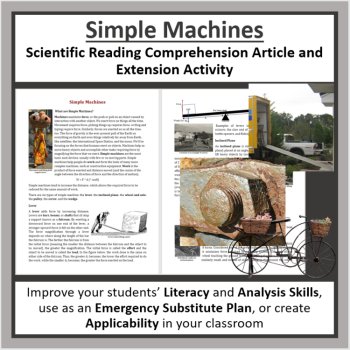
Simple Machines Reading Comprehension Passage and Questions. This resource is suitable for high school students as well as strong middle school students. Tackle literacy and science by having your students read and answer questions from a scientific article. Questions include knowledge (direct from
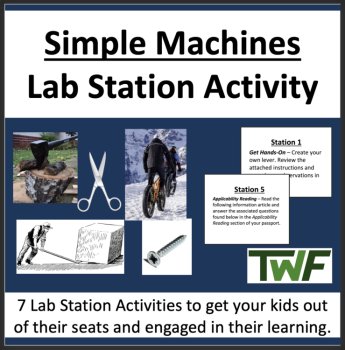
This fully editable Lab Station Activity on Simple Machines is meant to get your students out of their seats and engaged in the content.Each station not only offers a unique opportunity to test your students' knowledge (offer an opinion, answer questions based on a video or reading, draw, etc.) but
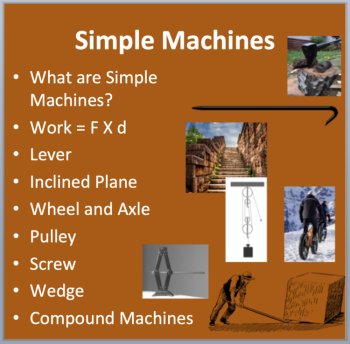
This 30-slide PowerPoint lesson on Simple Machines begins by examining what Simple Machines are as well as an explanation of what Work is. It then goes into the six main types of Simple Machines - Levers, Inclined Planes, Wheel and Axle, Pulleys, Screws, and Wedges. The lesson concludes by looking a
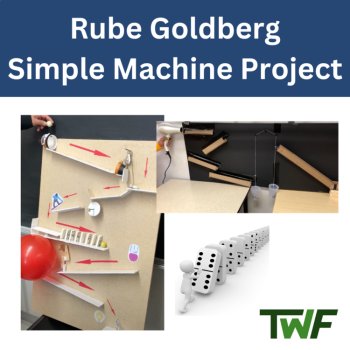
Unleash Creativity with the Rube Goldberg with this Simple Machine Challenge: The ChallengeThe main goal of this activity is for students to gain experience in collaborating with other students on a simple machine – Rube Goldberg design project. Students will also learn about force, motion, energy t
Unleash Creativity with the Rube Goldberg Machine Challenge: A Journey into the Heart of Physics and Engineering for High School Students!The ChallengeEquipped with a variety of commonplace materials, students are tasked to create an elaborate Rube Goldberg machine. The objective is to perform a sim
No questions yet.

Meet the Seller
Middle and High School Science Engaging Resources
I have been selling resources to middle and high school teachers for the last 15 years. During that time I've also been in the classroom so I know what works and what will help your students the most.
Canada