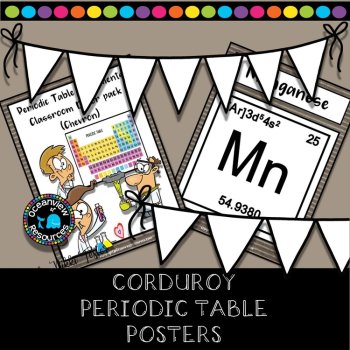
Science Posters- The Periodic Table-Brown Corduroy Design
$5.00 (1)

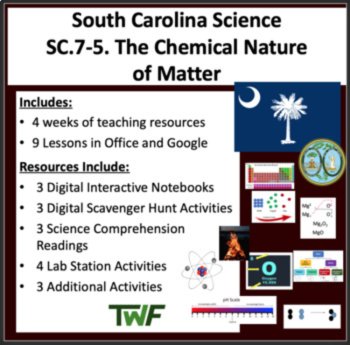
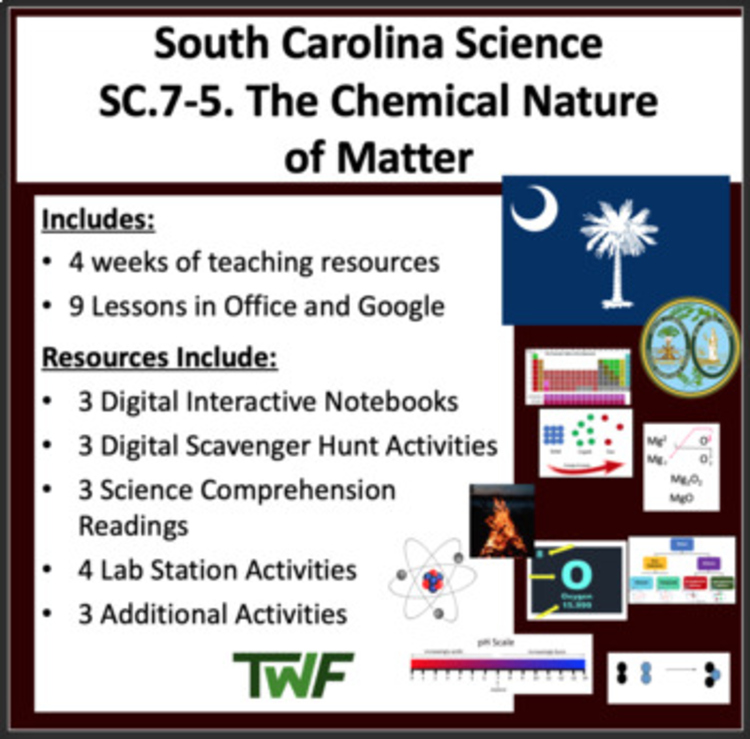
South Carolina State Standards-Science Gr7 SC.7-5. The Chemical Nature of Matter
$75.70 $38.82
Get BundleThis science package includes lessons and activities for SC.7-5. The Chemical Nature of Matter. Within the unit package, you'll find the lessons and activities I use in my own classroom.
SC.7-5. The Chemical Nature of Matter: The student will demonstrate an understanding of the classifications and properties of matter and the changes that matter undergoes.
This unit includes the following resources:
7-5.1. Recognize that matter is composed of extremely small particles called atoms.
7-5.2. Classify matter as an element, compound, or mixture on the basis of its composition.
7-5.3. Compare the physical properties of metals and nonmetals. AND
7-5.9. Compare physical properties of matter (including melting or boiling point, density, and color) to the chemical property of reactivity with a certain substance (including the ability to burn or to rust). AND
7-5.10. Compare physical changes (including changes in size, shape, and state) to chemical changes that are the result of chemical reactions (including changes in color or temperature and formation of a precipitate or gas).
7-5.4. Use the periodic table to identify the basic organization of elements and groups of elements (including metals, nonmetals, and families).
7-5.5. Translate chemical symbols and the chemical formulas of common substances to show the component parts of the substances (including NaCl [table salt], H2O [water], C6H12O6 [simple sugar], O2 [oxygen gas], CO2 [carbon dioxide], and N2 [nitrogen gas]).
7-5.6. Distinguish between acids and bases and use indicators (including litmus paper, pH paper, and phenolphthalein) to determine their relative pH.
7-5.7. Identify the reactants and products in chemical equations.
7-5.8. Explain how a balanced chemical equation supports the law of conservation of matter.
Included in the package:
Each lesson contains:
*****************************
The remaining South Carolina Grade 7 Science Standards are also available and can be found below:
If you'd like to gain access to ALL of the standards at a significant reduction in price, please check out my South Carolina Grade 7 Science Standards Bundle.
*****************************
Google, Office, and Distance Learning Ready
What are the student versions and how do they encourage student understanding?
The student versions of the presentations contain multiple blanks that need to be filled in throughout the lesson. These blanks are conveniently underlined and bolded on the teacher copy. I have found this to be the most effective means of keeping my students engaged and active without having them write everything out. This also leaves more time for discussion and activities.
***************************
I also have a range of assignments and lessons/units from other grade levels at my store. Please CLICK HERE to have a look around and don’t forget to follow if you like what you see.
Also, please visit my blog Teach With Fergy for my thoughts on teaching, learning, and everything in between.
Report this resource to Linked Through Learning
Reported resources will be reviewed by our team. Report this resource to let us know if this resource breaks our rules.
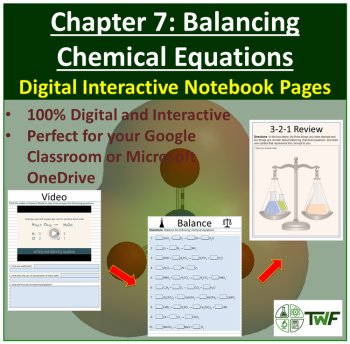
Middle School and High School Digital Interactive Notebook Pages - Balancing Chemical Equations. Designed specifically for the 1:1 classroom utilizing any kind of digital device such as Chromebooks, Cellphones, or Tablets.Engage your students and utilize technology to bring science to life for your
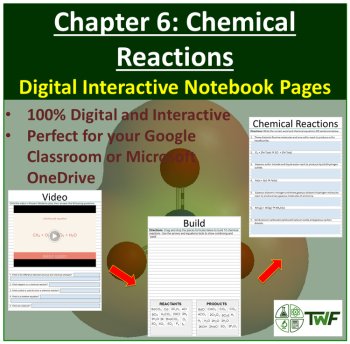
Middle School and High School Digital Interactive Notebook Pages - Chemical Reactions. Designed specifically for the 1:1 classroom utilizing any kind of digital device such as Chromebooks, Cellphones, or Tablets.Engage your students and utilize technology to bring science to life for your students.
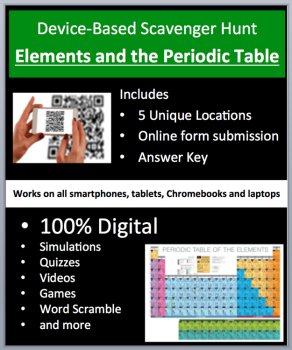
Elements and the Periodic Table – Scavenger Hunt – Device-Based Scavenger Hunt Activity. This activity is the coolest thing I've created and your kids are going to love it, mine do. Think of a scavenger hunt, then add devices (Smartphones, Chromebooks, Laptops, or Tablets), engaged students, and lea
25 Digital Boom Cards on Properties, Density, and Classification of Matter. Boom Cards are highly interactive Digital Task Cards that are self-grading and highly interactive. Boom Cards are the perfect addition to your curriculum.Perfect for practice, distance learning, reinforcement, and homeworkPr
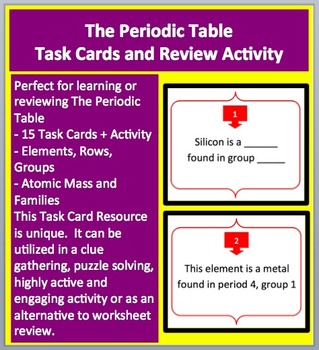
This 15 Periodic Table and Elements Task Card resource allows your students to review concepts involving Elements, Rows, Groups, Atomic Mass and Families. Example Questions Include: Question 1: Silicon is a ______ found in group _____. Question 2: This collection of elements on the periodic table co
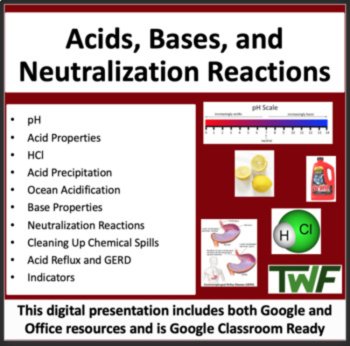
Acids and Bases - This TWO-DAY lesson package includes the lesson (student and teacher versions of the presentation), TWO worksheets with answers, FOUR embedded videos, and a student lesson handout as a document.➡️ Click here to have a look at the FULL LESSON VIDEOThe lesson is interesting, applicab...
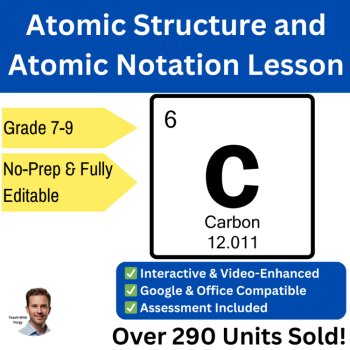
Atomic Structure and Notation Lesson. This lesson package introduces Atoms, Protons, Neutrons, and Electrons. Furthermore, it explains Atomic Number, Mass Number, and Atomic Symbols. This package includes the lesson (student and teacher versions of the presentation), an auto-graded Exit Ticket to ch
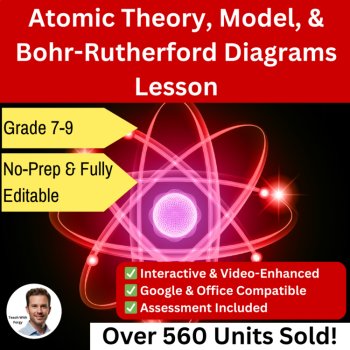
Atomic Model and Theory Lesson - The History of the Atom and Bohr-Rutherford Diagrams. This 27 slide Atomic Model lesson package examines the history of the atomic theory including the contributions of key persons as well as their influence on how the atom was perceived in their time including Democ
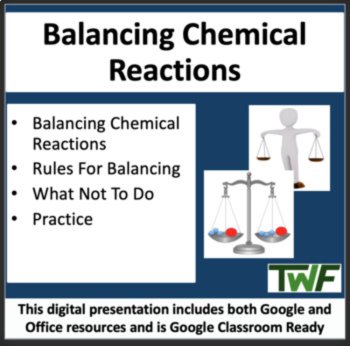
Balancing Chemical Reactions - This lesson package includes the lesson (student and teacher versions of the presentation), THREE worksheets with answers, one embedded video, and a student lesson handout as a document.The lesson is interesting, applicable, and provides many opportunities for students
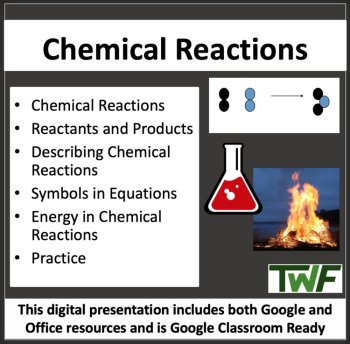
Chemical Reactions - This lesson package includes the lesson (student and teacher versions of the presentation), TWO worksheets with answers, and a student lesson handout as a document. The lesson is fun, applicable, and provides an easy-to-understand way of introducing chemical reactions.➡️ Click h...
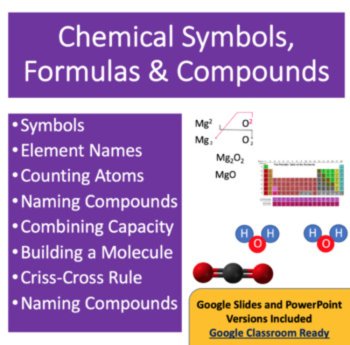
An introduction to Chemical Symbols, Formulas and Compounds. This TWO DAY package includes the lesson (student and teacher versions of the presentation), an auto-graded Exit Ticket to check student understanding, and a student lesson handout as a document. The lesson is fun and engaging with a works
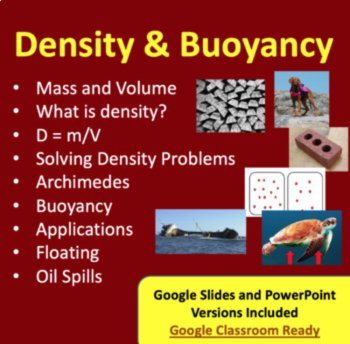
The THREE-DAY package includes the lesson (student and teacher versions of the presentation), an auto-graded Exit Ticket to check student understanding, a laboratory experiment, TWO worksheets with answers, and a student lesson handout as a document. The presentation is fun and applicable with FOUR
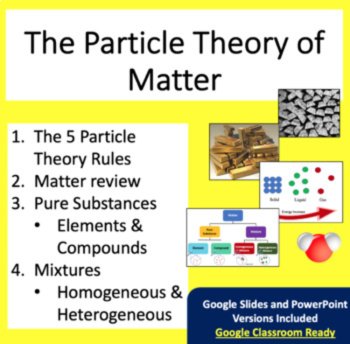
2 DAY Lesson Package on the Particle Theory and Classification of Matter. This package includes the lesson (student and teacher versions of the presentation), an auto-graded Exit Ticket to check student understanding, and a student lesson handout as a document. The presentation is fun and applicable
The periodic table made clear in a two-day lesson: students learn periodic table history (Mendeleev), element squares, atomic number & mass, valence electrons, metals/nonmetals/metalloids, and groups/families & periods of the periodic table. Editable Google Slides & PowerPoint with 2 emb
Physical and Chemical Properties and Changes. This TWO-DAY Physical and Chemical Properties and Changes package includes the lesson (student and teacher versions of the presentation), an auto-graded Exit Ticket to check student understanding, 3 student worksheets (including 1 video worksheet), and a
Tackle literacy and science by having your students read and answer questions from a scientific article about Cleaning up Acid Spills. Questions include knowledge (direct from the paper), thinking, connecting, application, and open-ended varieties.The reading looks at:- pH- How is an acid spill clea
Tackle literacy and science by having your students read and answer questions from a scientific article about Ocean Acidification. Questions include knowledge (direct from the paper), thinking, connecting, application, and open-ended varieties.The reading looks at:- Explaining pH value- The relation
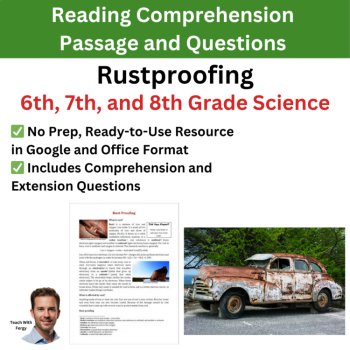
Tackle literacy and science by having your students read and answer questions from a scientific article about Rustproofing. Questions include knowledge (direct from the paper), thinking, connecting, application, and open-ended varieties.The reading looks at:- What is rust?- What is affected by rust?
No questions yet.

Meet the Seller
Middle and High School Science Engaging Resources
I have been selling resources to middle and high school teachers for the last 15 years. During that time I've also been in the classroom so I know what works and what will help your students the most.
Canada