
Riding Freedom Novel Study – A Cross-Curricular Journey

$12.00

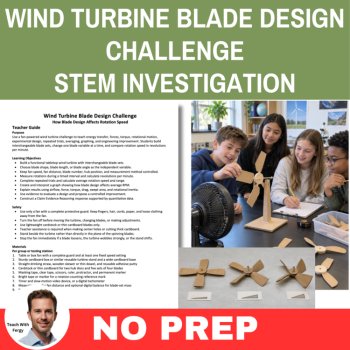
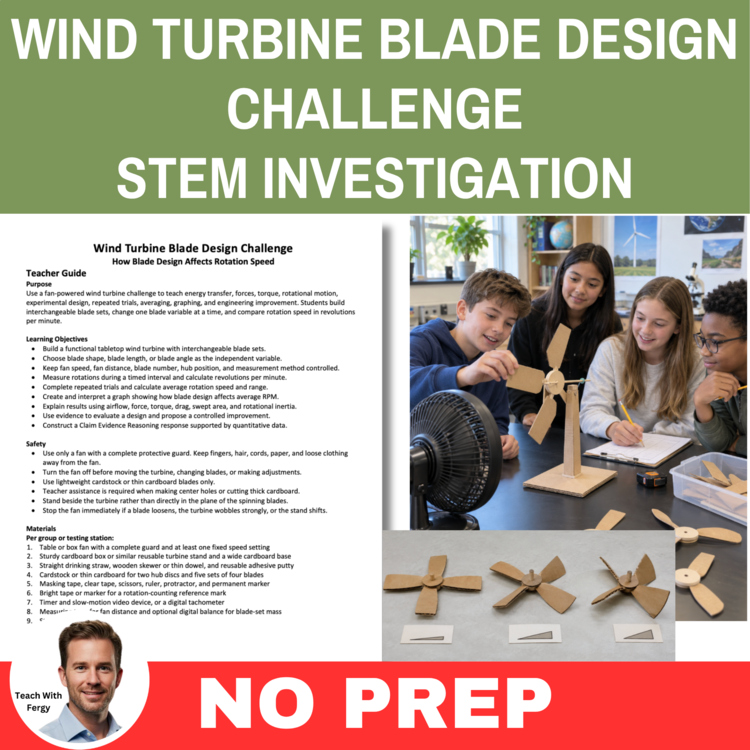
Students will investigate wind energy, turbine blade design, and rotational motion by designing and testing their own fan-powered model wind turbine. Using a guarded fan, reusable turbine stand, rotating axle, and interchangeable blade sets, students explore how blade shape, length, or angle affects rotation speed.
During this two- to three-day investigation, students count revolutions, calculate RPM, complete repeated trials, graph average rotation speed, and evaluate which blade design performs most effectively. Through engineering design, controlled testing, quantitative data collection, graphing, analysis questions, and a structured Claim–Evidence–Reasoning (CER) response, students connect energy transfer and forces to real-world wind-turbine engineering.
Learning Targets
What’s Included
Teacher Guide
Background explanations of wind energy, energy transfer, rotational motion, torque, drag, swept area, rotational inertia, blade angle, blade length, and blade shape. Includes safety information, recommended variable levels, turbine-building instructions, testing guidance, expected results, suggested timing, and common classroom pitfalls with practical fixes.
Student Packet
Driving question, hypothesis prompt, variable-selection chart, variables table, five-design planning chart, blade-design sketches, construction instructions, step-by-step testing procedure, RPM calculations, quantitative and qualitative data tables, graphing task, design evaluation, analysis questions, and a guided CER response.
Engineering Design Challenge
Students build one reusable turbine stand and five interchangeable four-blade rotors. Each group selects one blade feature—shape, length, or angle—to investigate while keeping the remaining design features and testing conditions controlled.
Data Collection & Graphing
Students complete three trials for each blade design. They count revolutions during a 10-second interval, convert their measurements to RPM, and calculate average RPM and range.
Students create either:
They then analyze the pattern and identify the most effective and consistent blade design.
Analysis & Answer Key
Includes sample blade-angle data, completed RPM and percentage-change calculations, a model graph, expected patterns, detailed analysis-question responses, scientific explanations, possible sources of error, and a complete model CER connecting blade design to airflow, torque, drag, and rotation speed.
Rubric
A one-page portrait rubric assesses understanding of the challenge, hypothesis, engineering design, variables, construction and safety, procedure, data collection, calculations, graphing, analysis, scientific understanding, CER writing, and design evaluation.
What Students Will Learn
Why Teachers Love It:
➡️ You can get this STEM as well as all my other ones in this series inside my STEM Investigations Growing Bundle. As more labs are added, the price will increase. CLICK HERE to have a look
Best For
Physical Science, renewable energy, energy transfer, forces and motion, rotational motion, engineering design, experimental variables, data collection, graphing, CER writing, STEM challenges, or project-based learning.
Materials Needed
Guarded table or box fan; sturdy cardboard box or similar reusable turbine stand; wide cardboard base; straight drinking straw; wooden skewer or thin dowel; reusable adhesive putty; cardstock or thin cardboard for hubs and blades; masking or clear tape; scissors; ruler; protractor; permanent marker; bright tape or marker for a rotation-counting reference mark; timer and slow-motion video device or digital tachometer; measuring tape; optional digital balance; student packet (included).
Estimated Timing
Day 1: Introduce the challenge → select one blade variable → write a hypothesis → plan five blade designs → build the turbine stand and rotors
Day 2: Set up the fan → test each blade design → complete three trials → calculate RPM, averages, and range → create a graph
Day 3 or Homework: Analyze results → complete the CER response → evaluate the design → propose a controlled improvement
Allow approximately 45–60 minutes for designing and building and another 45–60 minutes for testing, calculations, and graphing. Additional class time or homework may be used for analysis questions, CER writing, and the redesign proposal.
➡️ You can get this activity inside my STEM Investigations Growing Bundle.
I also have the following STEM Labs in My Store:
Assessment
Use the included one-page rubric to score understanding of the investigation, hypothesis, setup and procedure, variables and controls, data and observations, calculations and graphing, data analysis, scientific understanding, CER strength, limitations and improvements, collaboration, and safety.
Report this resource to Linked Through Learning
Reported resources will be reviewed by our team. Report this resource to let us know if this resource breaks our rules.
No questions yet.

Meet the Seller
Middle and High School Science Engaging Resources
I have been selling resources to middle and high school teachers for the last 15 years. During that time I've also been in the classroom so I know what works and what will help your students the most.
Canada
AI Assisted
I develop the ideas, plan the activities, and guide the creation of all resources. AI tools assist with writing, illustrations, and design. Every resource is reviewed, edited, and refined using my teaching experience to ensure quality, accuracy, and meaningful real-world learning.
$6.38 $7.98

AI Assisted
I develop the ideas, plan the activities, and guide the creation of all resources. AI tools assist with writing, illustrations, and design. Every resource is reviewed, edited, and refined using my teaching experience to ensure quality, accuracy, and meaningful real-world learning.
$7.60 $9.50

AI Assisted
I develop the ideas, plan the activities, and guide the creation of all resources. AI tools assist with writing, illustrations, and design. Every resource is reviewed, edited, and refined using my teaching experience to ensure quality, accuracy, and meaningful real-world learning.
$5.60 $7.00

AI Assisted
I develop the ideas, plan the activities, and guide the creation of all resources. AI tools assist with writing, illustrations, and design. Every resource is reviewed, edited, and refined using my teaching experience to ensure quality, accuracy, and meaningful real-world learning.
$5.60 $7.00
AI Assisted
I develop the ideas, plan the activities, and guide the creation of all resources. AI tools assist with writing, illustrations, and design. Every resource is reviewed, edited, and refined using my teaching experience to ensure quality, accuracy, and meaningful real-world learning.
$6.56 $8.20