
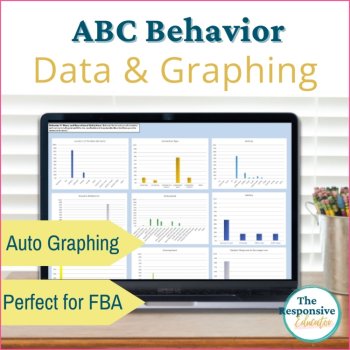
ABC Data Tracking Sheet Editable Behavior Checklist & Data Graphs Behavior Chart
(5 ratings)$16.50
Add to cart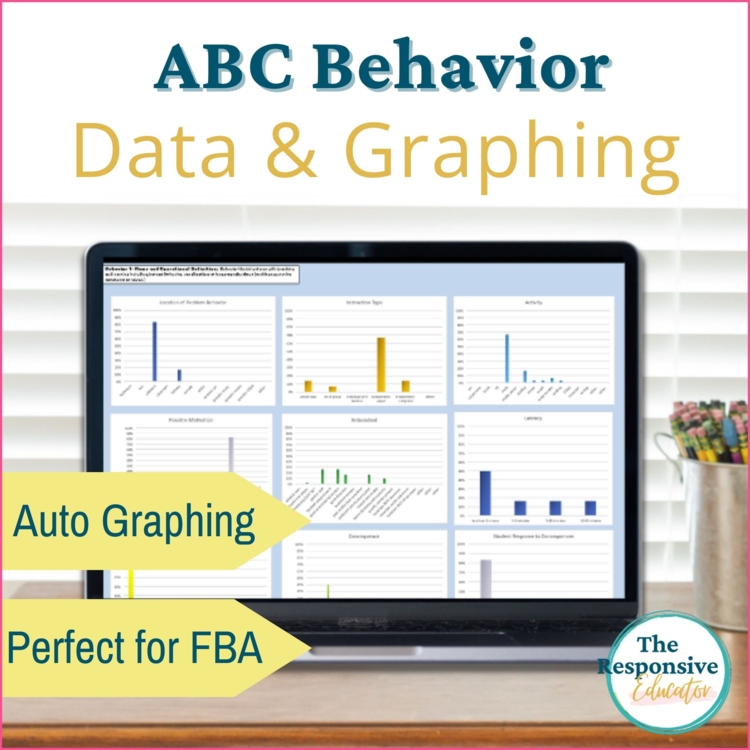
Description
Collecting ABC data is only the first step. The real value comes from understanding the patterns hidden within that information.
If you've ever looked at a stack of ABC data sheets, office referrals, or behavior notes and wondered, "Now what?", you're not alone. Individual observations tell you what happened during one incident.
Looking at many observations together helps you identify behavior patterns, determine the function of behavior, complete stronger Functional Behavior Assessments (FBAs), and develop more effective Behavior Intervention Plans (BIPs).
That's exactly what ABC Data Sheet Editable + Graphing Digital Data Tracking was designed to do.
Unlike a simple ABC Behavior Checklist or ABC Data Sheet, this resource helps you move beyond collecting behavior documentation to actually analyzing it.
This Resource Includes Two Powerful Parts
Part 1: Identify Your Target Behaviors
Before collecting detailed ABC data, it's important to determine which behaviors deserve your attention.
Simply enter the frequency of each problem behavior into the included spreadsheet. Automatic graphs help you quickly identify which behaviors occur most often, allowing you to prioritize the 1–3 behaviors that should become the focus of your Functional Behavior Assessment.
This helps teams avoid spending valuable time collecting detailed data on behaviors that may not be the greatest concern.
Part 2: Investigate the Function of Behavior
Once you've selected your target behaviors, begin collecting detailed ABC data for each one using the included ABC Data Sheet Editable, ABC Behavior Checklist, or your preferred Antecedent Behavior Consequence Form.
Enter those observations into the spreadsheets to automatically organize your data and generate graphs that help answer important questions such as:
- Which antecedents occur most often?
- Where does the behavior usually happen?
- During which activities or instructional settings?
- Which consequences are commonly following the behavior?
- What possible function of behavior is beginning to emerge?
Rather than flipping through dozens of individual ABC forms, you'll begin seeing meaningful patterns that support stronger decision-making.
Automatically Graph
Generate graphs for:
- Types of Problem Behavior
- Location of Problem Behavior
- Instruction Type
- Activity
- Possible Motivation
- Antecedent
- Latency
- Duration
- Consequence
- Student Response to Consequence
These graphs help teams organize information, communicate findings more effectively, and develop stronger Functional Behavior Assessments.
Perfect For
- Functional Behavior Assessments (FBAs)
- Behavior Specialists
- School Psychologists
- Special Education Teachers
- MTSS Teams
- Student Support Teams
- Behavior Problem Solving Meetings
- Determining the Function of Behavior
Please Note
This resource is designed to help teams investigate why behaviors are occurring by organizing ABC data and identifying behavior patterns.
If you're looking to measure whether a behavior intervention is working over time, you'll want ongoing behavior progress monitoring. For that purpose, see my Behavior Progress Monitoring Tracking Sheet + Graphing Bundle, which measures student growth using frequency, duration, interval, rate, and daily behavior goal graphs.
Because the goal isn't simply collecting behavior data. It's collecting meaningful information that helps you make better decisions for students.
Learn More!
In our blog post, From Data to Action: How to Use ABC Behavior Charting Graphs Effectively, you'll discover practical insights on harnessing the power of these graphs for more effective Functional Behavior Assessments. Gain a deeper understanding of behavior patterns and interventions, all geared towards creating a positive learning environment. Let's simplify your approach and empower you to make informed decisions in your classroom.
You may also be interested in:
FBA Interview Forms
FBA Interview Forms offer a comprehensive approach to gathering essential information from parents, teachers, and students for conducting a functional behavior assessment.
- The Parent Interview Form covers child strengths, problem behaviors, and parental strategies
- The Teacher Interview Form provides insights into academic progress, observed triggers, and attempted strategies
- The Student Interview Form offers a unique perspective, allowing students to share their interests, coping strategies, and insights into their problem behaviors and peer reactions.
These forms empower educators to develop personalized behavior intervention plans with a holistic understanding of the student's environment and perspectives.
Behavior Observation Form (s)
Behavior Observation Form (s) will walk you through the observation process. The forms will help you know what to look for as you observe, and assist you in breaking down what you are seeing in a way that will help you write a quality FBA.
Done correctly, your direct observation of the student (ideally across 2-3 settings) will allow you to compare what you observe with the interview information. It will also help you develop a definition of the target behavior that is observable and measurable (operational definition) and assist you in developing a functional hypothesis of why the student is engaging in the problem behavior.
FBA Template
If you aren’t confident in your ability to complete any of the components of a functional behavior assessment, then this FBA Template is for you.
The included Components of a Functional Behavior Assessment document will walk you through and offer examples along the way.
FBA Template includes:
- An editable functional behavior assessment template
- An 11-page document explaining how to complete a functional behavior assessment, outlining each of the necessary components of an FBA. Explanations and examples are given for each component.
- Sources of Data
- Target/Problem Behavior
- Relevant Background Information
- Setting Events/Contextual Analysis
- Motivating Factors/Antecedent Analysis (Triggers)
- Maintaining Consequences/Consequence Analysis
- Summary/Functional Hypothesis
Please follow me on TPT for more great behavior tracking and SEL resources. And remember, if you purchase, please leave a review and TPT will give you credits toward more fabulous TPT resources!
Report this resource to Linked Through Learning
Reported resources will be reviewed by our team. Report this resource to let us know if this resource breaks our rules.
Teacher reviews
“Tracking behavior can be challenging, but this resource makes it simple and goes the extra mile to take what data you’ve gathered and help to see where to go next!”
“This is a great resource for keeping track of student progress.”
Also included in
-
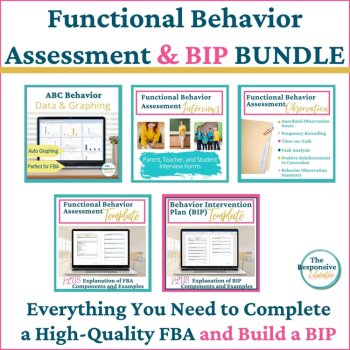 Functional Behavioral Assessment Form, ABC Data Sheet, Behavior Plan Template
$47.75
$53.75
Save 11%
-
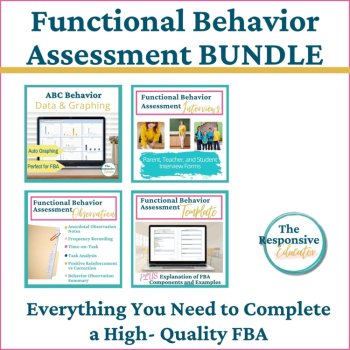 FBA Template Interview Questions Classroom Behavior Observation Forms ABC Data
$39.75
$44.50
Save 11%
-
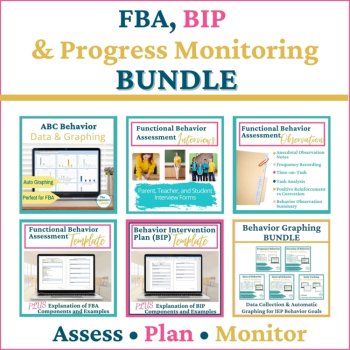 IEP Goal Tracking Behavior FBA BIP Data Tracking Sheets IEP & ABC Behavior Chart
$73.75
$84.20
Save 12%
Reviews
3.4
5
ratings
-
March 29, 2026
Tracking behavior can be challenging, but this resource makes it simple and goes the extra mile to take what data you’ve gathered and help to see where to go next!
hey O.
Grades taught: 1st
-
February 3, 2026
Not easy to use. Not easy to use after working with this for some time. Create your own.
Reply from The Responsive Educator
Kara,Thank you for taking the time to share your feedback. I’m sorry to hear the resource felt difficult to use—that’s definitely not the experience I want for teachers.This tool is designed to help organize and graph ABC behavior data in a way that supports real FBA and IEP decision-making, but I know it can feel unfamiliar at first if you haven’t used a system like this before. I include step-by-step directions in the file, and I’m always happy to help users get started or troubleshoot anything that feels confusing.If you’d like support, please feel free to reach out to me directly at jennifer@theresponsiveeducator.com. I’d be glad to walk you through the setup or help you adapt it to your specific situation. My goal is for this resource to make your job easier, not harder.
Kara E.
Grades taught: PreK, K, 1st, 2nd
-
October 3, 2025
I thought the graph would mirror the ABC behavior print out but it doesn't. I needed to be able to print the single use sheet and enter multiple incidents. I was hoping the graph would compile all the data from all the single incidents I record. It doesn't do that. It only does a graph for each individual incident. Also doesn't have a spot to actually enter the behavior into the spreadsheet. It leaves that component out. Due to this the only part of this purchase that will be useful is the actual single use printout.
Reply from The Responsive Educator
Thank you for your feedback. I’m sorry to hear the product didn’t work the way you expected. I want to clarify how the system is designed, in case it helps you or others who may be considering it.The single-incident ABC forms (included in both printable and digital formats) are intended for documenting each individual behavior occurrence. To create graphs, the system uses a summary process: you enter the frequency counts of each problem behavior into the Excel sheet. From there, the spreadsheet automatically generates graphs and allows you to identify the 1–3 most significant behaviors (by frequency or severity). Those target behaviors then have dedicated graphing pages for a deeper look at antecedents, activities, and consequences.The goal is not to graph every single incident one by one, but to streamline the FBA process by highlighting the top behaviors of concern and providing in-depth analysis for those. There is a place in the spreadsheet to enter the behavior and its frequency, which will immediately populate the overall graphs.I appreciate you sharing your perspective — it helps me see where I can make the listing even clearer so expectations are aligned.
Betsy J.
Grades taught: K, 1st, PreK
-
August 6, 2025
This is a great resource for keeping track of student progress.
Reply from The Responsive Educator
Thanks for your feedback, Megan! I really appreciate it!
Megan H.
Grades taught: PreK, K, 1st, 2nd
-
April 5, 2024
My students responded well to this resource and I will be using again.
Jennifer N.
Grades taught: K
Questions & Answers
Sign in to ask a questionNo questions yet.

Meet the Seller
Behavior Support and Interventions
I provide resources that help teachers manage classroom behavior and teach social-emotional skills effectively. With over 20 years of experience in special education, I offer practical tools and strategies to support both teachers and students in achieving their best. I have been dedicated to supporting students with special needs since 2005, specializing in both behavioral and academic interventions. My extensive experience spans teaching in self-contained classrooms from grades K-12 and assisting general and special education teachers with managing significant behavioral challenges. As a former lead of an RTI committee and a behavior specialist, I have a deep understanding of effective classroom management strategies.
Florida
- 4.76Store rating after 132 reviews
- 0Followers