Middle school students face increasing expectations for managing schedules, materials, emotions, communication, personal care, and daily responsibilities. Students may move between several classrooms, work with multiple adults, and be expected to advocate for themselves with less prompting.
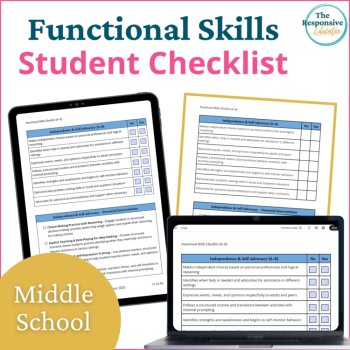
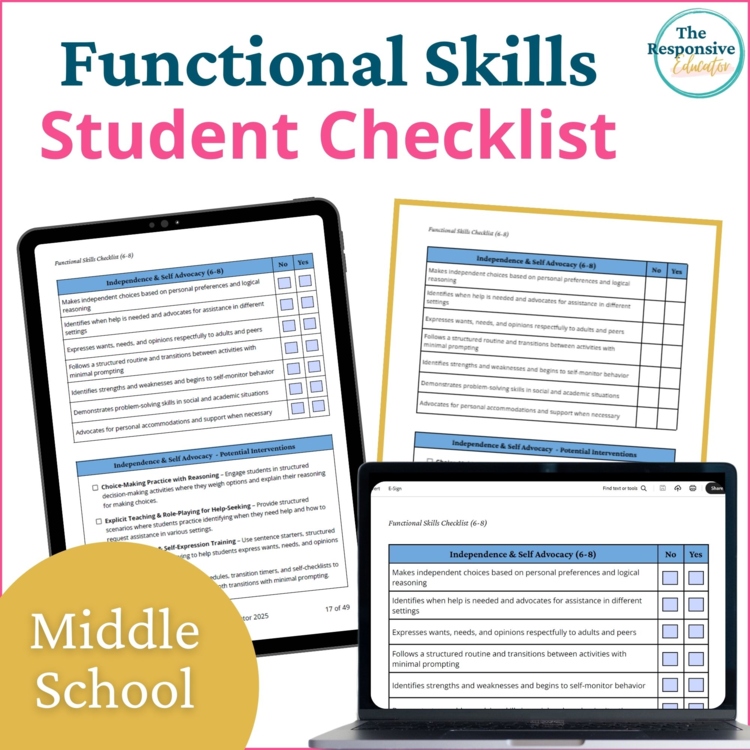
When a student struggles, it is not always clear which functional skill needs to be taught. The 6th-8th Grade Functional Life Skills Checklist, IEP Goals & Interventions helps educators identify specific strengths and needs, select targeted interventions, and develop measurable goals that support greater independence.
I created this resource to keep assessment and planning connected. Instead of searching separately for a daily living skills checklist, intervention ideas, and middle-school life skills IEP goals, educators can move from observation to instruction using one aligned system.
MOVE FROM A BROAD CONCERN TO A SPECIFIC SKILL
A student described as disorganized, unmotivated, dependent, or unprepared for middle-school expectations may need support with several different functional skills.
The student may have difficulty:
- Managing routines across multiple classes
- Keeping track of materials and assignments
- Following increasingly complex schedules
- Asking for clarification or assistance
- Advocating for personal or academic needs
- Managing emotions during challenging situations
- Completing age-appropriate self-care responsibilities
- Making safe decisions in school and community settings
- Accepting responsibility with fewer adult prompts
This informal functional skills assessment separates broad concerns into specific, observable skills. Once the team identifies the skill that needs support, the included interventions and sample goals provide a practical starting point for individualized planning.
WHAT’S INCLUDED
This resource includes:
- Developmentally appropriate functional life skills checklists
- Fourteen functional skill areas
- Student skill indicators for identifying strengths and needs
- Targeted interventions aligned with each skill area
- Measurable sample goals that can be individualized
- Notes and comments sections
- Optional tracking sheets for progress monitoring
- Printable and digital tracking options
These components help educators move from identifying a need to choosing instruction, planning support, and monitoring progress.
FOURTEEN FUNCTIONAL LIFE SKILL AREAS
The checklist addresses:
- Community Navigation and Safety
- Daily Living Skills
- Employment and Job Readiness
- Independence and Self-Advocacy
- Meal Preparation and Nutrition
- Medical and Health Management
- Motor Skills and Safety Awareness
- Personal Finance and Money Management
- Play and Leisure Skills
- Pre-Academic and Academic Readiness
- Self-Care Skills
- Self-Regulation and Emotional Control
- Social Skills and Communication
- Toileting Skills
Each area focuses on functional expectations appropriate for students in Grades 6–8. The skills support participation, responsibility, communication, self-management, and increasing independence across school, home, and community settings.
TARGETED FUNCTIONAL SKILLS INTERVENTIONS
Identifying a missing skill is useful only when the team knows what to do next. Each checklist area includes targeted interventions that educators can select and adapt based on the student’s needs.
Intervention ideas may include:
- Explicit instruction and modeling
- Visual schedules and organizational supports
- Task analysis
- Guided practice
- Prompting and systematic prompt fading
- Reinforcement
- Environmental adjustments
- Role-play and rehearsal
- Supported decision-making
- Self-monitoring
- Practice across classes, adults, and settings
- Emotional-regulation strategies
The interventions provide practical starting points rather than a single plan for every student. Educators can choose strategies that match the identified skill, the setting, and the likely reason the skill is difficult.
MEASURABLE FUNCTIONAL LIFE SKILLS IEP GOALS
The sample goals connect directly to the functional skills assessed. Teachers can adjust the setting, prompting level, frequency, performance criteria, and expected degree of independence to reflect the student’s baseline and individual needs.
The goals may support instruction related to:
- Daily living skills
- Communication
- Self-care
- Personal and community safety
- Emotional regulation
- Social participation
- Self-advocacy
- Organization and responsibility
- Academic readiness and work habits
- Independent functioning
- Early job-readiness and transition skills
The aligned format makes it easier to explain why a goal was selected, what skill the student is working to develop, and how the team plans to support progress.
USE THIS RESOURCE TO
- Identify functional life skill strengths and needs
- Establish informal baseline information
- Select skills for direct instruction
- Choose interventions aligned with identified needs
- Develop measurable life skills IEP goals
- Document observations and progress
- Prepare for IEP and student-support meetings
- Support BIP and MTSS planning
- Improve communication among teachers, families, and service providers
- Plan instruction that supports high-school and transition readiness
WHO THIS RESOURCE IS FOR
This resource may be especially helpful for:
- Special education teachers
- General education teachers in inclusive classrooms
- Behavior specialists
- School psychologists
- Interventionists
- Occupational therapists and related-service providers
- Self-contained classroom teams
- IEP, BIP, MTSS, and transition teams
Use the resource with an individual student or as part of a team discussion about functional skills, instructional priorities, and needed supports.
IMPORTANT ASSESSMENT INFORMATION
This resource is an informal educational assessment and planning tool. It is not a standardized, norm-referenced, or diagnostic assessment. It does not replace a formal evaluation, functional behavior assessment, transition assessment, or other individualized assessment when one is required.
The checklist, interventions, and sample goals should be individualized based on the student’s needs, baseline performance, environment, and required level of support.
The purpose is not simply to document whether a student can or cannot perform a skill. It is to help the team identify what the student needs to learn next and plan instruction that supports meaningful independence over time.
Learn More About Behavior Data & Measuremen
Not sure what kind of data collection you need? Take a look at my FREE Resource, Data Collection for Behavior, which will walk you through various types of data collection, how to use them, and which types of behavior each data collection method is best suited to.
Please follow me on TPT for more great behavior tracking and SEL resources. And remember, if you purchase, please leave a review and TPT will give you credits toward more fabulous TPT resources!