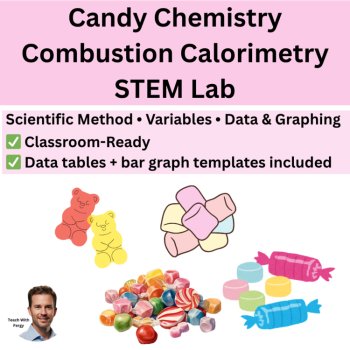
Turn everyday candy into a rigorous calorimetry and energy conservation investigation. Students burn a small candy sample under a soda-can calorimeter, measure the water’s temperature change, calculate q = m·c·ΔT, and estimate energy per gram (J/g and kcal/g)—then deduce from evidence which candy has the most energy.
What students do
- Identify IV, DV, and controls and write a testable hypothesis
- Follow a step-by-step procedure to conduct replicated trials
- Measure mass (initial/final), Tᵢ/Tf, ΔT, and compute q and kcal/g
- Create a bar graph (Candy Type vs Energy per gram) with labeled axes/units
- Complete analysis questions on heat loss pathways, method differences, and comparison to ~4 kcal/g for sugar
- Write a CER that uses conservation of energy to explain results
What you get
- Teacher Guide: Setup checklist, materials, safety/ignition protocol, timing/roles; background on combustion, heat transfer (q = m·c·ΔT), and conservation of energy; quick troubleshooting.
- Student Packet: Driving question, hypothesis template, variables table (IV/DV/controls), and a numbered, step-by-step procedure for fair tests and repeats.
- Data Tables: Trial logs for mass (initial/final), water volume, Tᵢ/Tf, ΔT, with spaces for averages and quick notes.
- Calculations & Graph Page: Structured prompts for q = m·c·ΔT, J/g ↔ kcal/g conversions, and a bar-graph template (Candy Type vs Energy per gram).
- Analysis + Model Answers: Focused questions on energy losses, procedural differences, comparison to ~4 kcal/g sugar value, and an exemplar CER; concise answer key.
- Simple Rubric: Single-point rubric with 4 performance levels for Safety/Setup, Design & Procedure, Data Quality, Calculations/Units, Graphing, and Analysis/CER.
Materials needed
- Aluminum soda-can calorimeter + stand (or ring stand)
- 100 mL water (≈100 g), thermometer
- Balance (0.01 g preferred), small candy samples (mini marshmallow, hard candy, sugar cube, chocolate mini), small foil tray
- Wire/paperclip holder, heat-resistant tray or tile, tongs/forceps
- Goggles for all students; lighter/matches (teacher-only), fire blanket/extinguisher
Timing & prep
- Prep: 10–15 minutes (set out cans, water cups, thermometers, balances, trays)
- Class time: 45–70 minutes (intro/safety 5, measurements 25–35, calculations/CER 10–15, debrief 5)
- Cleanup: 5–10 minutes (cool apparatus; discard residue; rinse/dry)
Why teachers love it
- High-engagement with real chemistry math (and candy!)
- Clear, copy-ready handouts—minimal prep, low-cost materials
- Strong alignment to data literacy (units, significant figures, graphing) and CER
- Works in one period; easy to scale for honors or general chemistry
➡️ You can get this STEM as well as all my other ones in this series inside my STEM Investigations Growing Bundle. As more labs are added, the price will increase. CLICK HERE to have a look
I also have the following STEM Labs in My Store:
- Blow Cup Challenge STEM Lab
- Paper Table STEM Lab
- Pendulum STEM Lab
- Parachute STEM Lab
- Catapult STEM Lab
- Paper Airplane - Angle of Attack STEM Lab
- Bottle Flip STEM Lab
- Paper Helicopter STEM Lab
- Yeast Balloon STEM Lab
- Balloon Lift Design STEM Lab
- Candy Combustion Calorimetry STEM
- Marble Ramp: Height vs Average Speed STEM Lab
- Clean Water Filtration STEM Lab
- Beetle Genetics STEM Lab
- Adaptations by Design - Extreme Environments STEM Lab
NGSS alignment
- HS-PS3-1/4: Energy conservation; energy transfer and temperature change
- Science & Engineering Practices: Planning & Carrying Out Investigations; Analyzing & Interpreting Data; Using Mathematics & Computational Thinking; Engaging in Argument from Evidence (CER)
- Crosscutting Concepts: Energy & Matter; Cause & Effect


 STEM Investigations Growing Bundle — Scientific Method, Design, Data & CER
$24.97
$88.13
Save 72%
 Valentine's Day Science Activities | STEM, Project, Readings | High School
$8.40
$20.79
Save 60%
 Chemistry Curriculum | Fully Editable Chemistry Activities, Lessons, Assessments
$197.97
$954.43
Save 79%