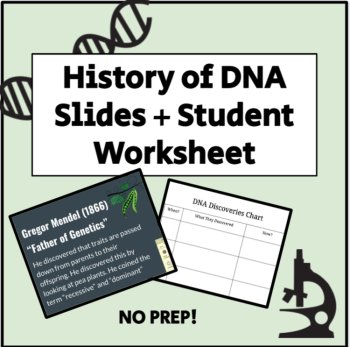
History of DNA Slides + Student Worksheet
 Ms Kiaras Science Teacher Shoppe
$4.00

TEKS Science 7th and 8th Grade 2024 Texas TWO-Year Bundle | STAAR Science
$1,157.70 $249.00
Get BundleThis RESOURCE BUNDLE is for Texas grade 7 and grade 8 science teachers who are teaching according to the Texas Essential Knowledge and Skills (TEKS) Standards set down by the Texas Education Agency and want to prepare their students for STAAR and will SAVE YOU 89%!
✅ UPDATED AUGUST 2026
✅ Covers All 7th and 8th Grade TEKS Standards: Fully aligned with Texas' standards for Grade 7 and 8 Science.
✅ Massive Resource Library: Includes 5E lesson bundles, labs, lessons, readings, activities, quizzes, and more across all science domains.
✅ Organized by Standard: Easy-to-navigate layout helps you teach S.7.1-14 and S.8.1-13.
✅ No Prep & Editable: Ready-to-use PDFs, Word docs, and digital versions for seamless classroom integration.
🔥🔥 BONUS: When you purchase this bundle, you get access to the resources from MY ENTIRE STORE for 6 months!
My Promise to You
I know every classroom is different. If you purchase a resource and feel it is not the right fit for your students, contact me and I’ll provide 2x the amount you paid in store credit toward another resource in my store, so you can find something that better supports your students.
Grade 7 Resources:
S.7.1-5 Scientific & Engineering Practices and Recurring Themes and Concepts
Resources:
S.7.6 Matter and energy. Matter and energy. The student distinguishes between elements and compounds, classifies changes in matter, and understands the properties of solutions. The student is expected to:
S.7.6.A - The student is expected to compare and contrast elements and compounds in terms of atoms and molecules, chemical symbols, and chemical formulas.
Resources:
S.7.6.B - The student is expected to use the periodic table to identify the atoms and the number of each kind within a chemical formula.
Resources:
S.7.6.C - The student is expected to distinguish between physical and chemical changes in matter.
S.7.6.D - The student is expected to describe aqueous solutions in terms of solute and solvent, concentration, and dilution.
Resources:
S.7.6.E - The student is expected to investigate and model how temperature, surface area, and agitation affect the rate of dissolution of solid solutes in aqueous solutions.
Resources:
S.7.7 Force, motion, and energy. The student describes the cause-and-effect relationship between force and motion.
S.7.7.A – Calculate average speed using distance and time measurements from investigations.
Resources:
S.7.7.B - The student is expected to distinguish between speed and velocity in linear motion in terms of distance, displacement, and direction.
Resources:
S.7.7.C – Measure, record, and interpret an object’s motion using distance-time graphs.
Resources:
S.7.7.D - The student is expected to analyze the effect of balanced and unbalanced forces on the state of motion of an object using Newton's First Law of Motion.
Resources:
S.7.8 Force, motion, and energy. The student understands the behavior of thermal energy as it flows into and out of the systems.
S.7.8.A - The student is expected to investigate methods of thermal energy transfer into and out of systems, including conduction, convection, and radiation.
Resources:
S.7.8.B - The student is expected to investigate how thermal energy moves in a predictable pattern from warmer to cooler until all substances within the system reach thermal equilibrium.
Resources:
S.7.8.C - The student is expected to explain the relationship between temperature and the kinetic energy of the particles within a substance.
Resources:
S.7.9 Earth and space. The student understands the patterns of movement, organization, and characteristics of components of our solar system.
S.7.9.A - The student is expected to describe the physical properties, locations, and movements of the Sun, planets, moons, meteors, asteroids, comets, Kuiper belt, and Oort cloud;
Resources:
S.7.9.B - The student is expected to describe how gravity governs motion within Earth's solar system.
Resources:
S.7.9.C - The student is expected to analyze the characteristics of Earth that allow life to exist such as the proximity of the Sun, presence of water, and composition of the atmosphere.
Resources:
S.7.10 Earth and space. The student understands the causes and effects of plate tectonics.
S.7.10.A - The student is expected to describe the evidence that supports that Earth has changed over time, including fossil evidence, plate tectonics, and superposition.
Resources:
S.7.10.B - The student is expected to describe how plate tectonics causes ocean basin formation, earthquakes, mountain building, and volcanic eruptions, including supervolcanoes and hot spots.
Resources:
S.7.10.C - The student is expected to describe the interactions between ocean currents and air masses that produce tropical cyclones, including typhoons and hurricanes.
Resources:
S.7.11 - Earth and space. The student understands how human activity can impact the hydrosphere.
S.7.11.A - The student is expected to analyze the beneficial and harmful influences of human activity on groundwater and surface water in a watershed.
Resources:
S.7.11.B - The student is expected to describe human dependence and influence on ocean systems and explain how human activities impact these systems.
Resources:
S.7.12 - Organisms and environments. The student understands that ecosystems are dependent upon the cycling of matter and the flow of energy.
S.7.12.A - The student is expected to diagram the flow of energy within trophic levels and describe how the available energy decreases in successive trophic levels in energy pyramids.
Resources:
S.7.12.B - The student is expected to describe how ecosystems are sustained by the continuous flow of energy and the recycling of matter and nutrients within the biosphere.
Resources:
S.7.13 - Organisms and environments. The student knows how systems are organized and function to support the health of an organism and how trait are inherited.
S.7.13.A - The student is expected to identify and model the main functions of the systems of the human organism, including the circulatory, respiratory, skeletal, muscular, digestive, urinary, reproductive, integumentary, nervous, immune, and endocrine systems.
Resources:
S.7.13.B - The student is expected to describe the hierarchical organization of cells, tissues, organs, and organ systems within plants and animals.
Resources:
S.7.13.C - The student is expected to compare the results of asexual and sexual reproduction of plants and animals in relation to the diversity of offspring and the changes in the population over time.
Resources:
S.7.13.D - The student is expected to describe and give examples of how natural and artificial selection change the occurrence of traits in a population over generations.
Resources:
Grade 8 Resources:
S.8.1-5 Scientific & Engineering Practices and Recurring Themes and Concepts
Resources:
S.8.6 Matter and energy. The student understands that matter can be classified according to its properties and matter is conserved in chemical changes that occur within closed systems.
S.8.6.A - The student is expected to explain by modeling how matter is classified as elements, compounds, homogeneous mixtures, or heterogeneous mixtures.
Resources:
o Properties of Matter Reading Comprehension Passage & Questions
o Matter - Exploring the World Around You - Reading Article
o Matter and the Particle Theory - Middle School Lab Station Activity
o Matter and the Particle Theory Infographic Assignment
o Particle Motion, Temperature, and States of Matter – Lesson
o Particle Theory and Matter Classification - Digital Interactive Notebook Pages
o Matter - Speed Quizzing
S.8.6.B - The student is expected to use the periodic table to identify the atoms involved in chemical reactions.
Resources:
o Elements and the Periodic Table - Device-Based Scavenger Hunt Activity
o The Periodic Table - Task Cards and UNIQUE Activity
o The Periodic Table - Google Slides and PowerPoint Lesson
o The Periodic Table Lab Station Activity _ 7 Hands-on Activities _ Elements
S.8.6.C - The student is expected to describe the properties of cohesion, adhesion, and surface tension in water and relate to observable phenomena such as the formation of droplets, transport in plants, and insects walking on water.
Resources:
S.8.6.D - The student is expected to compare and contrast the properties of acids and bases, including pH relative to water.
Resources:
o Acid, Bases, and Neutralization Reactions – Lesson
o Cleaning up Acid Spills - Science Reading Article
o Acids, Bases and pH – Digital Scavenger Hunt Activity
o Acids and Bases - Lab Station Activity
S.8.6.E - The student is expected to investigate how mass is conserved in chemical reactions and relate conservation of mass to the rearrangement of atoms using chemical equations, including photosynthesis.
Resources:
S.8.7 Matter and energy. The student understands that matter can be classified according to its properties and matter is conserved in chemical changes that occur within closed systems.
S.8.7.A - The student is expected to calculate and analyze how the acceleration of an object is dependent upon the net force acting on the object and the mass of the object using Newton's Second Law of Motion.
Resources:
S.8.7.B - The student is expected to investigate and describe how Newton's three laws of motion act simultaneously within systems such as in vehicle restraints, sports activities, amusement park rides, Earth's tectonic activities, and rocket launches.
Resources:
S.8.8 Force, motion, and energy. The student knows how energy is transferred through waves.
S.8.8.A - The student is expected to compare the characteristics of amplitude, frequency, and wavelength in transverse waves, including the electromagnetic spectrum.
Resources:
S.8.8.B - The student is expected to explain the use of electromagnetic waves in applications such as radiation therapy, wireless technologies, fiber optics, microwaves, ultraviolet sterilization, astronomical observations, and X-rays.
Resources:
S.8.9 Earth and space. The student describes the characteristics of the universe and the relative scale of its components.
S.8.9.A - The student is expected to describe the life cycle of stars and compare and classify stars using the Hertzsprung-Russell diagram.
Resources:
o Life and Death of Stars – Lesson
o The Life and Death of Stars - Lab Station Activity
o Stars - The Element Factories – Reading
o The Life and Death of Stars - Digital Interactive Notebook Pages
S.8.9.B - The student is expected to categorize galaxies as spiral, elliptical, and irregular and locate Earth's solar system within the Milky Way galaxy.
Resources:
S.8.9.C - The student is expected to research and analyze scientific data used as evidence to develop scientific theories that describe the origin of the universe.
Resources:
S.8.10 Earth and space. The student knows that interactions between Earth, ocean, and weather systems impact climate.
S.8.10.A - The student is expected to describe how energy from the Sun, hydrosphere, and atmosphere interact and influence weather and climate.
Resources:
S.8.10.B - The student is expected to identify global patterns of atmospheric movement and how they influence local weather.
Resources:
S.8.10.C - The student is expected to describe the interactions between ocean currents and air masses that produce tropical cyclones, including typhoons and hurricanes.
Resources:
S.8.11 - Earth and space. The student knows that natural events and human activity can impact global climate.
S.8.11.A - The student is expected to use scientific evidence to describe how natural events, including volcanic eruptions, meteor impacts, abrupt changes in ocean currents, and the release and absorption of greenhouse gases influence climate.
Resources:
o Earthquakes, Volcanoes, and Tsunamis - Lesson
o Earthquakes and Volcanoes – A Digital Scavenger Hunt Activity
o Earthquakes and Volcanoes - Lab Station Activity
S.8.11.B - The student is expected to use scientific evidence to describe how human activities, including the release of greenhouse gases, deforestation, and urbanization, can influence climate.
Resources:
S.8.11.C – Describe the carbon cycle
Resources:
S.8.12 - Organisms and environments. The student understands stability and changes in populations and ecosystems.
S.8.12.A - The student is expected to explain how disruptions such as population changes, natural disasters, and human intervention impact the transfer of energy in food webs in ecosystems.
Resources:
S.8.12.B - The student is expected to describe how primary and secondary ecological succession affect populations and species diversity after ecosystems are disrupted by natural events or human activity.
Resources:
o Ecological Succession – Lesson
o Ecological Succession - Primary and Secondary - Lab Station Activity
o Ecological Succession - Digital INB
o Ecosystems and Ecological Succession – Digital Scavenger Hunt Activity
S.8.12.C - The student is expected to describe how biodiversity contributes to the stability and sustainability of an ecosystem and the health of the organisms within the ecosystem.
Resources:
S.8.13 - Organisms and environments. The student knows how cell functions support the health of an organism and how adaptation and variation relate to survival.
S.8.13.A - The student is expected to identify the function of the cell membrane, cell wall, nucleus, ribosomes, cytoplasm, mitochondria, chloroplasts, and vacuoles in plant or animal cells.
Resources:
o Cell Organelle Structure and Function – Lesson
o Cell Organelle Structure and Function - Lab Station Activity
o Cell Organelles - Digital Scavenger Hunt Activity
o Cells and Organelles Digital INB
o Cell Organelles Card Matching Activity
S.8.13.B - The student is expected to describe the function of genes within chromosomes in determining inherited traits of offspring.
Resources:
S.8.13.C - The student is expected to describe how variations of traits within a population lead to structural, behavioral, and physiological adaptations that influence the likelihood of survival and reproductive success of a species over generations.
Resources:
Report this resource to Linked Through Learning
Reported resources will be reviewed by our team. Report this resource to let us know if this resource breaks our rules.
This RESOURCE BUNDLE is for Texas grade 7 science teachers who are teaching S.7.1-5 Science Skills and STEM according to the Texas Essential Knowledge and Skills (TEKS) Standards set down by the Texas Education Agency and want to prepare their students for STAAR. The bundle will SAVE YOU OVER 70%.✅
This RESOURCE BUNDLE is for Texas grade 7 science teachers who are teaching S.7.6.A - Atoms, Elements, and Compounds according to the Texas Essential Knowledge and Skills (TEKS) Standards set down by the Texas Education Agency and want to prepare their students for STAAR. The bundle will SAVE YOU OV
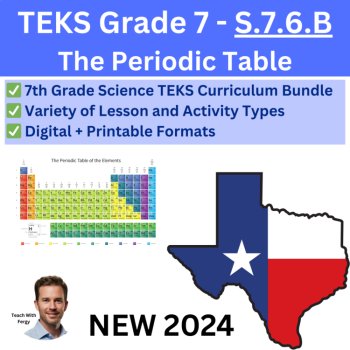
This RESOURCE BUNDLE is for Texas grade 7 science teachers who are teaching S.7.6.B - The Periodic Table of Elements according to the Texas Essential Knowledge and Skills (TEKS) Standards set down by the Texas Education Agency and want to prepare their students for STAAR. The bundle will SAVE YOU OV
This RESOURCE BUNDLE is for Texas grade 7 science teachers who are teaching S.7.6.C - Physical and Chemical Properties and Changes according to the Texas Essential Knowledge and Skills (TEKS) Standards set down by the Texas Education Agency and want to prepare their students for STAAR. The bundle wi
This RESOURCE BUNDLE is for Texas grade 7 science teachers who are teaching S.7.6.D - Solutions and Mechanical Mixtures according to the Texas Essential Knowledge and Skills (TEKS) Standards set down by the Texas Education Agency and want to prepare their students for STAAR. The bundle will SAVE YOU
This RESOURCE BUNDLE is for Texas grade 7 science teachers who are teaching S.7.6.E - Factors Affecting Dissolving according to the Texas Essential Knowledge and Skills (TEKS) Standards set down by the Texas Education Agency and want to prepare their students for STAAR. ✅ Complete S.7.6.E - 7th Gra...
This RESOURCE BUNDLE is for Texas grade 7 science teachers who are teaching S.7.7.A - Calculate Average Speed Using Distance and Time according to the Texas Essential Knowledge and Skills (TEKS) Standards set down by the Texas Education Agency and want to prepare their students for STAAR. ✅ Complet...
This RESOURCE BUNDLE is for Texas grade 7 science teachers who are teaching S.7.7.B - Speed and Velocity in Linear Motion according to the Texas Essential Knowledge and Skills (TEKS) Standards set down by the Texas Education Agency and want to prepare their students for STAAR. ✅ Complete S.7.7.B -...
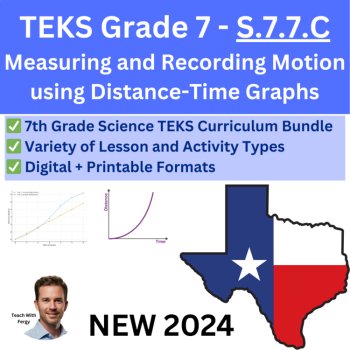
This RESOURCE BUNDLE is for Texas grade 7 science teachers who are teaching S.7.7.C - Measuring and Recording Motion using Distance-Time Graphs according to the Texas Essential Knowledge and Skills (TEKS) Standards set down by the Texas Education Agency and want to prepare their students for STAAR.
This RESOURCE BUNDLE is for Texas grade 7 science teachers who are teaching S.7.7.D - Newton's First Law of Motion according to the Texas Essential Knowledge and Skills (TEKS) Standards set down by the Texas Education Agency and want to prepare their students for STAAR. ✅ Complete S.7.7.C - 7th Gra...
This RESOURCE BUNDLE is for Texas grade 7 science teachers who are teaching S.7.8.A - Thermal Energy Transfer - Conduction, Convection, and Radiation according to the Texas Essential Knowledge and Skills (TEKS) Standards set down by the Texas Education Agency and want to prepare their students for S
This RESOURCE BUNDLE is for Texas grade 7 science teachers who are teaching S.7.8.B - Thermal Energy Change Reactions according to the Texas Essential Knowledge and Skills (TEKS) Standards set down by the Texas Education Agency and want to prepare their students for STAAR. ✅ Complete S.7.8.B - 7th...
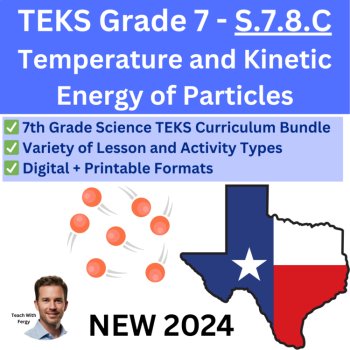
This RESOURCE BUNDLE is for Texas grade 7 science teachers who are teaching S.7.8.C - Temperature and Kinetic Energy of Particles according to the Texas Essential Knowledge and Skills (TEKS) Standards set down by the Texas Education Agency and want to prepare their students for STAAR. ✅ Complete S....
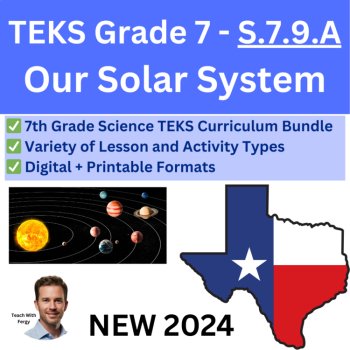
This RESOURCE BUNDLE is for Texas grade 7 science teachers who are teaching S.7.9.A - Our Solar System according to the Texas Essential Knowledge and Skills (TEKS) Standards set down by the Texas Education Agency and want to prepare their students for STAAR. ✅ Complete S.7.9.A - 7th Grade Science T...
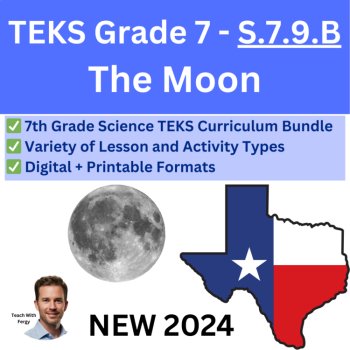
This RESOURCE BUNDLE is for Texas grade 7 science teachers who are teaching S.7.9.B - The Moon according to the Texas Essential Knowledge and Skills (TEKS) Standards set down by the Texas Education Agency and want to prepare their students for STAAR. ✅ Complete S.7.9.B - 7th Grade Science TEKS Curr...
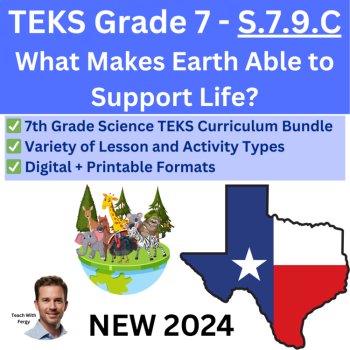
This RESOURCE BUNDLE is for Texas grade 7 science teachers who are teaching S.7.9.C - What Makes Earth Able to Support Life? according to the Texas Essential Knowledge and Skills (TEKS) Standards set down by the Texas Education Agency and want to prepare their students for STAAR. ✅ Complete S.7.9.C
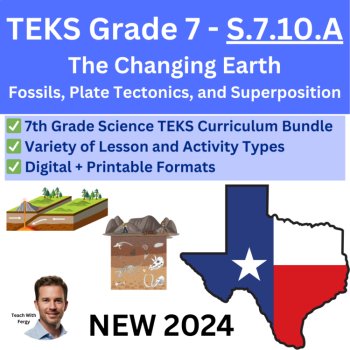
This RESOURCE BUNDLE is for Texas grade 7 science teachers who are teaching S.7.10.A - The Changing Earth - Fossils, Plate Tectonics, and Superposition according to the Texas Essential Knowledge and Skills (TEKS) Standards set down by the Texas Education Agency and want to prepare their students for
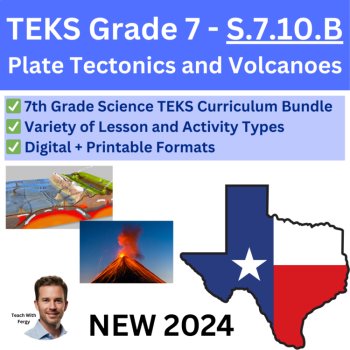
This RESOURCE BUNDLE is for Texas grade 7 science teachers who are teaching S.7.10.B - Tectonic Plates, Volcanoes, and Earthquakes according to the Texas Essential Knowledge and Skills (TEKS) Standards set down by the Texas Education Agency and want to prepare their students for STAAR. ✅ Complete S...
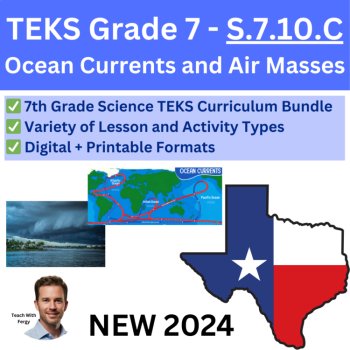
This RESOURCE BUNDLE is for Texas grade 7 science teachers who are teaching S.7.10.C - Ocean Currents and Air Masses according to the Texas Essential Knowledge and Skills (TEKS) Standards set down by the Texas Education Agency and want to prepare their students for STAAR. ✅ Complete S.7.10.C - 7th...
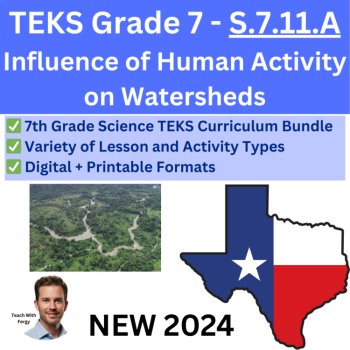
This RESOURCE BUNDLE is for Texas grade 7 science teachers who are teaching S.7.11.A - Influence of Human Activity on Watersheds - Groundwater and Surface Water according to the Texas Essential Knowledge and Skills (TEKS) Standards set down by the Texas Education Agency and want to prepare their stu
This RESOURCE BUNDLE is for Texas grade 7 science teachers who are teaching S.7.11.B - Human Dependence and Influence on Ocean System according to the Texas Essential Knowledge and Skills (TEKS) Standards set down by the Texas Education Agency and want to prepare their students for STAAR. ✅ Complet...
This RESOURCE BUNDLE is for Texas grade 7 science teachers who are teaching S.7.12.A - The Flow of Energy within Trophic Levels according to the Texas Essential Knowledge and Skills (TEKS) Standards set down by the Texas Education Agency and want to prepare their students for STAAR. ✅ Complete S.7....
This RESOURCE BUNDLE is for Texas grade 7 science teachers who are teaching S.7.12.B - Cycling of Matter in Ecosystems according to the Texas Essential Knowledge and Skills (TEKS) Standards set down by the Texas Education Agency and want to prepare their students for STAAR. ✅ Complete S.7.12.B - 7t...
This RESOURCE BUNDLE is for Texas grade 7 science teachers who are teaching S.7.13.A - Functions of Human Body Systems - Circulatory, Respiratory, Skeletal, Muscular, Digestive, Urinary, Reproductive, Integumentary, Nervous, Immune, and Endocrine systems according to the Texas Essential Knowledge an
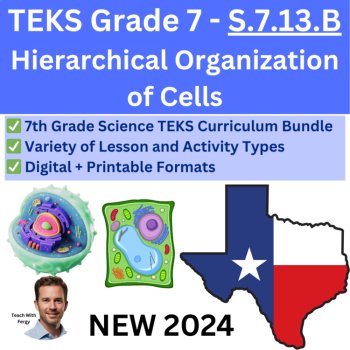
This RESOURCE BUNDLE is for Texas grade 7 science teachers who are teaching S.7.13.B - Hierarchical Organization of Cells - Cells, Tissues, Organs, and Organ Systems within Plants and Animals. systems according to the Texas Essential Knowledge and Skills (TEKS) Standards set down by the Texas Educat
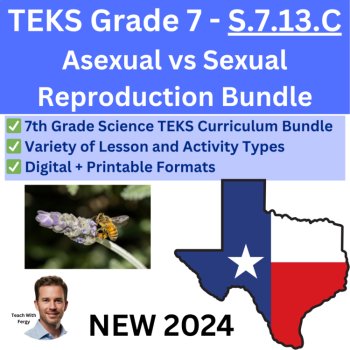
This RESOURCE BUNDLE is for Texas grade 7 science teachers who are teaching S.7.13.C - Asexual vs Sexual Reproduction Bundle: Diversity & Population Change. systems according to the Texas Essential Knowledge and Skills (TEKS) Standards set down by the Texas Education Agency and want to prepare t
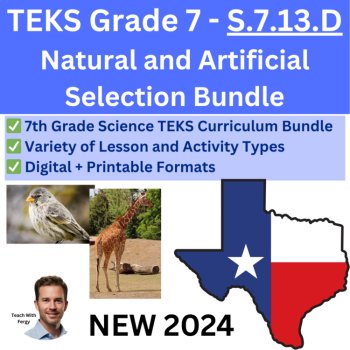
This RESOURCE BUNDLE is for Texas grade 7 science teachers who are teaching S.7.13.D - Natural vs Artificial Selection Bundle: Traits in Populations Over Time. systems according to the Texas Essential Knowledge and Skills (TEKS) Standards set down by the Texas Education Agency and want to prepare th
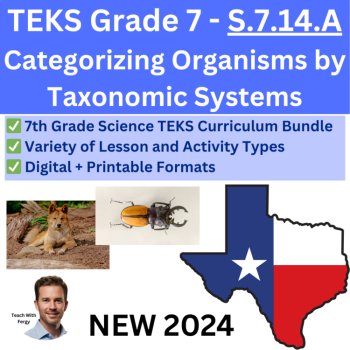
This RESOURCE BUNDLE is for Texas grade 7 science teachers who are teaching S.7.14.A - Categorizing Organisms by Taxonomic Systems systems according to the Texas Essential Knowledge and Skills (TEKS) Standards set down by the Texas Education Agency and want to prepare their students for STAAR. ✅ Co...
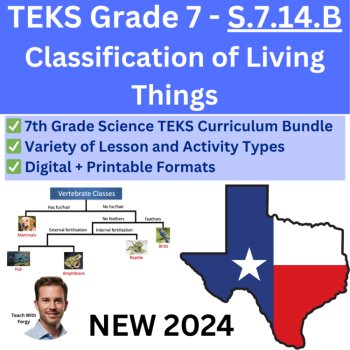
This RESOURCE BUNDLE is for Texas grade 7 science teachers who are teaching S.7.14.B - The Classification of Living Things systems according to the Texas Essential Knowledge and Skills (TEKS) Standards set down by the Texas Education Agency and want to prepare their students for STAAR. ✅ Complete S...
This RESOURCE BUNDLE is for Texas grade 8 science teachers who are teaching S.8.1-5 Science Skills and STEM according to the Texas Essential Knowledge and Skills (TEKS) Standards set down by the Texas Education Agency and want to prepare their students for STAAR. The bundle will SAVE YOU OVER 50%.✅
This RESOURCE BUNDLE is for Texas grade 8 science teachers who are teaching S.8.6.A Classification of Matter according to the Texas Essential Knowledge and Skills (TEKS) Standards set down by the Texas Education Agency and want to prepare their students for STAAR. The bundle will SAVE YOU OVER 60%....
This RESOURCE BUNDLE is for Texas grade 8 science teachers who are teaching S.8.6.B The Periodic Table of Elements according to the Texas Essential Knowledge and Skills (TEKS) Standards set down by the Texas Education Agency and want to prepare their students for STAAR. The bundle will SAVE YOU OVER
This RESOURCE BUNDLE is for Texas grade 8 science teachers who are teaching S.8.6.C Cohesion, Adhesion, & Surface Tension in Water according to the Texas Essential Knowledge and Skills (TEKS) Standards set down by the Texas Education Agency and want to prepare their students for STAAR. The bundl
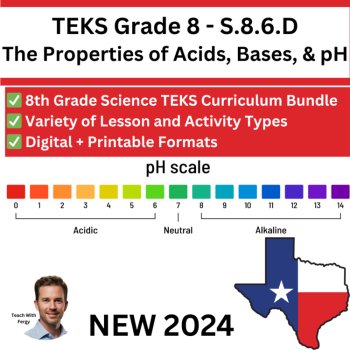
This RESOURCE BUNDLE is for Texas grade 8 science teachers who are teaching S.8.6.D - The Properties of Acids, Bases, and pH according to the Texas Essential Knowledge and Skills (TEKS) Standards set down by the Texas Education Agency and want to prepare their students for STAAR. The bundle will SAV
This RESOURCE BUNDLE is for Texas grade 8 science teachers who are teaching S.8.6.E - The Conservation of Mass according to the Texas Essential Knowledge and Skills (TEKS) Standards set down by the Texas Education Agency and want to prepare their students for STAAR. ✅ Complete S.8.6.D - 8th Grade S...
This RESOURCE BUNDLE is for Texas grade 8 science teachers who are teaching S.8.7.A Newton's Second Law of Motion according to the Texas Essential Knowledge and Skills (TEKS) Standards set down by the Texas Education Agency and want to prepare their students for STAAR. The bundle will SAVE YOU OVER
This RESOURCE BUNDLE is for Texas grade 8 science teachers who are teaching S.8.7.B - Newton’s Laws in Real-World Systems according to the Texas Essential Knowledge and Skills (TEKS) Standards set down by the Texas Education Agency and want to prepare their students for STAAR. The bundle will SAVE Y
This RESOURCE BUNDLE is for Texas grade 8 science teachers who are teaching S.8.8.A - Wave Properties: Amplitude, Frequency, & Waves including the Electromagnetic Spectrum according to the Texas Essential Knowledge and Skills (TEKS) Standards set down by the Texas Education Agency and want to pr
This RESOURCE BUNDLE is for Texas grade 8 science teachers who are teaching S.8.8.A - Wave Properties: Amplitude, Frequency, & Waves including the Electromagnetic Spectrum according to the Texas Essential Knowledge and Skills (TEKS) Standards set down by the Texas Education Agency and want to pr
This RESOURCE BUNDLE is for Texas 8th grade science teachers who are teaching S.8.9.A - The Life Cycle of Stars & Star Classification according to the Texas Essential Knowledge and Skills (TEKS) Standards set down by the Texas Education Agency and want to prepare their students for STAAR. The bu
This RESOURCE BUNDLE is for Texas 8th grade science teachers who are teaching S.8.9.B - Galaxy Types & The Milky Way according to the Texas Essential Knowledge and Skills (TEKS) Standards set down by the Texas Education Agency and want to prepare their students for STAAR. The bundle will SAVE YO
This RESOURCE BUNDLE is for Texas 8th grade science teachers who are teaching S.8.9.C - The Origin of the Universe and the Big Bang Theory according to the Texas Essential Knowledge and Skills (TEKS) Standards set down by the Texas Education Agency and want to prepare their students for STAAR. The b
This RESOURCE BUNDLE is for Texas 8th grade science teachers who are teaching S.8.10.A - Sun, Water, and Atmosphere: How Energy Shapes Weather and Climate according to the Texas Essential Knowledge and Skills (TEKS) Standards set down by the Texas Education Agency and want to prepare their students
This RESOURCE BUNDLE is for Texas 8th grade science teachers who are teaching S.8.10.B - Global Wind Patterns and Their Impact on Local Weather according to the Texas Essential Knowledge and Skills (TEKS) Standards set down by the Texas Education Agency and want to prepare their students for STAAR.
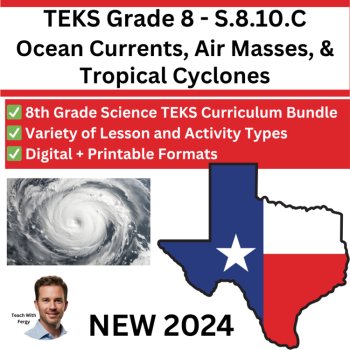
This RESOURCE BUNDLE is for Texas 8th grade science teachers who are teaching S.8.10.C - Ocean Currents, Air Masses, & Tropical Cyclones including Typhoons and Hurricanes according to the Texas Essential Knowledge and Skills (TEKS) Standards set down by the Texas Education Agency and want to pre
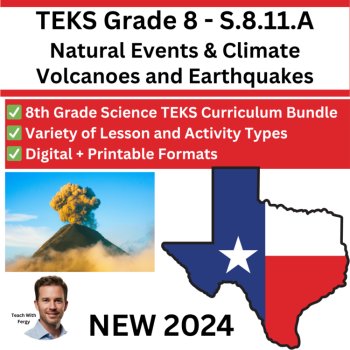
This RESOURCE BUNDLE is for Texas 8th grade science teachers who are teaching S.8.11.A - Natural Events & Climate - Volcanoes and Earthquakes according to the Texas Essential Knowledge and Skills (TEKS) Standards set down by the Texas Education Agency and want to prepare their students for STAAR
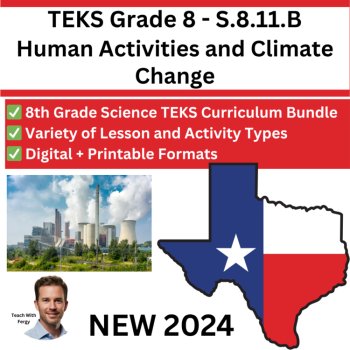
This RESOURCE BUNDLE is for Texas 8th grade science teachers who are teaching S.8.11.B - Human Activities and Climate Change according to the Texas Essential Knowledge and Skills (TEKS) Standards set down by the Texas Education Agency and want to prepare their students for STAAR. The bundle will SAV
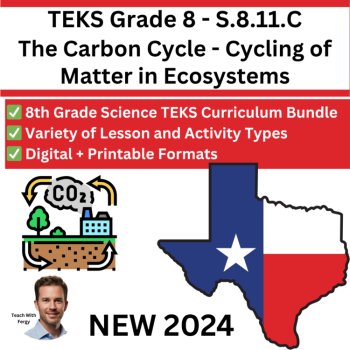
This RESOURCE BUNDLE is for Texas 8th grade science teachers who are teaching S.8.11.C - The Carbon Cycle - Cycling of Matter in Ecosystems according to the Texas Essential Knowledge and Skills (TEKS) Standards set down by the Texas Education Agency and want to prepare their students for STAAR. The
This RESOURCE BUNDLE is for Texas 8th grade science teachers who are teaching S.8.12.A - Energy Transfer Disruptions in Ecosystem Food Webs according to the Texas Essential Knowledge and Skills (TEKS) Standards set down by the Texas Education Agency and want to prepare their students for STAAR. The
This RESOURCE BUNDLE is for Texas 8th grade science teachers who are teaching S.8.12.B - Primary & Secondary Ecological Succession and Populations according to the Texas Essential Knowledge and Skills (TEKS) Standards set down by the Texas Education Agency and want to prepare their students for
This RESOURCE BUNDLE is for Texas 8th grade science teachers who are teaching S.8.12.C - Biodiversity and the Stability of Ecosystems and the Health of the Organisms Within In according to the Texas Essential Knowledge and Skills (TEKS) Standards set down by the Texas Education Agency and want to pr
This RESOURCE BUNDLE is for Texas 8th grade science teachers who are teaching S.8.13.A - Function of Organelles in Animal and Plant Cells according to the Texas Essential Knowledge and Skills (TEKS) Standards set down by the Texas Education Agency and want to prepare their students for STAAR. The bu
This RESOURCE BUNDLE is for Texas 8th grade science teachers who are teaching S.8.13.B - Function of Genes in Determining Inherited Traits according to the Texas Essential Knowledge and Skills (TEKS) Standards set down by the Texas Education Agency and want to prepare their students for STAAR. The b
This RESOURCE BUNDLE is for Texas 8th grade science teachers who are teaching S.8.13.C - Variations of Traits and Adaptations for Survival according to the Texas Essential Knowledge and Skills (TEKS) Standards set down by the Texas Education Agency and want to prepare their students for STAAR. The b
Elevate your students' preparation for the STAAR exams with my comprehensive review package. It was specifically designed to align with the Texas Essential Knowledge and Skills (TEKS) standards. This all-encompassing resource is designed to not only provide a thorough overview of the pivotal topics
No questions yet.

Meet the Seller
Middle and High School Science Engaging Resources
I have been selling resources to middle and high school teachers for the last 15 years. During that time I've also been in the classroom so I know what works and what will help your students the most.
Canada