Animal Habitats Clipart MEGA Bundle – 6 Sets
$32.50 $50.00 (398)

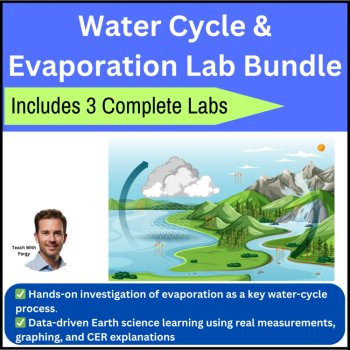
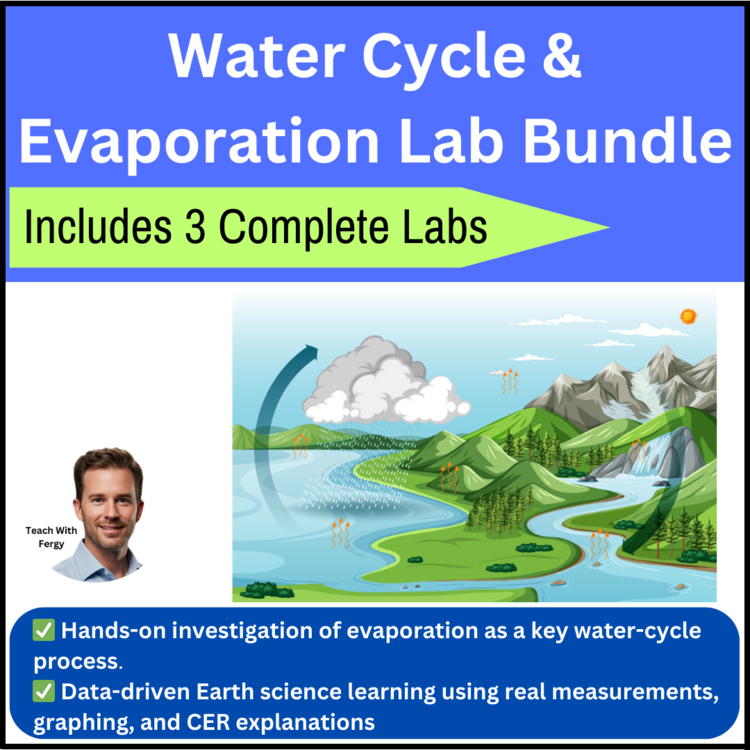
3 Lab Investigations on the Water Cycle - Evaporation • Energy Transfer • Salinity & Earth Systems
Students will explore evaporation as a driving force in the water cycle through three connected, hands-on STEM investigations. Across short-term and multi-day labs, students measure evaporation rates, model phase changes in a closed system, and quantitatively analyze how evaporation changes salinity.
Using real data, graphing, and CER-based explanations, students develop a deep, systems-level understanding of how energy and matter move through Earth’s hydrosphere.
This bundle is designed to scaffold learning from observable evaporation, to particle-level explanations, to real-world Earth science applications.
Learning Targets
Across the three labs, students will:
What’s Included
1) Evaporation Race: Measure Evaporation Rates
Students compare evaporation under control, warm, and wind conditions. Through repeated measurements and graphing, they determine how temperature and airflow affect evaporation rate and connect results to real-world puddles, lakes, and oceans.
2) Mini Water Cycle Lab (Closed System Model)
Students create a sealed mini water cycle to observe evaporation, condensation, and water movement. Using qualitative observations and optional temperature data, students construct a CER explaining how energy transfer drives phase changes in a closed system.
3) Salt & Evaporation: Mass, Volume, and Salinity Changes
Students track freshwater, ocean-like, and high-salinity solutions over multiple days to analyze how evaporation concentrates salt. Data-driven analysis connects lab results to ocean salinity, salt pans, and enclosed basins like the Dead Sea.
Included in Every Lab
Why Teachers Love This Bundle
Best For
Middle and high school Earth science, physical science, water cycle units, evaporation & phase changes, oceanography, data analysis, and CER writing.
Materials Used Across the Bundle
Shallow dishes, water, measuring tools, balances or rulers, zip bags, table salt, fans or lamps, labels, trays, and student lab sheets (all included). Optional: thermometers, hot plates (teacher supervised).
Estimated Timing
NGSS Alignment
MS-ESS2-4, HS-ESS2-4, HS-ESS2-5, HS-PS1-3, HS-PS1-4
Practices: Planning & Carrying Out Investigations; Analyzing & Interpreting Data; Using Mathematics & Computational Thinking; Developing & Using Models; Constructing Explanations; Argument from Evidence
Assessment
Each lab assess experimental design, data accuracy, calculations, graph interpretation, CER quality, and understanding of Earth system processes.
Report this resource to Linked Through Learning
Reported resources will be reviewed by our team. Report this resource to let us know if this resource breaks our rules.
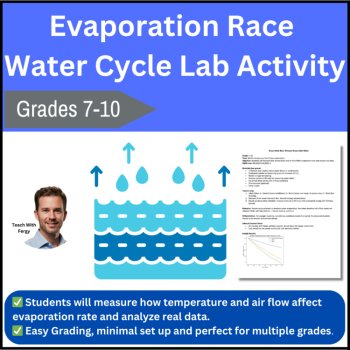
Students will investigate evaporation in the water cycle by measuring how temperature and air flow affect evaporation rate. Using identical shallow dishes filled with equal volumes of water, students set up control, warm, and wind conditions and track changes in water volume over time. Through repea
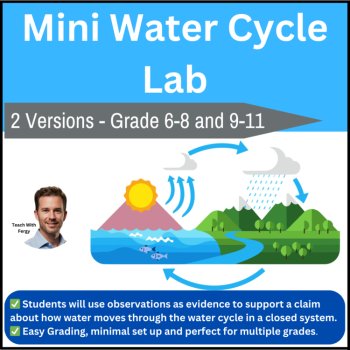
Students will model the water cycle in a closed system by creating a mini “water cycle” using a sealed clear bag. By adding energy from sunlight or a lamp, students observe evaporation, condensation, and water movement over time. Through structured observations, optional temperature tracking, and a
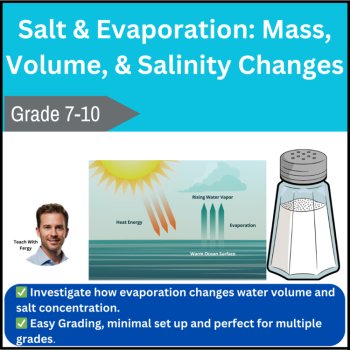
Students will investigate how evaporation changes water volume and salt concentration by comparing freshwater, ocean-like salinity, and high-salinity solutions over multiple days. Using shallow dishes, measured salt masses, and repeated mass or volume measurements, students track evaporation and cal
No questions yet.

Meet the Seller
Middle and High School Science Engaging Resources
I have been selling resources to middle and high school teachers for the last 15 years. During that time I've also been in the classroom so I know what works and what will help your students the most.
Canada
$32.50 $50.00 (398)
$22.50 $34.50 (169)
$18.50 $36.50 (84)