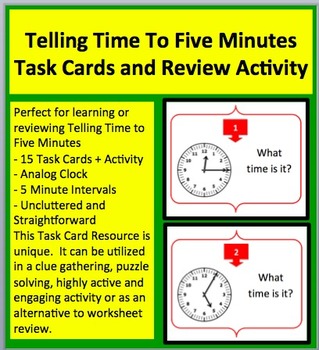
Telling Time to Five Mintues - Task Cards and Engaging Review Activity

$5.97

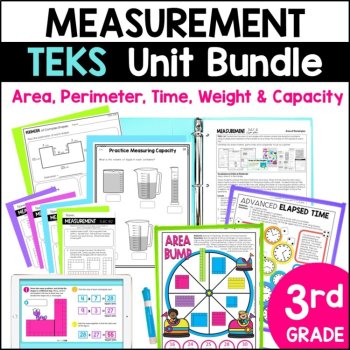
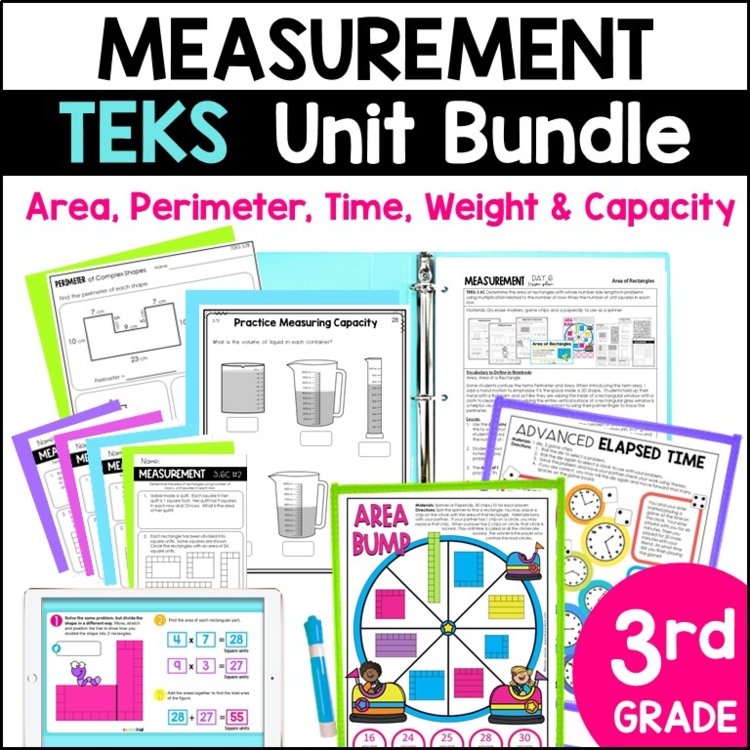
3rd Grade Measurement Unit Area and Perimeter, Elapsed Time, Weight and Capacity
(5 ratings)$77.00 $29.99
Get BundleDiscover All the Essentials for your 3rd grade Measurement Unit right here! Packed with Fun and Interactive activities covering area and perimeter, elapsed time, plus weight and capacity, this complete unit bundle equips you with everything for daily lessons, math stations, intervention tools, continuous assessment, and test prep!
You and your students will love the incredible activities and resources inside this bundle. These engaging activities will build a strong understanding of perimeter, area, elapsed time, weight and capacity while preparing your students for STAAR 2.0.
⭐️ BUNDLE & SAVE ⭐️
This 3rd Grade Measurement Unit is part of the 3rd Grade Math Curriculum - Year Long Bundle. Check it out and get everything you need to teach 3rd grade math this year!
What 3rd Measurement topics are covered?
Click on the Preview to get a closer look at everything included.
What's Included in this 3rd grade Measurement Unit Bundle?
The included 3rd grade meaurement resources are designed to work together seamlessly and provide you with plenty of activities to select from for:
What Printable 3rd Grade Measurement Resources are Included?
What Digital 3rd Grade Measurement Resources are Included?
The following sets of Interactive Google Slides with Movable Pieces are Included. Each set has 15 slides with problems or activities and video instructions for students.
4 Digital Color By Code practice activities are included as Google Forms:
The following digital resources are Self-Grading Google Forms.
A Digital Version of the Measurement Vocabulary Bunting is also included in Google Slides.
Standards Alignment:
This unit is built for the Texas Math TEKS, and all pages are aligned to the TEKS. However, it also covers most Common Core Standards.
The differences between the TEKS and Common Core Measurement Standards:
Standards Alignment
TEKS
3.6C: Determine the area of rectangles with whole number side lengths in problems using multiplication related to the number of rows times the number of unit squares in each row.
3.8D: Decompose composite figures formed by rectangles into non‐overlapping rectangles to determine the area of the original figure using the additive property of area.
3.7B: Determine the perimeter of a polygon or a missing length when given perimeter and remaining side lengths in problems.
3.7C: Determine the solutions to problems involving addition and subtraction of time intervals in minutes using pictorial models or tools such as a 15‐minute event plus a 30‐minute event equals 45 minutes.
3.7D: Determine when it is appropriate to use measurements of liquid volume (capacity) or weight.
3.7E: Determine liquid volume (capacity) or weight using appropriate units and tools.
Common Core
3.MD.1: Tell and write time to the nearest minute and measure time intervals in minutes. Solve word problems involving addition and subtraction of time intervals in minutes, e.g., by representing the problem on a number line diagram.
3.MD.2: Measure and estimate liquid volumes and masses of objects using standard units of grams (g), kilograms (kg), and liters (l). Add, subtract, multiply, or divide to solve one-step word problems involving masses or volumes that are given in the same units, e.g., by using drawings (such as a beaker with a measurement scale) to represent the problem.
3.MD.5.A: A square with side length 1 unit, called "a unit square," is said to have "one square unit" of area, and can be used to measure area.
3.MD.5.B: A plane figure which can be covered without gaps or overlaps by n unit squares is said to have an area of n square units.
3.MD.6: Measure areas by counting unit squares (square cm, square m, square in, square ft, and improvised units).
3.MD.7.A: Find the area of a rectangle with whole-number side lengths by tiling it, and show that the area is the same as would be found by multiplying the side lengths.
3.MD.7.B: Multiply side lengths to find areas of rectangles with whole-number side lengths in the context of solving real world and mathematical problems, and represent whole-number products as rectangular areas in mathematical reasoning.
3.MD.7.D: Recognize area as additive. Find areas of rectilinear figures by decomposing them into non-overlapping rectangles and adding the areas of the non-overlapping parts, applying this technique to solve real world problems.
3.MD.8: Solve real world and mathematical problems involving perimeters of polygons, including finding the perimeter given the side lengths, finding an unknown side length, and exhibiting rectangles with the same perimeter and different areas or with the same area and different perimeters.
___________________________________
Copyright © Marvel Math
Permission to copy for single classroom use only.
Please purchase additional licenses if you intend to share this product.
Report this resource to Linked Through Learning
Reported resources will be reviewed by our team. Report this resource to let us know if this resource breaks our rules.
“Thank you for creating this! Was great to use with my third graders.”
“I can not rave enough about this resource! This was a life savor this year as we navigated a group of kids that needed a lot more note taking and assignment options! I am so excited to continue using this next year!”
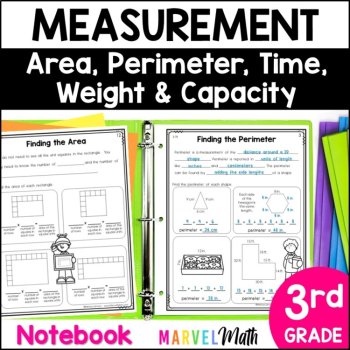
You and your students will love these Easy-to-Use 3rd Grade Measurement worksheet style Notebook Pages! There are engaging pages to teach area and perimeter, elapsed time, capacity and weight. Students learn about the area of composite figures, solving problems with an elapsed time number line, usin
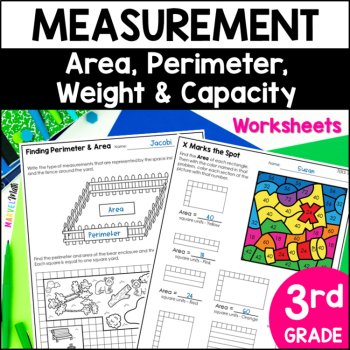
No Prep Area and Perimeter Worksheets plus Capacity and Weight worksheets? Yes, please! Give your students the fun and engaging measurement practice they need with fun worksheets and a hands-on Area Project. The worksheets give your students a huge variety of area and perimeter practice, including a
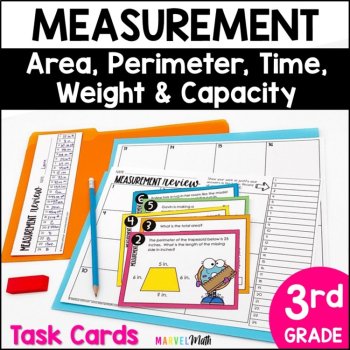
This resource includes 24 TEKS-aligned Task Cards for Area, Perimeter, Elapsed Time and Measurement. Questions cover finding the perimeter of 2D shapes, finding the missing side length, area of rectangles and complex figures, elapsed time, weight and capactiy.Find the digital Google Form version
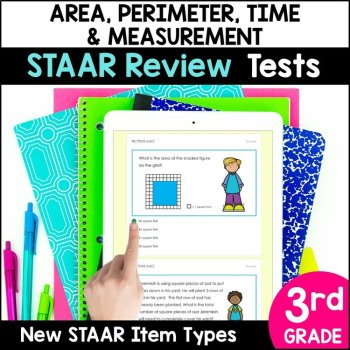
This resource includes 2 ten question Assessments that cover the Measurement TEKS. The questions are STAAR formatted. Test questions cover area, perimeter, elapsed time and measurement. The assessments are in 2 formats: printable PDF and digital, self-grading Google Forms.The assessments are created
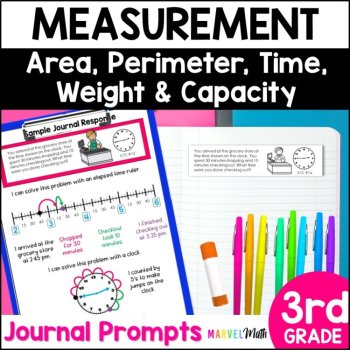
Need high quality, No Prep 3rd Grade Area and Perimeter, Elapsed Time, Capacity and Weight Activities? You will love this set of Math Journal Prompts that encourage deep thinking and help you collect data on student learning. Students will enjoy drawing and writing about how to find area and perimet
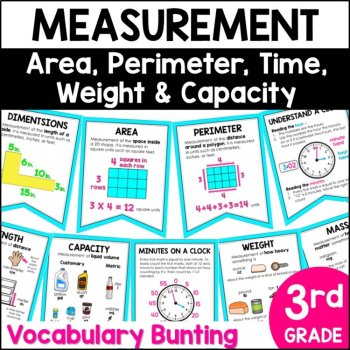
This Measurement Vocabulary Banner is perfect for your 3rd Grade Math Word Wall and will visually motivate you and your students to use precise mathematical language in your classroom! This vocabulary bunting gives students visual representations of all the math vocabulary terms they need to know fo
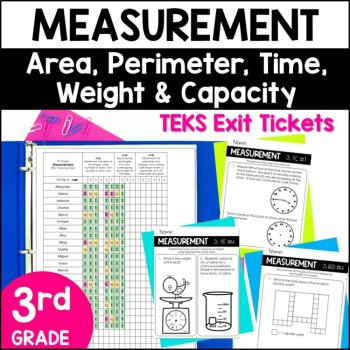
This set of Exit Slips covers all of the 3rd grade MEASUREMENT TEKS: 3.6C, 3.6D, 3.7B, 3.7C, 3.7D, & 3.7E, assessing each with STAAR formatted questions. These Exit Tickets cover Area, Perimeter, Elapsed Time, Capacity & Weight.Exit Slips allow you to get a quick snapshot of student understa
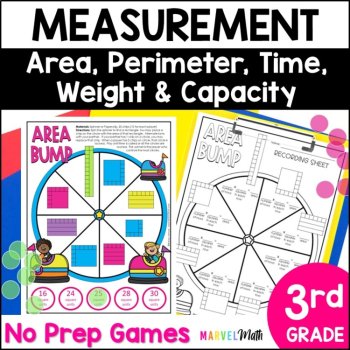
Your students will LOVE these Fun and Engaging 3rd Grade Measurement Games! An Area and Perimeter game is always more fun than a worksheet! The Elapsed Time games will help your students practice reading clocks and solving elapsed time word problems. The Weight and Capacity games will help your stud
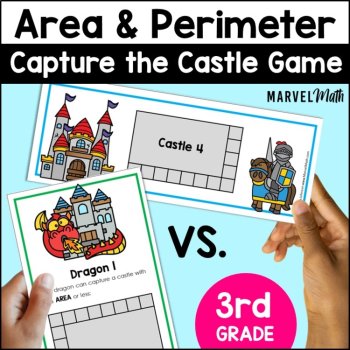
Need some engaging Area and Perimeter Activities? This is a FUN GAME to practice area and perimeter! My students struggled switching back and forth between the two, which is why I created this game! Your video game loving students will be very engaged with the theme of this area and perimeter activi
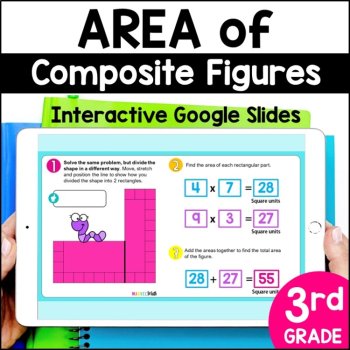
Your students will truly grasp finding the Area of Composite Figures after completing these fun digital Google Slides. Students find the Area of Combined Rectangles by dividing figures into rectangles. Student practice finding the area of composite figures in many ways, including moving lines to div
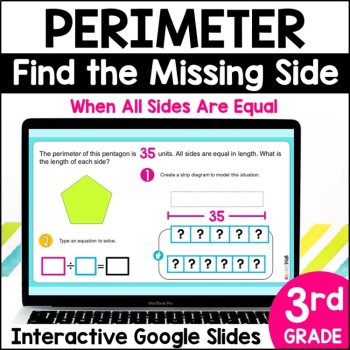
Fun and Engaging Find the Missing Side Perimeter practice? Yes, Please! Your students will love these interactive Find the Missing Side Perimeter activities. The problems integrate strip diagrams to help students visualize each problem. These Google Slides focus on problems where all sides are equa
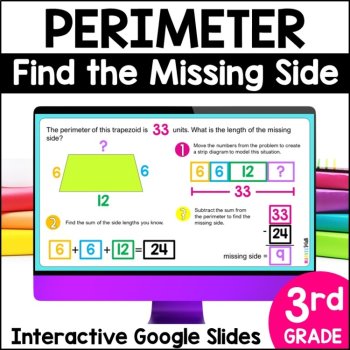
Game-Changing Find the Missing Side Perimeter practice? Yes, Please! Your students will love these interactive Find the Missing Side Perimeter activities. The problems integrate strip diagrams to help students visualize each problem. The numbers of side lengths on the shapes, as well as the perimet
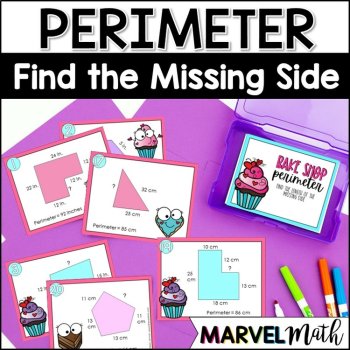
Your students will have fun finding the Missing Side Lengths of polygons when given the other sides and the Perimeter. Students need so much practice with Find the Missing Side Perimeter Problems, and this resource makes that practice fun and engaging. The problems can be used as Task Cards or a Fu
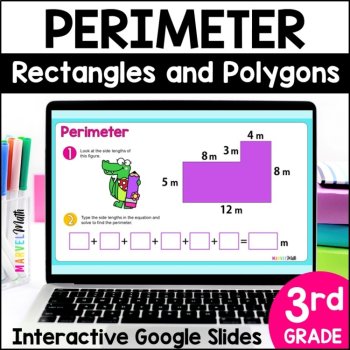
Students will love these fun & engaging slides to practice finding the perimeter of polygons. Students begin this activity by creating equations to find the perimeter of bright and colorful rectangles and polygons. Next, your students will return lost alligators to the correct pond by finding th
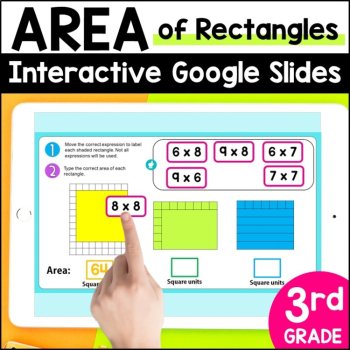
Fun and Engaging finding the Area of Rectangles practice? Yes, Please! Your students will love these interactive Finding the Area of Rectangles and Squares activities. The problems offer a variety of practice to help students find the area of rectangles based on the number of rows and the number of
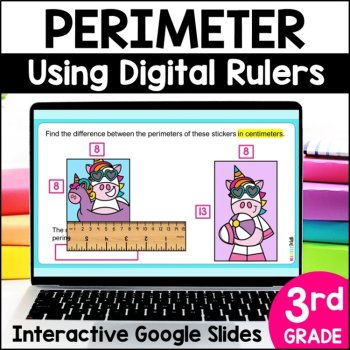
These Interactive Perimeter Google Slides will be a hit with your students! Students use digital rulers to find the perimeter of rectangles. This resource is perfect practice for state tests where students use digital tools to measure side lengths and find the perimeter of objects.Benefits and Featu
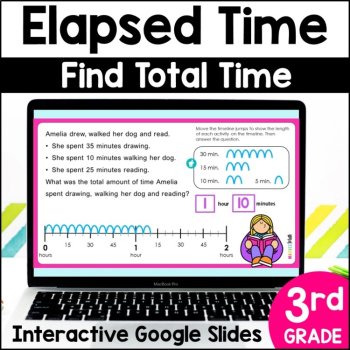
Your 3rd grade students will truly grasp finding the total elapsed time by using the elapsed time number line models in these fun digital problems! Students start by moving digital pieces to show jumps on elapsed time number lines to match word problems. Then students progress to adding time interva
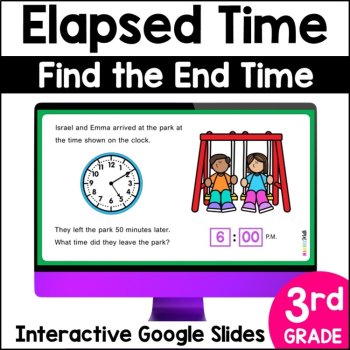
Fun and Engaging 3rd Grade elapsed time word problems with interactive elapsed time number line models are here are ready to assign! Students begin by using clocks to solve one and two-step elapsed time word problems. Students get more practice by moving digital pieces to show jumps on elapsed time
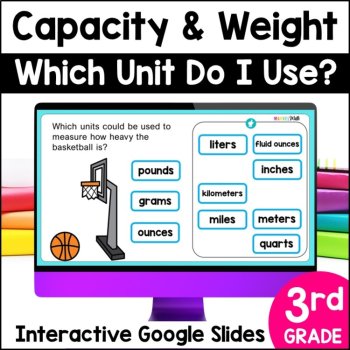
Students need lots of practice selecting between capacity and weight units of measurement. In these fun and engaging Google Slides to practice math TEKS 3.7D, students move measurement unit labels to show the various weight and capacity units that could be used to measure objects. Benefits and Featu
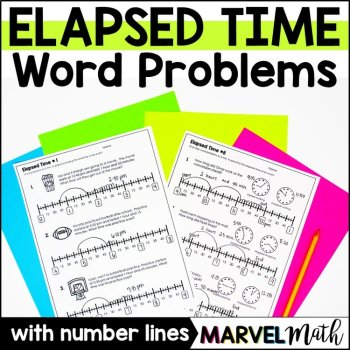
Master elapsed time word problems with our engaging elapsed time number line tool, designed for 3rd graders. Your students will feel supported while solving these word problems with elapsed time number lines! Elapsed time Word Problems with Clocks are also included so that students get practice read
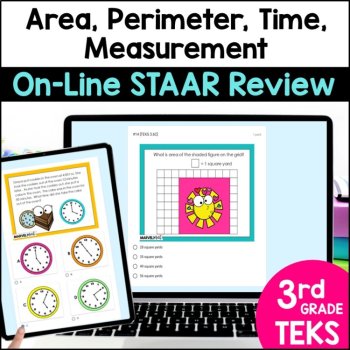
This resource includes 24 TEKS-aligned Digital Task Cards for Area, Perimeter, Elapsed Time and Measurement that can be assigned for Distance Learning via Google Classroom. These task cards are in a Google Form, which means they are automatically graded when students click submit! I have designed t
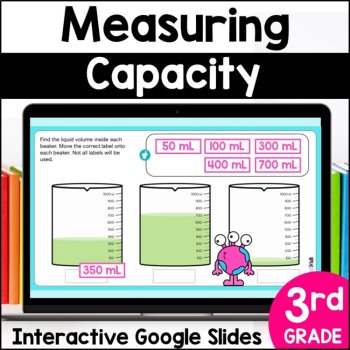
Students will be engaged with this Measuring Capacity and Liquid Volume Google Slides. First, students drag and drop measurements of capacity to label beakers and cylinders. The fun continues as students adjust the level of liquid in containers to match capacity labels.Benefits and Features of this
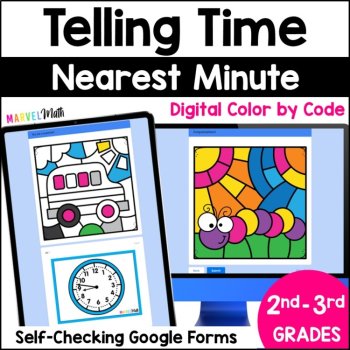
Practice makes permanent. These Telling Time to the Minute Digital Coloring Activities only progress when your students get the correct answer, so that misconceptions can be caught and corrected quickly. As students correctly read clocks and type the time to the nearest minute, sections of each pict
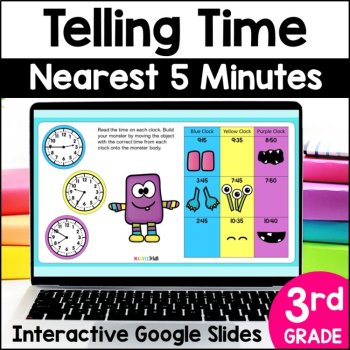
Your students will absolutely love this Telling Time to the Nearest 5 Minutes Build a Monster digital activity. Students read analog clocks and tell time to the nearest 5 minutes to find the legs, eyes and mouth for each cute monster. These fun Google Slides are sure to be a hit with students durin
5.0
5
ratings
For Equal Groups Multiplication and Division Word Problems Strip Diagrams 3rd grade
This was wonderful practice for my students in small group! Great visuals
Rebekah H.
Grades taught: 3rd
For 3rd Grade Math STAAR Review - Math Test Prep Games
Thank you for providing this great resource, much appreciated!
Cecilia C.
Grades taught: 1st, K, 2nd
For 4th Grade Math STAAR Review - Math Test Prep Games
Thank you for providing this great resource, much appreciated!
Cecilia C.
Grades taught: 1st, K, 2nd
For 3rd Grade Math TEKS STAAR Review Task Card Bundle - Print
Thank you for providing this great resource, much appreciated!
Cecilia C.
Grades taught: 1st, K, 2nd
For Multiplication and Division Practice - 4th Grade TEKS - Online STAAR Review
This review of Multiplication and Division was a great resource for my classroom!
Julia B.
For 4th Grade Math STAAR Review - Math Test Prep Games
"This resource is an absolute game-changer for teaching Unit 3 in 4th grade! If you are feeling overwhelmed by the dense teacher manuals or spending hours trying to format your own presentations, do yourself a favor and buy this right now. The slides are completely no-prep, beautifully designed, and student-friendly. Every single lesson includes clearly stated learning targets right at the beginning, which keeps my students focused and aligns perfectly with our instructional goals. I especially love the embedded anchor charts and direct hyperlinks—they save me so much transition time during lessons because I don’t have to hunt for materials across different tabs or manuals. The included student worksheets and guided practice prompts provide wonderful scaffolding that keeps student engagement high and supports all learners, including my emerging bilinguals and students who need extra support. It breaks down complex concepts into bite-sized, manageable pieces without watering down the curriculum. Thank you for creating such a polished, time-saving, and effective teaching tool! It has easily cut my planning time in half and made our daily lessons run seamlessly."
Michelle C.
Grades taught: PreK, K, 1st, 2nd
For 3rd Grade Addition and Subtraction Worksheets TEKS 3.4A 3.4B 3.4C 3.5A
"This resource is an absolute game-changer for teaching Unit 3 in 4th grade! If you are feeling overwhelmed by the dense teacher manuals or spending hours trying to format your own presentations, do yourself a favor and buy this right now. The slides are completely no-prep, beautifully designed, and student-friendly. Every single lesson includes clearly stated learning targets right at the beginning, which keeps my students focused and aligns perfectly with our instructional goals. I especially love the embedded anchor charts and direct hyperlinks—they save me so much transition time during lessons because I don’t have to hunt for materials across different tabs or manuals. The included student worksheets and guided practice prompts provide wonderful scaffolding that keeps student engagement high and supports all learners, including my emerging bilinguals and students who need extra support. It breaks down complex concepts into bite-sized, manageable pieces without watering down the curriculum. Thank you for creating such a polished, time-saving, and effective teaching tool! It has easily cut my planning time in half and made our daily lessons run seamlessly."
Michelle C.
Grades taught: PreK, K, 1st, 2nd, 4th
For 4th Grade Math Review Bundle - Digital Task Cards - Online STAAR Practice
This really supported my 4th graders, and had great variety
Ashley D.
Grades taught: 4th
For 2 Digit by 2 Digit Multiplication Worksheets with Mazes - 2x2 Multiplication
Great resource to give kids extra practice in a fun way.
Meghan F.
Grades taught: 3rd, 4th
For 3rd Grade Multiplication and Division Unit TEKS - Notebook, Worksheets, Games
These bundles are an absolute must have. They have everything you need to teach the unit.
Teach J.
Grades taught: 3rd
For 3rd Grade Addition and Subtraction Unit - Word Problems, Regrouping TEKS
These resources are simply a must have. There are lots of activies to choose from. Thank you!
Teach J.
Grades taught: 3rd
For Area of Composite Figures using Side Lengths - Interactive Google Slides
Really good for early finishers, they also love anything they can do on the computer!
Sara S.
Grades taught: PreK, K, 1st, 2nd, 3rd
For Math Interactive Notebook 4th Grade - TEKS Bundle
This interactive notebook has been very useful for reinforcing 4th grade math skills. The pages are organized, easy for students to follow, and work well for notes, review, and extra practice. I especially like having everything in one resource that aligns well with what we are teaching.
Jasmine T.
Grades taught: 5th, 4th
For Digital Game - Ten Times Place Value Relationships - Digital Math Stations
This is a great option for students who finish their work early.
Serafina D.
Grades taught: 3rd, 4th, 5th
For 3rd Grade Math Interactive Notebook Bundle - 3rd Grade Math TEKS
This is a fantastic resource for student math notebooks. This is my go-to resource following a lesson. Each page has a student-friendly definition/ explanation when needed and ample examples. The layout is clean, and the fonts are student-friendly. It also has an answer key for each page. Love this resource!
Kira C.
Grades taught: 3rd
For Place Value Charts to Support Expanded Notation and Place Value Relationships
This was SUPER HELPFUL FOR MY SMALL GROUP MATH! great source!
sassyclass2
Grades taught: 5th
For Use Multiplication to Solve Division - Connecting Multiplication and Division
This was perfect for my students to complete while practicing
Noelle C.
For No Prep Multiplication Games & Division Games for Math Stations
This resource was a great, yet short fact fluency practice. I set a timer for 5 minutes and my third graders had a blast practicing their facts.
carline S.
Grades taught: 5th, 3rd
For 5th Grade STAAR Review Math TEKS - Games, Assessments, STAAR Practice
This resource is great! I have set up stations using storage clipboards that have everything the kids need- the game board choices, the markers, the pieces, the dice, the task cards. These are wonderful!
Tiny T.
Grades taught: 4th, 5th
For 3 Digit Subtraction with Regrouping #1 - Base 10 Blocks - Subtracting in Space
Thank you for this! It was great to use with my class.
Edventures T.
Grades taught: 3rd
No questions yet.

Meet the Seller
In addition to my work in education, I also run a STEM-based Christmas Light Show business. When I'm not creating new math resources or working with teachers, I'm designing and fabricating light shows sequenced to music with my husband and our team. That business came about after our family was featured on ABC's The Great Christmas Light Fight. My son attends the University of Texas, Austin and I'm currently soaking up every last minute with my daughter, a high school senior.
San Antonio, Texas