American Alligator: A Complete Project-Based Unit Study differentiated K-12

$8.00

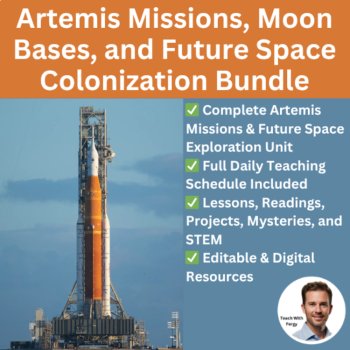
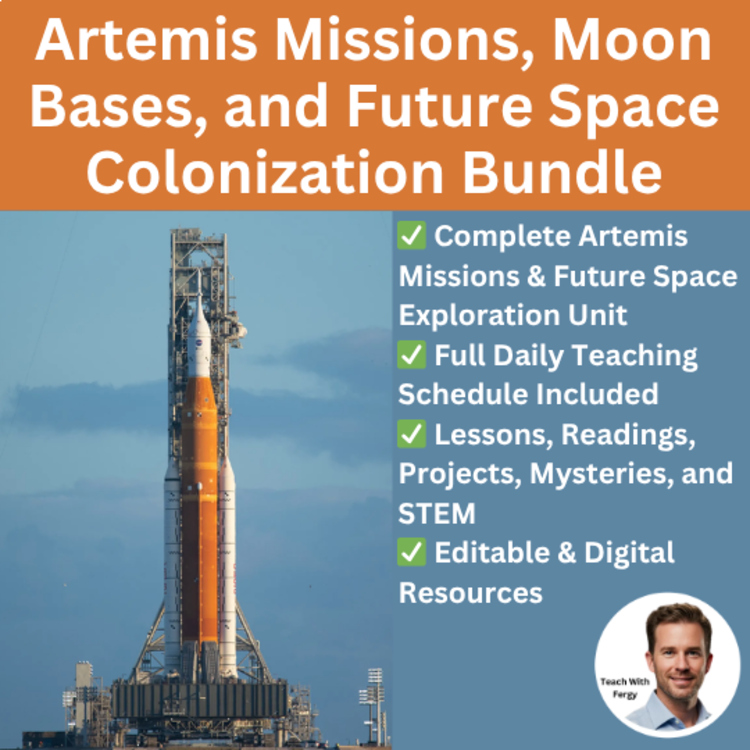
Bring the excitement of NASA’s Artemis missions, future Moon exploration, and long-term space colonization into your classroom with this engaging full-unit bundle. This resource collection is designed to work across grade levels by including a mix of differentiated readings, projects, mystery activities, lessons, and STEM investigations that explore the same big ideas at different levels of complexity.
The bundle also includes a NO PREP, day-by-day teaching schedule.
This bundle helps students examine how humans return to the Moon, how future missions may lead to long-term lunar habitats, and what science, engineering, and problem-solving are needed for life beyond Earth.
Rather than teaching space exploration as isolated facts, this unit helps students connect rockets, microgravity, Moon science, astronaut survival, habitats, and colonization into one larger story about the future of human spaceflight.
Big Ideas Covered in This Bundle
1. Artemis Missions, Moon Exploration, and the Future of Lunar Travel
Students build background knowledge about how space exploration has developed from Apollo to Artemis and what future Moon missions may involve.
Included resources:
2. Building and Living in Future Moon Habitats
Students explore what it would take to build, use, and survive in a Moon base or future space colony.
Included resources:
3. Rockets, Launches, and Getting Into Space
Students learn how missions begin by exploring rocket science, forces, and launch concepts.
Included resources:
4. Microgravity and Living Beyond Earth
Students examine what happens to astronauts and objects in orbit and why space missions require specialized systems and design.
Included resources:
5. Mission Design, Creativity, and Space Exploration Identity
Students connect science learning with creativity and engineering design by developing mission-based projects.
Included resources:
Why Teachers Love This Bundle
Perfect For
This bundle includes:
This bundle gives you the tools to teach a complete, engaging unit on Artemis, space exploration, and future space colonization while keeping students focused on the science, engineering, and possibilities of human life beyond Earth.
Report this resource to Linked Through Learning
Reported resources will be reviewed by our team. Report this resource to let us know if this resource breaks our rules.
“I like that this has a variety of topics and ways of covering the material. This was a great resource to flesh out my space exploration unit and allow for some "real" work for days when I had a sub planned. The kids were able to keep on track with our unit without losing a day to "busy work". Great material to work with.”
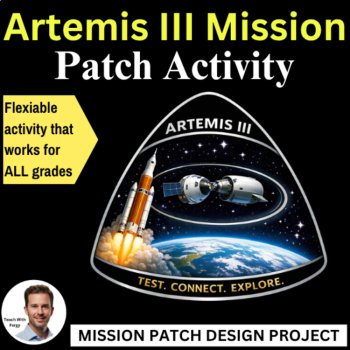
In this project, your students will research the Artemis III mission, decide which mission ideas matter most, and turn those ideas into an original mission patch. Students explore mission goals, spacecraft and systems, future Moon exploration, and the symbolism used in real mission patches. They mus
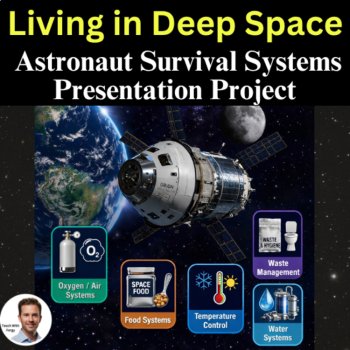
In this project, your students will work in groups to figure out how astronauts survive during a space mission like the Artemis missions. Each student becomes the team expert for one major survival system—oxygen, water, food, temperature control, or waste management—and then teaches the class throug
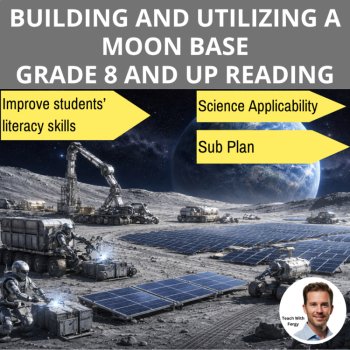
Building and Utilizing a Moon Base: Why, How, and When Reading Comprehension Passage and QuestionsThis reading explores the real-world science and engineering behind building and maintaining a moon base and how it could shape the future of space exploration. It is a high-interest topic that helps st
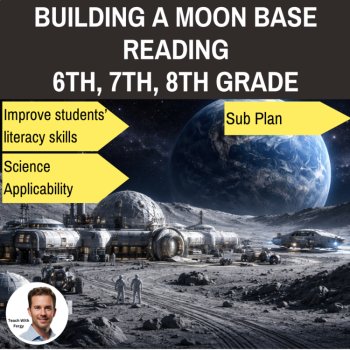
Building a Moon Base: Why We Go, How We Live, and What Comes Next Reading Comprehension Passage and QuestionsThis middle school reading introduces students to the science and engineering behind building a moon base and why humans want to live and work on the Moon. Students learn how space agencies l
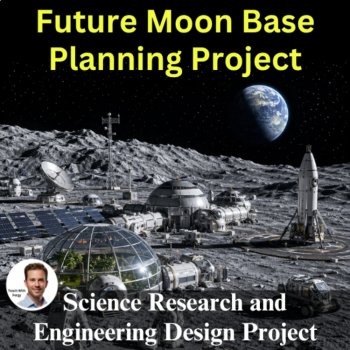
In this project, your students will work in groups to plan a future Moon base for the years after Artemis III. Each student becomes the team expert for one major Moon base system—habitat construction and maintenance, life support, food production, power, or transportation and safety—and then teaches
From Apollo to Artemis: Exploring the Moon Reading Comprehension Passage and QuestionsThis middle school reading introduces students to the history and future of human space exploration, from the Apollo Moon landings to NASA’s modern Artemis program. Students learn how astronauts first reached the M
Artemis Missions: From Apollo to Artemis Moon Exploration Reading Comprehension Passage and QuestionsThis reading explores the real-world science and history behind NASA’s return to the Moon through the Artemis program and how it builds on the legacy of the Apollo missions. It is a high-interest top
Turn your students into science detectives with this NO PREP, engaging, real-world investigation focused on how rockets leave Earth. In this case file activity, students analyze evidence about thrust, gravity, fuel burning, exhaust gases, rocket mass, staging, nozzle design, and repeated launch patt
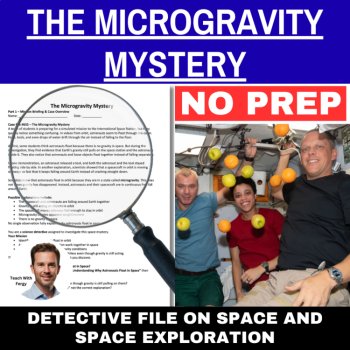
Turn your students into science detectives with this NO PREP, engaging, real-world investigation focused on why astronauts float in space. In this case file activity, students analyze evidence about gravity in orbit, free fall, sideways motion, floating tools, water behavior, astronaut movement, and
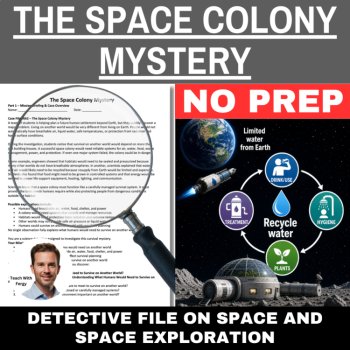
Turn your students into science detectives with this NO PREP, engaging, real-world investigation focused on human survival beyond Earth. In this case file activity, students analyze habitat needs, examine life-support systems, evaluate resource management, investigate environmental dangers, rank pos
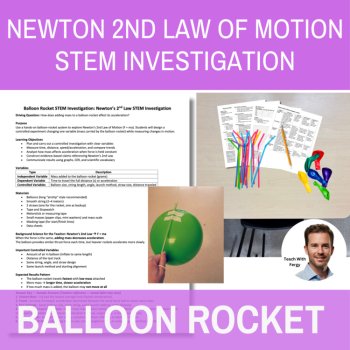
Students will investigate Newton’s 2nd Law of Motion by testing how changing the mass carried by a balloon rocket affects its acceleration. Using a taut string track, a straw, a balloon, and removable mass clips, students run repeated launches to measure travel time and calculate average speed. Thro
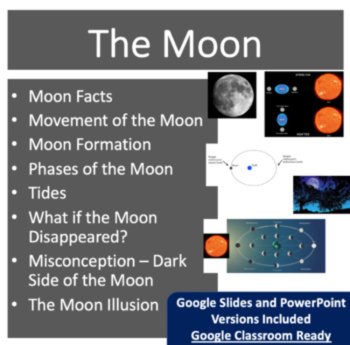
The Moon - This lesson package includes the lesson (student and teacher versions of the presentation), an auto-graded Exit Ticket to check student understanding, 2 student-led activities, and a student lesson handout as a document. The presentation is fun and applicable with FIVE videos embedded int
For Chemistry Concepts Cipher Puzzle Bundle | Periodic Table, Nomenclature, Stoich
Excellent resource, helpful in teaching Chemistry.
A P.
Grades taught: 7th, 8th
For Periodic Table Elements Cipher Puzzle - Physical Science Activity | Atoms
Fun activity with the students. Always looking for different ways to engage.
A P.
Grades taught: 7th, 8th
For Artemis Missions Reading: From Apollo to Artemis to the Moon | Grade 8 & Up
Artemis had recently completed its mission when I was looking for engaging activities to fill post-assessment instructional time. This resource, combined with several activities I designed myself, helped provide meaningful learning opportunities for students during that period.
Monica W.
Grades taught: 9th
For The Temperature Change Mystery - Chemistry Activity | Exothermic, Endothermic
I used this along with a demo on endo and exo reactions. It fit the needs of my class.
Emily C.
Grades taught: 8th
For Real World Ecology Decision Challenges Bundle | Ecosystems Activity
I'm excited to use with my freshman biology students. Will go well with our ecology unit.
Tammy H.
Grades taught: 6th, 7th, 8th
For Antibiotic Resistance Reading | How Bacteria Evolve and Adapt | Grade 8 & Up
Great reading to make the students think. Easy to use in class.
Tammy H.
Grades taught: 6th, 7th, 8th
For Mosquito Control Ecology Decision Challenge Activity | Ecosystems Impact
Can't wait to use this with my freshman. It will be a good (and applicable) lesson for them.
Tammy H.
Grades taught: 6th, 7th, 8th, 9th
For Real World Ecology Decision Challenges Bundle | Ecosystems Activity
I have used some of these resources in the past. A great way to get the students thinking and questioning their own ideas. I cannot wait to incorporate more of these challenges into a variety of my courses.
Laura S.
Grades taught: 9th, 10th, 11th, 12th
For Artemis Missions, Moon Bases, and Future Space Colonization Unit Bundle
I like that this has a variety of topics and ways of covering the material. This was a great resource to flesh out my space exploration unit and allow for some "real" work for days when I had a sub planned. The kids were able to keep on track with our unit without losing a day to "busy work". Great material to work with.
Science 3.
Grades taught: 9th, 8th
For Periodic Table Elements Cipher Puzzle - Physical Science Activity | Atoms
We just so happened to be learning about code talkers in WWII, and my son is currently obsessed with the periodic table. The convergence was great! This project was completely self-directed, easy to understand, and added to his knowledge of the periodic table.
Ansley S.
Grades taught: 3rd, 5th, 6th, 7th
No questions yet.

Meet the Seller
Middle and High School Science Engaging Resources
I have been selling resources to middle and high school teachers for the last 15 years. During that time I've also been in the classroom so I know what works and what will help your students the most.
Canada
AI Assisted
I develop the ideas, plan the activities, and guide the creation of all resources. AI tools assist with writing, illustrations, and design. Every resource is reviewed, edited, and refined using my teaching experience to ensure quality, accuracy, and meaningful real-world learning.
$6.38 $7.98
AI Assisted
I develop the ideas, plan the activities, and guide the creation of all resources. AI tools assist with writing, illustrations, and design. Every resource is reviewed, edited, and refined using my teaching experience to ensure quality, accuracy, and meaningful real-world learning.
$7.60 $9.50
AI Assisted
I develop the ideas, plan the activities, and guide the creation of all resources. AI tools assist with writing, illustrations, and design. Every resource is reviewed, edited, and refined using my teaching experience to ensure quality, accuracy, and meaningful real-world learning.
$5.60 $7.00
AI Assisted
I develop the ideas, plan the activities, and guide the creation of all resources. AI tools assist with writing, illustrations, and design. Every resource is reviewed, edited, and refined using my teaching experience to ensure quality, accuracy, and meaningful real-world learning.
$5.60 $7.00
AI Assisted
I develop the ideas, plan the activities, and guide the creation of all resources. AI tools assist with writing, illustrations, and design. Every resource is reviewed, edited, and refined using my teaching experience to ensure quality, accuracy, and meaningful real-world learning.
$6.56 $8.20
AI Assisted
I develop the ideas, plan the activities, and guide the creation of all resources. AI tools assist with writing, illustrations, and design. Every resource is reviewed, edited, and refined using my teaching experience to ensure quality, accuracy, and meaningful real-world learning.
$7.60 $9.50
AI Assisted
I develop the ideas, plan the activities, and guide the creation of all resources. AI tools assist with writing, illustrations, and design. Every resource is reviewed, edited, and refined using my teaching experience to ensure quality, accuracy, and meaningful real-world learning.
$7.20 $9.00